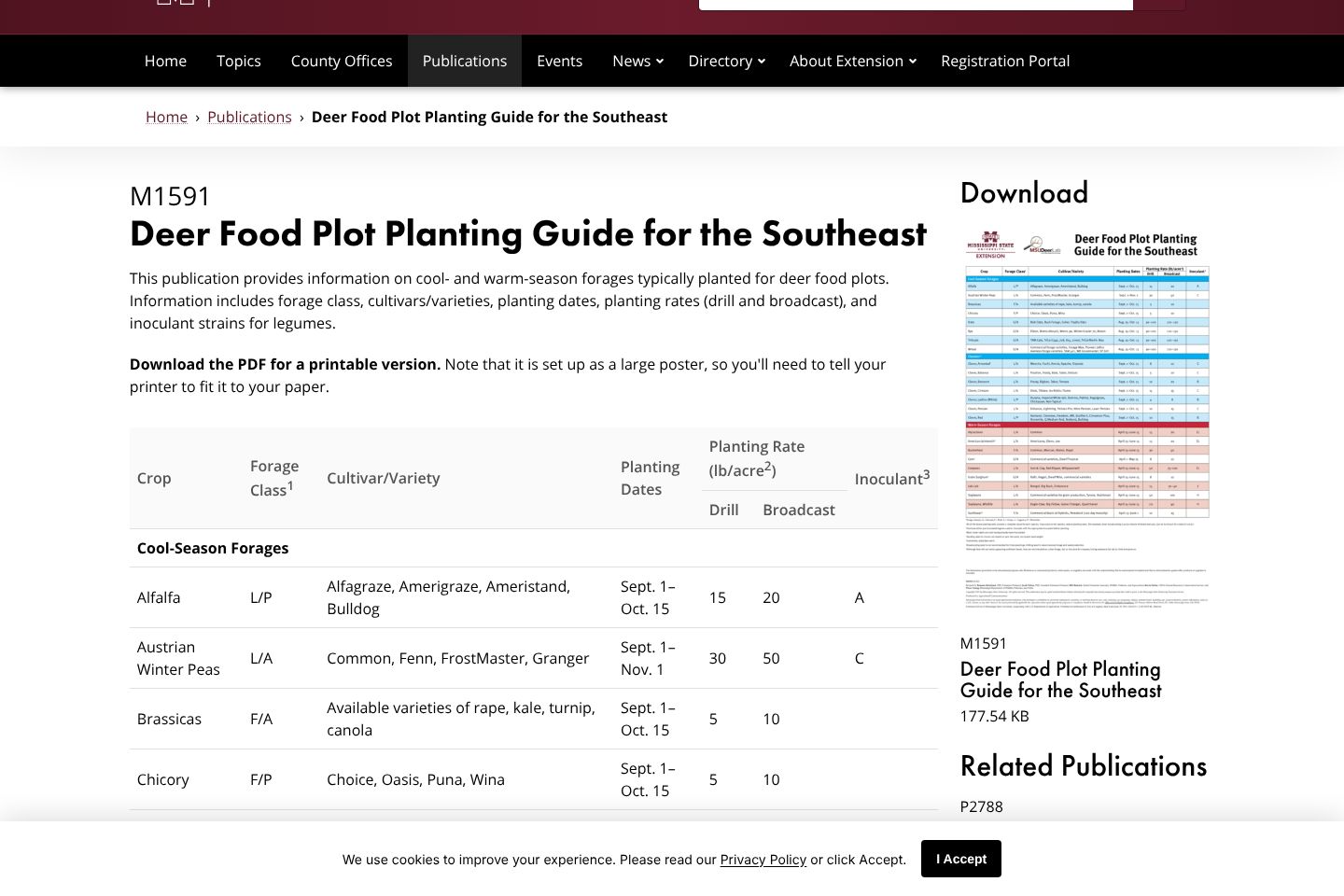
Wrong Rhizobium on a warm-season deer plot is an expensive green failure. Mississippi State University Extension’s Deer Food Plot Planting Guide (M1591) assigns inoculant letters by crop: cowpeas and alyceclover/jointvetch use EL, grain and wildlife soybeans use H, and lab lab uses J, while cool-season clovers split across B and C and alfalfa uses A (Mississippi State University Extension). University of Arkansas Extension’s forage inoculation guide states the principle behind those letters: Rhizobia are host-specific - strains that nodulate soybeans will not effectively nodulate clovers - and buying an inoculant labeled for the legume you plant is essential (University of Arkansas Extension FSA2035). Rechecking the bag against the M1591 column before the drill rolls is how cowpea, soybean, and lablab plots actually fix nitrogen instead of looking planted while starving (Mississippi State University Extension; University of Arkansas Extension FSA2035).
Key Takeaways
- M1591: cowpeas/alyce/jointvetch → EL; soybeans → H; lab lab → J (Mississippi State University Extension).
- Clovers on the same poster use B or C - not EL/H/J (Mississippi State University Extension).
- UAEX: soybean Rhizobium will not nodulate clover; match the label to the crop (University of Arkansas Extension FSA2035).
- Check expiration dates; sunlight and heat kill inoculant (University of Arkansas Extension FSA2035).
- Pink/red nodule centers signal effective fixation; white/green do not (University of Arkansas Extension FSA2035).
- Do not store inoculated seed in fertilizer mixes that kill Rhizobia (University of Arkansas Extension FSA2035).
Why groups exist
UAEX explains inoculation as introducing the correct Rhizobium so root nodules can fix atmospheric nitrogen into forms the plant can use (University of Arkansas Extension FSA2035). Cross-inoculation tables exist because one strain does not serve every legume (University of Arkansas Extension FSA2035). M1591 compresses that science into single-letter columns for Southeast deer plantings (Mississippi State University Extension).
Warm-season letters on the deer poster
Cowpeas (Iron & Clay, Red Ripper, Whippoorwill), alyceclover, and American jointvetch share inoculant EL on M1591 (Mississippi State University Extension). Grain soybeans and wildlife soybeans (Eagle Claw and kin) share H (Mississippi State University Extension). Lab lab (Rongai, Big Buck, Endurance) uses J (Mississippi State University Extension). Swapping a leftover clover “B” packet onto cowpeas ignores both documents (Mississippi State University Extension; University of Arkansas Extension FSA2035).
Clover caution for mixed drills
M1591 puts crimson/arrowleaf/persian-type clovers on inoculant C and ladino/red/berseem-type entries on B (Mississippi State University Extension). UAEX likewise warns that arrowleaf can require a specific inoculum that will not cross with other clover groups (University of Arkansas Extension FSA2035). A warm-season recheck still matters when leftover cool-season inoculant sits in the same tote (Mississippi State University Extension).
Handling that keeps groups alive
UAEX: keep inoculants cool (refrigerate, do not freeze), respect expiration dates, avoid direct sunlight, and do not leave Rhizobia cooking above about 90°F (University of Arkansas Extension FSA2035). Premixed inoculants that also carry fungicide or molybdenum often have fewer viable Rhizobia (University of Arkansas Extension FSA2035). Plant soon after inoculation (University of Arkansas Extension FSA2035).
Field check
Effective nodules often cluster on the primary root with pink to beefsteak-red centers within two to three weeks after emergence; green or white centers are not fixing (University of Arkansas Extension FSA2035). Yellow, nitrogen-starved legumes after a “planted” stand usually mean the wrong group, dead inoculant, or acid soils that need lime before Rhizobia can work (University of Arkansas Extension FSA2035; Mississippi State University Extension).
Recheck rule
Match M1591’s EL/H/J letters to cowpea, soybean, and lablab bags, confirm the UAEX host-specific rule on the label, and discard expired or heat-killed inoculant before you blame the cultivar (Mississippi State University Extension; University of Arkansas Extension FSA2035).
Bottom line
Recheck warm-season inoculant groups against M1591 - EL for cowpea-type legumes, H for soybeans, J for lab lab - because UAEX is clear that the wrong Rhizobium will not nodulate your crop (Mississippi State University Extension; University of Arkansas Extension FSA2035).
The other side of it
In fairness to the guy who skips the recheck, the article’s own field check lists acid soil right alongside the wrong group and dead inoculant, so a yellow stand isn’t automatically a lettering mistake. Rechecking the bag takes a minute; fixing ground that needs lime takes a lot longer. Still, anybody tossing a leftover clover packet on cowpeas because inoculant is inoculant has basically fertilized his plot with hope.
Keep reading
Latest deer news
Comments