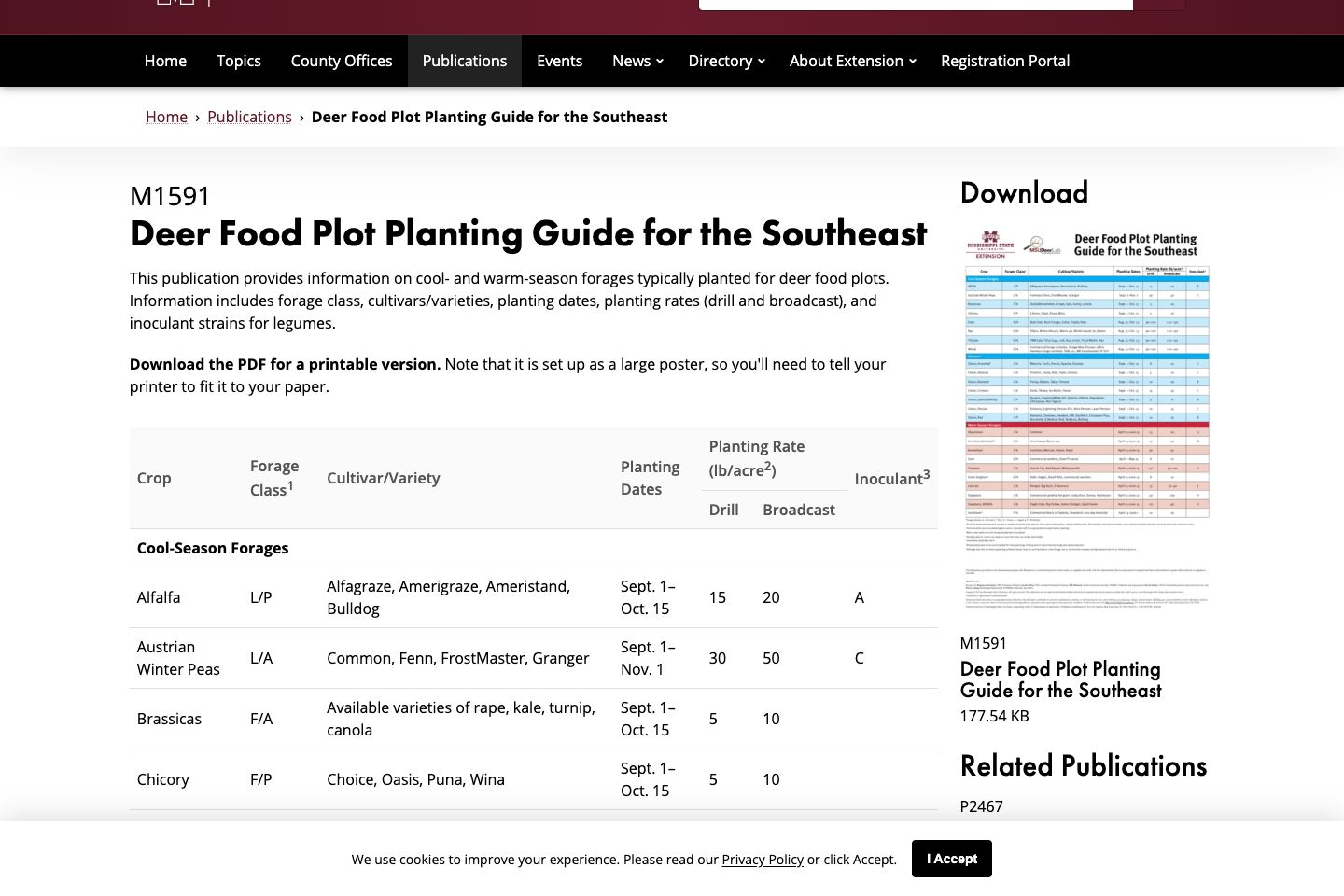
Sunflowers on Mississippi State University Extension’s deer poster are a trellis crop first. M1591 lists sunflower F/A annual with commercial black oil hybrids and Peredovik (120-day maturity) at 10 lb drilled or 25 lb broadcast for April 15 through June 1 (Mississippi State University Extension). Footnote 8 states that although deer will eat newly appearing sunflower heads, sunflowers are not intended as a deer forage but as structure for cowpeas, vining soybeans, and lab lab to climb and grow on (Mississippi State University Extension). P2111 emphasizes black oil hybrids as dove and songbird seed crops on fertile, well-drained soils with drill rates as low as 4 lb in wide rows for bird plantings (MSU Extension P2111). Layout sunflowers as living poles inside a vine planting, not as the protein plot itself (Mississippi State University Extension; MSU Extension P2111). Judge the planting by whether vines climbed, not by whether deer ate every head (Mississippi State University Extension).
Key Takeaways
- M1591: 10 drilled / 25 broadcast; Apr 15-Jun 1; black oil / Peredovik (Mississippi State University Extension).
- Footnote 8: structure for vines, not primary deer forage (Mississippi State University Extension).
- Deer may nip young heads - still not the forage goal (Mississippi State University Extension).
- P2111: dove/songbird seed; fertile well-drained soils (MSU Extension P2111).
- Pair with cowpeas, wildlife soybeans, or lablab (Mississippi State University Extension).
- Cut rates in mixtures per footnote 2 (Mississippi State University Extension).
Read footnote 8 before buying bags
Managers who plant sunflowers expecting alfalfa-like deer forage miss the poster’s own warning (Mississippi State University Extension). Heads may be nipped; the designed product is vertical structure for legumes (Mississippi State University Extension).
Trellis layout
Drill sunflower rows at M1591 rates, then seed cowpeas, vining soybeans, or lab lab in the same system at cut rates (Mississippi State University Extension). Wide rows give vines alley space and keep towers from shading everything into a jungle too early (MSU Extension P2111; Mississippi State University Extension).
Rate choices
M1591’s 10/25 lb complete-stand columns suit denser trellis goals; P2111’s lighter bird-plot drill rates suit seed production with fewer stalks (Mississippi State University Extension; MSU Extension P2111). Match the rate to trellis density, then still cut when legumes share the seeder (Mississippi State University Extension).
Soil and fertility
P2111 wants fertile, well-drained ground and a heavy nitrogen program example for bird plantings (MSU Extension P2111). Weak stalks make poor trellises even if footnote 8 intent is correct (MSU Extension P2111).
Secondary wildlife seed
If heads mature, black oil hybrids feed doves and songbirds - a bonus on top of the vine-support job (MSU Extension P2111). That bonus does not convert sunflowers into a primary deer forage crop on M1591 (Mississippi State University Extension).
Peredovik and dove timing
M1591 notes Peredovik at about 120-day maturity (Mississippi State University Extension). P2111’s dove guidance uses roughly 135 days before the first intended hunt when bird seed is also a goal (MSU Extension P2111). Align maturity so stalks are tall enough to trellis vines before cold weather (Mississippi State University Extension; MSU Extension P2111).
Trellis rule
Plant sunflowers at M1591’s 10/25 lb spring rates as living trellises for cowpeas, vining soybeans, or lablab, expect some head browsing, and judge success by vine canopy rather than by sunflowers as standalone deer feed (Mississippi State University Extension; MSU Extension P2111).
Bottom line
Use sunflower rows as M1591 footnote 8 living trellises for warm-season vines at 10/25 lb - not as primary deer forage - while accepting incidental head browse and possible dove seed later (Mississippi State University Extension; MSU Extension P2111).
The other side of it
A hunter could fairly argue that if deer hit the young heads anyway, sunflowers are forage whether the footnote likes it or not, and the trellis plan depends on vines outrunning the browse. P2111 also wants fertile, well-drained ground and a heavy nitrogen program, which is a lot of fuss for a pole. Then again, the guy who planted sunflowers for the trail-cam pictures already knows exactly what they were for.
Keep reading
Latest deer news
Comments