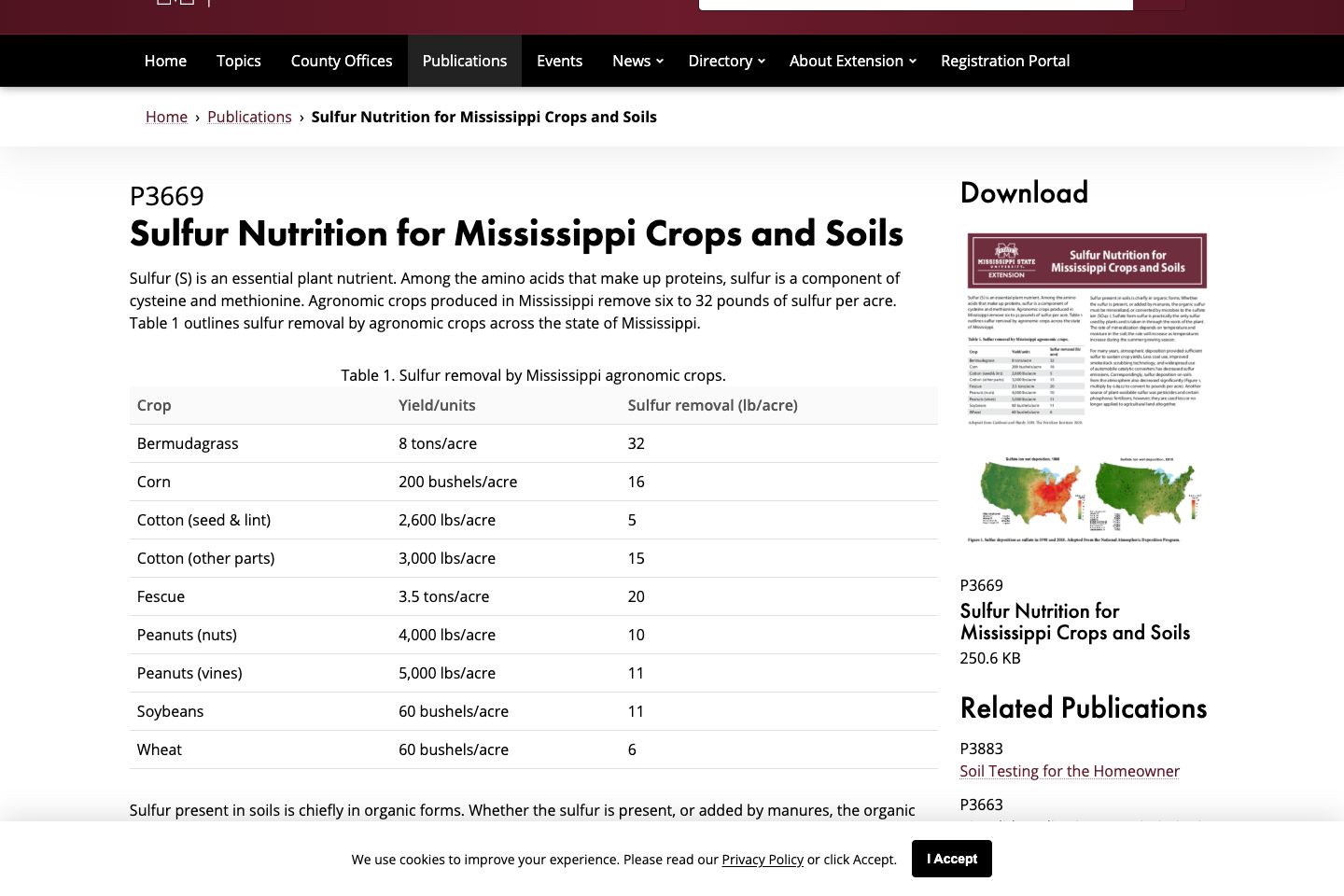
Sulfur can limit clovers and other deer forages on sandy Coastal Plain soils even when nitrogen and phosphorus look fine on a bag. Mississippi State University Extension’s sulfur nutrition guide explains that plant-available sulfate leaches like nitrate, with losses more likely in coarse-textured sandy soils, and that deficiencies often occur on sandy, low cation-exchange, low organic-matter ridge soils (MSU Extension sulfur guide). Pale green to yellow young leaves with darker older leaves signal deficiency because sulfur does not remobilize well inside the plant (MSU Extension sulfur guide). Soil tests for sulfur are not well calibrated in warm humid Southern climates; MSU recommends noting symptoms, confirming with tissue tests (including N:S ratios), and using sulfate fertilizers when deficiency is real (MSU Extension sulfur guide). On deer plots, that means asking whether S - not just N or P - is why inoculated clovers still look pale on sand (MSU Extension sulfur guide; MSU Extension lime guide).
Key Takeaways
- Sulfate leaches readily on sandy low-OM soils (MSU Extension sulfur guide).
- Deficiency: pale young leaves, darker old leaves, spindly growth (MSU Extension sulfur guide).
- Soil S tests poorly calibrated in MS climate; use tissue confirmation (MSU Extension sulfur guide).
- Atmospheric S deposition has declined (MSU Extension sulfur guide).
- Gypsum, ammonium sulfate, potassium sulfate supply available S (MSU Extension sulfur guide).
- Elemental S is slow; some S fertilizers acidify soil (MSU Extension sulfur guide).
Why Coastal Plain deer plots are vulnerable
Coarse sands and low organic matter mineralize and hold less sulfur while leaching sulfate after rains (MSU Extension sulfur guide). Ridge plantings that look fine on a P-K report can still starve clovers of cysteine and methionine building blocks (MSU Extension sulfur guide).
Do not guess from NPK alone
MSU’s lime guide already shows fertilizer waste when pH is wrong; sulfur adds another hidden limiter when atmospheric deposition no longer supplies free S (MSU Extension lime guide; MSU Extension sulfur guide). Tissue tests comparing good and bad spots confirm whether S is the story (MSU Extension sulfur guide).
In-season correction
Confirmed deficiencies can be addressed early with readily available sulfate fertilizers (MSU Extension sulfur guide). Early-season symptoms sometimes ease as summer warming increases mineralization - still note the field for next year’s plan (MSU Extension sulfur guide).
Rate basis
Without strong soil-test calibration, MSU bases rates on crop, texture, organic matter, and site factors rather than a single universal number (MSU Extension sulfur guide). Work with county Extension for deer-plot mixtures on sand (MSU Extension sulfur guide).
Protein link
Sulfur is a component of cysteine and methionine in proteins - pale clovers on sand may be protein-limited even when nitrogen fertilizer was applied (MSU Extension sulfur guide).
S rule
On Coastal Plain deer plots, watch for young-leaf yellowing, confirm with tissue tests, and use sulfate amendments when S - not N or P - is limiting forage on sandy low-OM ground (MSU Extension sulfur guide).
Fertilizer source table
Readily available sulfate sources include ammonium sulfate, potassium sulfate, gypsum, and zinc sulfate; elemental sulfur must oxidize for months before plants can use it (MSU Extension sulfur guide). Ammonium sulfate and elemental sulfur also acidify soils, so pair them with liming plans on already acid Coastal Plain plots (MSU Extension sulfur guide; MSU Extension lime guide).
Atmospheric deposition decline
MSU notes decades of declining atmospheric sulfur deposition as coal scrubbing and catalytic converters cut emissions, so historical ‘free S’ can no longer be assumed on sandy deer plots (MSU Extension sulfur guide).
Bottom line
Treat sulfur as a Coastal Plain deer-plot limiter on sandy low-OM soils: confirm with tissue tests and apply sulfate sources when pale young clover leaves point past N and P (MSU Extension sulfur guide).
The other side of it
The sulfur guide was written for Mississippi crops, not deer plots, and a pale clover on sand has other suspects, from low pH to an inoculant that never took. The same source admits early yellowing can fade on its own once summer warms the soil, so a hunter could fairly wait a few weeks before paying for tissue tests. That still beats the guy who treats every yellow leaf as a reason to buy another bag.
Keep reading
Latest deer news
Comments