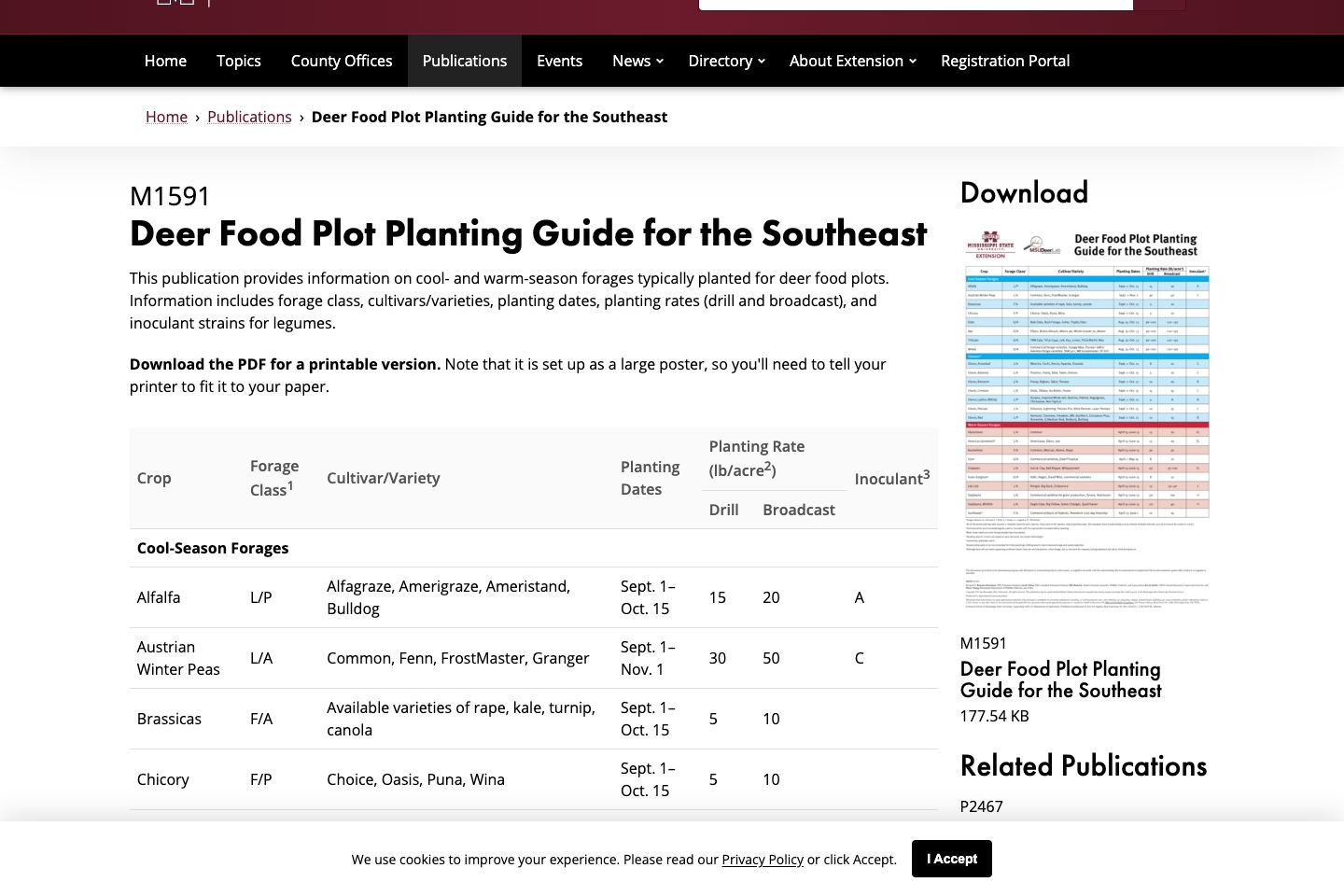
Warm-season grain sorghum can screen sanctuary edges while producing seed heads deer use in fall. Mississippi State University Extension’s Deer Food Plot Planting Guide for the Southeast lists grain sorghum (Kafir, Hegari, Dwarf Milo, and commercial varieties) as a warm-season grass for April 15 to June 15 at 8 pounds per acre drilled and 12 pounds per acre broadcast (MSU Extension). A footnote on that table states broadcasting is not recommended and that drilling in rows improves forage and seed production (MSU Extension). Those rates assume a complete stand; when mixing species, MSU instructs managers to reduce planting rates, using a wheat-and-oats broadcast example of 60 pounds of each instead of full monoculture rates in a 50/50 blend (MSU Extension). Grain sorghum sits in the same April 15 to June 15 warm-season block as cowpeas, lab lab, alyceclover, buckwheat, and soybeans on the MSU table (MSU Extension). Dwarf Milo and other grain-oriented entries on the variety list are the class managers should match when the goal is reachable seed heads rather than out-of-reach silage height (MSU Extension).
Key Takeaways
- MSU SE: grain sorghum Apr 15–Jun 15; 8 lb/A drilled; 12 lb/A broadcast (MSU Extension).
- Prefer drilling; broadcasting is not recommended for sorghum on the MSU table (MSU Extension).
- Varieties listed: Kafir, Hegari, Dwarf Milo, commercial types (MSU Extension).
- Cut rates when mixing species; complete-stand rates assume monoculture stands (MSU Extension).
- Same warm-season window as cowpeas, lab lab, and wildlife soybeans (MSU Extension).
- Choose grain/dwarf classes when seed reachability matters for deer (MSU Extension).
Calendar and neighbors
Plant sorghum in the April 15 to June 15 warm-season forage window shared with cowpeas, lab lab, alyceclover, buckwheat, and soybeans (MSU Extension). Do not force it into cool-season clover drills (MSU Extension).
Drill versus broadcast
MSU lists 8 pounds drilled and 12 pounds broadcast but footnotes that broadcasting is not recommended and drilling in rows improves forage and seed production (MSU Extension). Sanctuary screens that need even stalks should be drilled (MSU Extension).
Variety class
Named entries include Kafir, Hegari, Dwarf Milo, and commercial varieties (MSU Extension). Dwarf and grain classes keep seed heads in a browseable zone compared with tall forage types not singled out on this deer-plot table (MSU Extension).
What about sorghum-sudangrass itself?
The MSU deer-plot table never lists sorghum-sudangrass, only grain sorghum (MSU Extension). Missouri Extension’s warm-season grass guide does. It lists 20 to 25 pounds per acre drilled or 30 to 35 broadcast, seeded May 1 to June 30, and rates its suitability for wildlife cover as “Poor” (MU Extension G4661). Penn State Extension puts forage sorghum and sudangrass among forages with “a demonstrated reduction in deer feeding and damage” (Penn State Extension). So by these sources, sorghum-sudangrass is not deer food, and Missouri doesn’t vouch for it as cover either.
Mixing math
All MSU rates assume a complete stand; reduce each species when blending, as in the 60-plus-60 wheat/oats broadcast example (MSU Extension). Stacking full sorghum rates on top of cowpeas or lab lab overshoots the guide (MSU Extension).
Layout for screening plus feed
Drill sorghum on sanctuary edges for visual screen and keep grain-type rows where deer can reach heads, using the MSU rate and drill preference rather than broadcast overseeding (MSU Extension).
Checklist
Hit the April 15 to June 15 window, drill at 8 pounds per acre (or thoughtfully reduced mix rates), pick grain/dwarf variety classes from the MSU list, and skip broadcast when uniform rows matter (MSU Extension).
Why the drill footnote matters for sanctuaries
Uneven broadcast sorghum creates thin spots deer walk through and thick clumps that lodge, while drilled rows give the screening wall managers want on sanctuary borders (MSU Extension). Follow the MSU note that drilling improves forage and seed production instead of treating the higher broadcast rate as a better option (MSU Extension).
Pairing with climbing legumes
MSU notes forage can serve as structure for cowpeas, vining soybeans, or lab lab to climb (MSU Extension). Drilled sorghum rows in the same warm-season block can supply that architecture when managers want screen plus climbing browse (MSU Extension).
Bottom line
Drill MSU grain sorghum at 8 lb/A (12 broadcast listed but not recommended) in the April 15 to June 15 window, using grain/dwarf varieties and reduced rates in mixes (MSU Extension).
The other side of it
The title says sorghum-sudangrass, but the only extension guide here that rates it, Missouri’s, calls it poor wildlife cover, and the rest of the planting advice is for grain sorghum. Dwarf Milo keeps seed heads where deer can reach them, which is exactly why a hunter trying to hide his walk-in would want the tall forage types MSU’s guide never covers. Pick one job per row, unless you enjoy explaining to your buddy how the deer watched you over the milo.
Keep reading
Latest deer news
Comments