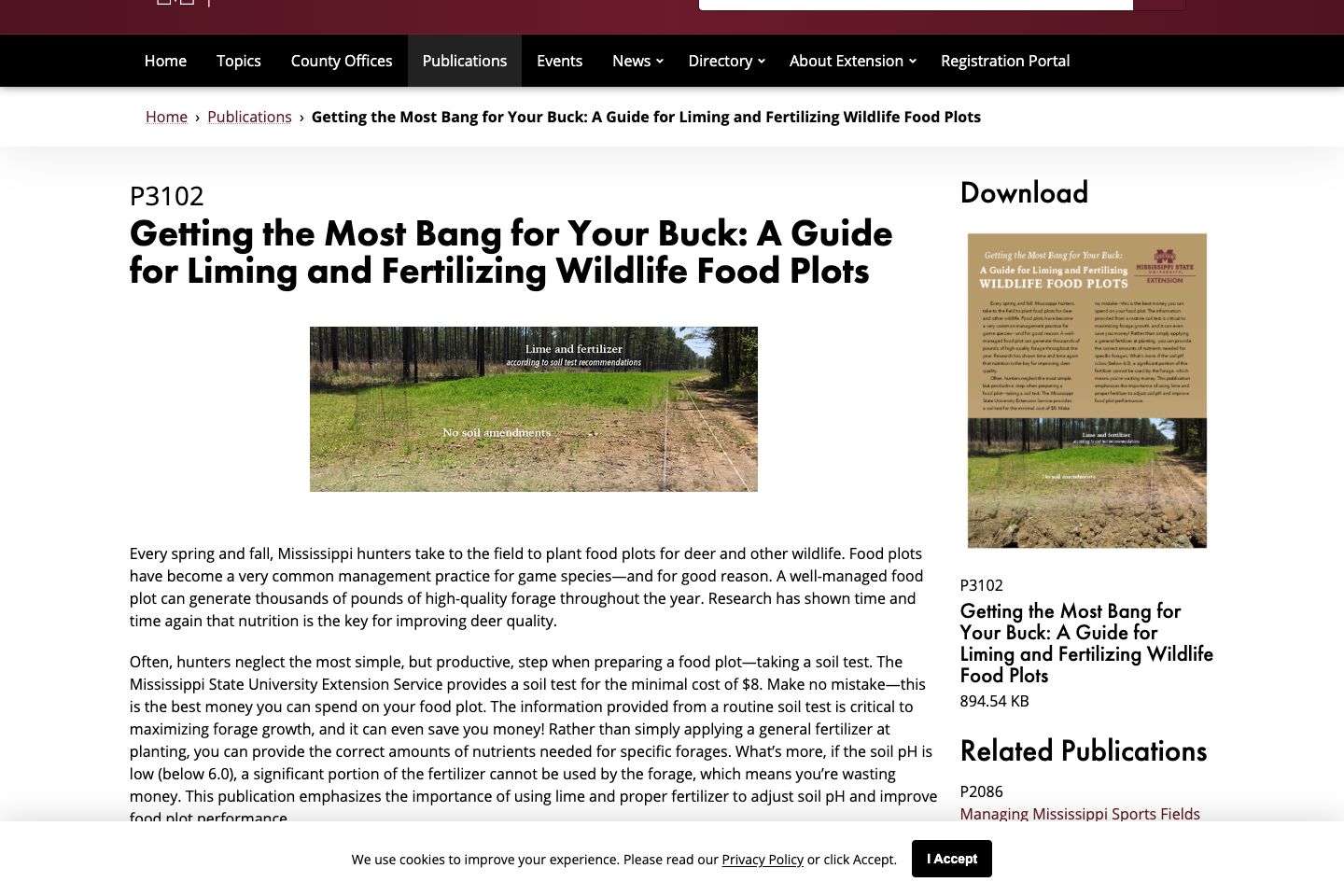
Potassium floors on a soil test decide whether deer-plot stems stand or lodge. Mississippi State University Extension’s wildlife liming and fertilizing guide ties fertilizer recommendations to soil tests rather than guesswork, and notes liming improves nutrient availability including potassium retention via higher cation exchange capacity (MSU Extension lime guide). The MSU alfalfa forage page cites optimum soil-test indices near 65 lb P and 350 lb K per acre for that crop, with split potassium applications for efficiency (Mississippi State University Extension Forages). White clover is described as highly responsive to potassium on the MSU ladino forage page (Mississippi State University Extension Forages). Stem strength in brassicas, small grains, and legumes fails when K is deficient even if nitrogen looks generous - soil-test floors prevent that blind spot before seed goes in (MSU Extension lime guide; Mississippi State University Extension Forages).
Key Takeaways
- Soil-test before buying K; do not guess (MSU Extension lime guide).
- Lime first if pH < ~6 so K and other nutrients stay available (MSU Extension lime guide).
- Alfalfa example optimum ~350 lb K/ac soil-test index (Mississippi State University Extension Forages).
- White clover highly K-responsive (Mississippi State University Extension Forages).
- Split K applications can improve efficiency on alfalfa (Mississippi State University Extension Forages).
- Crop code 95 wildlife samples at MSU lab (MSU Extension lime guide).
Why stem strength tracks K
Potassium supports turgor and structural function in forages; deficient plants lodge or wilt under browse and weather (Mississippi State University Extension Forages; MSU Extension lime guide). Managers who only chase nitrogen green-up miss weak stems that deer flatten overnight (MSU Extension lime guide).
Read the soil report
MSU wildlife food plot tests include potassium among routine nutrients and recommend rates for the site (MSU Extension lime guide). Sample 0-6 inches with multiple subsamples; use crop code 95 for mixtures (MSU Extension lime guide). Retest about every two years on existing plots (MSU Extension lime guide).
Crop-specific floors
Alfalfa’s roughly 350 lb K per acre optimum index is a high-demand reminder for perennial legumes (Mississippi State University Extension Forages). Clovers may not share that exact number, but the ladino page’s high K responsiveness means ignoring K on clover plots is still a stem and yield risk (Mississippi State University Extension Forages). Always prefer the lab recommendation for your crop code over copying alfalfa numbers blindly (MSU Extension lime guide).
Lime interaction
Low pH wastes fertilizer; liming improves CEC so potassium and other cations leach less (MSU Extension lime guide). Correcting acid soils is part of holding a K floor, not a separate hobby (MSU Extension lime guide).
Timing
Split K - half in fall and half after first cutting on alfalfa - can improve use efficiency (Mississippi State University Extension Forages). For annual plots, apply recommended K at establishment based on the test (MSU Extension lime guide).
Lodging link to brassicas and grains
Tall brassicas and small grains on M1591 still need adequate K from soil tests even though the deer poster focuses on seed rates (Mississippi State University Extension; MSU Extension lime guide). Weak stems after frost are as much a fertility story as a weather story (MSU Extension lime guide).
Manure caveat
If manure supplies some K, still verify with soil tests and manure analysis so you do not assume residual K covers the floor (MSU Extension lime guide). Variable manure nutrient content makes guessing dangerous for stem strength goals (MSU Extension lime guide).
Bottom line
Set potassium from soil-test recommendations after liming acid soils - alfalfa’s ~350 lb K index and clover K responsiveness show stem strength is a lab number, not a nitrogen-only decision (MSU Extension lime guide; Mississippi State University Extension Forages; Mississippi State University Extension Forages).
The other side of it
For a piece about potassium floors, the only actual floor is an alfalfa number, and the article admits clover may not share it. The link between K and flattened stems is also argued from forage pages rather than from anyone measuring lodging in a deer plot, so a skeptic could say weather and browse do more of the flattening than fertility. None of that excuses the guy who spreads whatever bag the co-op had on sale and calls it a fertility program.
Keep reading
Latest deer news
Sources
- Getting the Most Bang for Your Buck: A Guide for Liming and Fertilizing Wildlife Food Plots | Mississippi State University Extension Service
- Alfalfa (Medicago sativa) | Mississippi State University Extension Service
- White Ladino Clover (Trifolium repens) | Mississippi State University Extension Service
- Deer Food Plot Planting Guide for the Southeast | Mississippi State University Extension Service
Comments