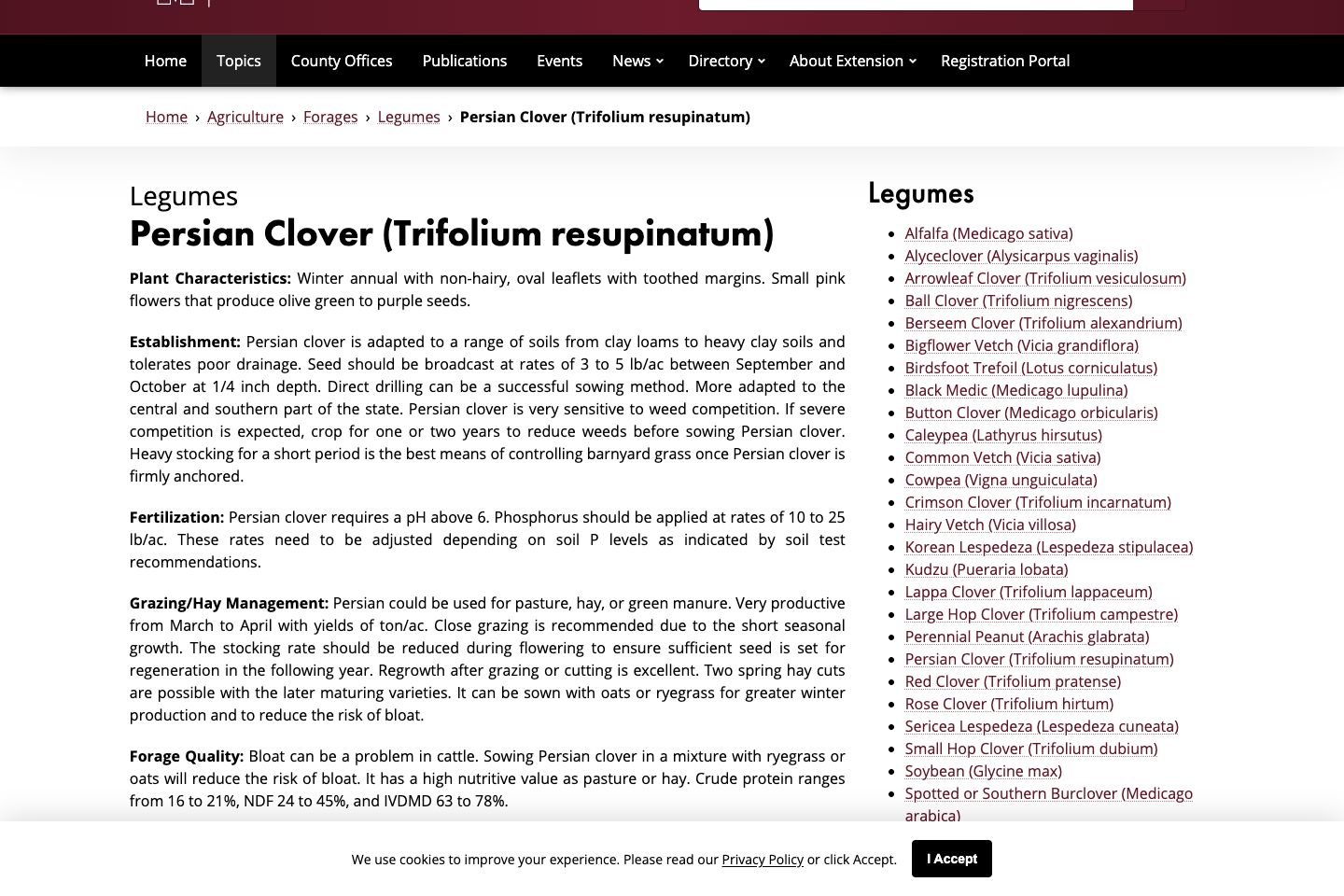
Persian clover is the cool-season annual Mississippi State University Extension points managers toward when deer openings sit on heavy clay or poorly drained ground. The MSU forage profile states persian clover is adapted from clay loams to heavy clay soils and tolerates poor drainage, with strongest fit in central and southern Mississippi (Mississippi State University Extension Forages). On the deer food-plot poster (M1591), persian clover is classed L/A annual with Enhance, Lightning, Persian Pro, Nitro Persian, and Laser Persian for September 1 through October 15 at 10 lb drilled or 15 lb broadcast pure live seed (Mississippi State University Extension). That poster rate is the complete-stand deer-plot column; the forage page’s lighter 3 to 5 lb broadcast band describes a different general-pasture context, so calibrate to the guide that matches your objective (Mississippi State University Extension; Mississippi State University Extension Forages). Compared with crimson clover’s high 15/25 lb monoculture rates on the same poster, persian’s moisture niche - not raw seed weight - is why wet openings often favor it (Mississippi State University Extension; Mississippi State University Extension Forages).
Key Takeaways
- MSU forage: clay loams to heavy clay; tolerates poor drainage; central/southern MS (Mississippi State University Extension Forages).
- M1591 deer rates: 10 drilled / 15 broadcast PLS; Sept 1-Oct 15; L/A (Mississippi State University Extension).
- Cultivars on the poster: Enhance, Lightning, Persian Pro, Nitro Persian, Laser Persian (Mississippi State University Extension).
- Forage page notes weed sensitivity and pH above 6 (Mississippi State University Extension Forages).
- Peak production March-April; close grazing; cut stocking at flowering if reseeding matters (Mississippi State University Extension Forages).
- Nurse with oats or ryegrass for winter growth and lower bloat risk in mixed livestock settings (Mississippi State University Extension Forages).
Drainage first, seed rate second
The forage page’s drainage language is the decision driver for wet-natured openings: persian handles poor drainage on heavy clays where water sits after winter storms (Mississippi State University Extension Forages). Once the site fits, use M1591’s 10/15 lb PLS complete-stand columns for a dedicated deer monoculture, or cut those rates under footnote 2 inside a blend (Mississippi State University Extension). Do not borrow crimson’s 25 lb broadcast column - that species is a different seed-load story on the same poster (Mississippi State University Extension).
Poster cultivars versus forage maturity table
M1591 names Enhance, Lightning, Persian Pro, Nitro Persian, and Laser Persian for deer plantings (Mississippi State University Extension). The forage page’s maturity table expands the commercial set - Prolific, Nitro, Kyambro, Lightning, Morbulk, Laser, Maral - with hard-seed and disease notes that matter if you expect natural regeneration (Mississippi State University Extension Forages). Nitro carries high hard seed and Phytophthora resistance on that table; Lightning has no hard seed (Mississippi State University Extension Forages). Match cultivar hard-seed traits to whether you want a true one-and-done plot or a chance at year-two seedlings (Mississippi State University Extension Forages).
Weed pressure on wet ground
MSU warns persian is very sensitive to weed competition and suggests cropping one or two years to cut weed seed banks before sowing when pressure is severe (Mississippi State University Extension Forages). Wet openings often grow barnyard grass; once persian is anchored, heavy short-duration stocking is the forage page’s preferred grass control (Mississippi State University Extension Forages). Skipping weed prep is a common reason wet-plot persian fails even when drainage tolerance was correct (Mississippi State University Extension Forages).
Fertility and depth on clay
Keep pH above 6 and apply phosphorus in the 10 to 25 lb per acre band adjusted to soil test (Mississippi State University Extension Forages). Seed shallow - about 1/4 inch - whether broadcasting or drilling (Mississippi State University Extension Forages). M1591 still requires PLS math on coated clover bags and inoculation checks under footnotes 3-5 (Mississippi State University Extension).
Seasonal use pattern
Persian is very productive from March into April on the forage page, with close grazing recommended because the seasonal growth window is short (Mississippi State University Extension Forages). Reduce stocking during flowering if you need seed set for regeneration (Mississippi State University Extension Forages). Mixing with oats or ryegrass lifts winter production and lowers bloat risk where cattle share the acreage; deer plots still benefit from the nurse-crop soil cover (Mississippi State University Extension Forages). Crude protein ranges about 16 to 21% (Mississippi State University Extension Forages).
Field call versus crimson
Pick persian when the opening stays wet and heavy; pick crimson when you want the heaviest annual seed load on better-drained ground inside M1591’s shared Sept 1-Oct 15 window (Mississippi State University Extension Forages; Mississippi State University Extension). Both are annuals - neither replaces a ladino or red perennial crown plan (Mississippi State University Extension).
Bottom line
On wet clay deer openings, plant persian clover at M1591’s 10/15 lb PLS rates for its documented poor-drainage tolerance, control weeds first, and treat it as an annual rather than a perennial carpet (Mississippi State University Extension Forages; Mississippi State University Extension).
The other side of it
Everything here comes out of Mississippi State, and the forage page’s best fit is central and southern Mississippi, so a wet bottom farther north is a different bet. A lot of the management advice, like close grazing and cutting stocking at flowering, was written for cattle, and deer don’t take instructions on when to graze. Funny how the guy with the soggiest opening on the lease is always the one who swears clover just won’t grow on his place.
Keep reading
Latest deer news
Comments