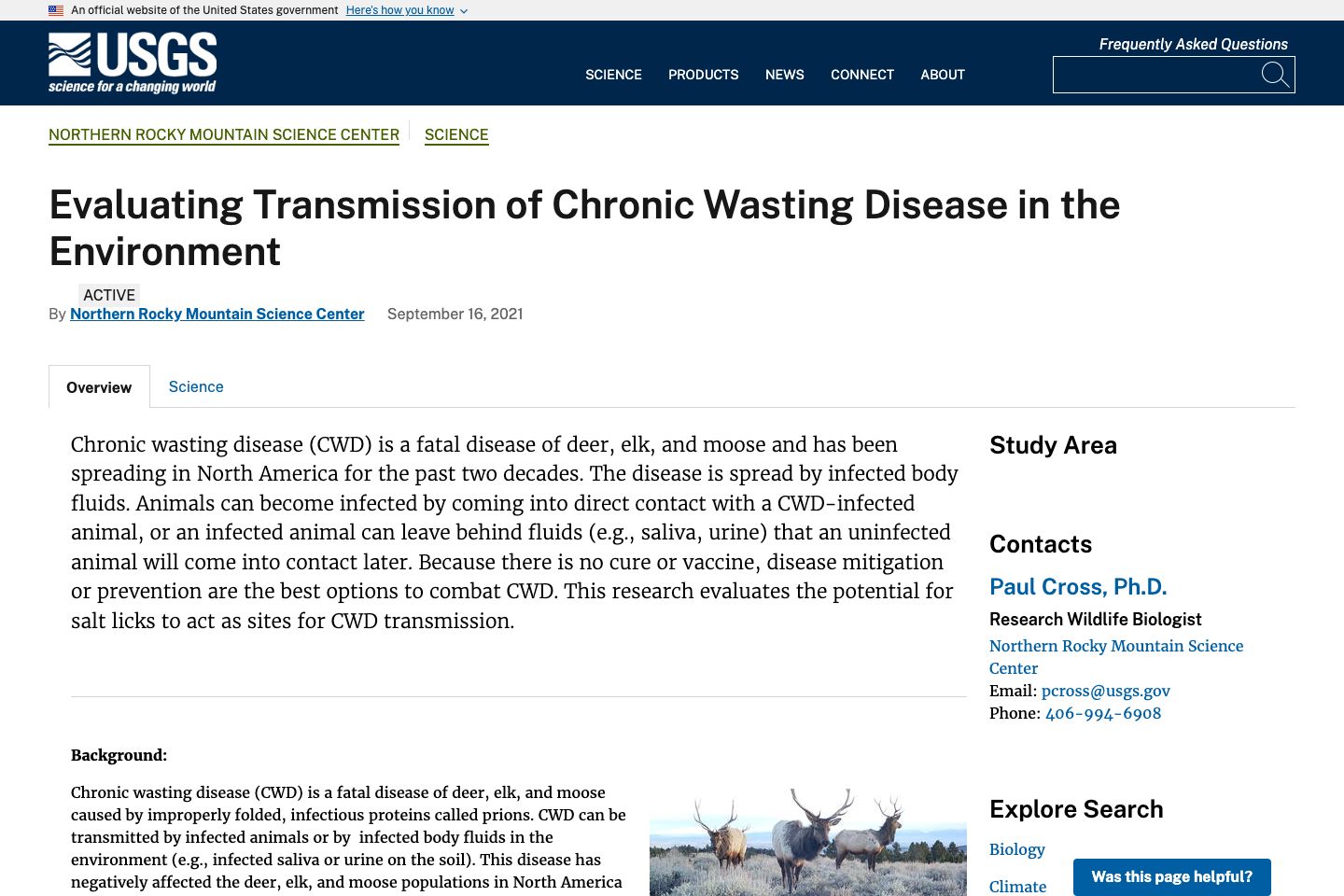
Mineral licks can be a CWD prion risk for deer: they concentrate deer, and in chronic wasting disease country they can concentrate prions too. A PLOS One study of mineral licks in a Wisconsin CWD zone found prions in soil, water or both at 9 of 11 sampled licks, and concluded that licks can act as environmental reservoirs that may help the disease spread indirectly (PLOS One). USGS work flags agricultural mineral licks the same way, as congregation sites where saliva left behind could matter (USGS).
Key Takeaways
- Prions turned up at 9 of 11 licks studied inside a Wisconsin outbreak zone (PLOS One).
- Saliva left while deer lick soil or water is a plausible way prions get there (PLOS One).
- Livestock and other wildlife also use some licks, a cross-species exposure question researchers flag (PLOS One; USGS).
- AFWA’s CWD best practices emphasize cutting down environmental contamination pathways (AFWA CWD BMPs).
What did the Wisconsin mineral lick study find?
Researchers sampled soil and water at 11 mineral licks (10 man-made, one natural) used by free-ranging whitetails in a large enzootic zone west of Madison during 2012-2015 (PLOS One).
Dirt is hard to test. Soil holds inhibitors that often hide the signal, so the team tuned its extraction methods until misfolding cyclic amplification assays could pick up CWD prions anyway (PLOS One).
What they found (PLOS One):
| Result | Licks |
|---|---|
| Prions in soil | 7 |
| Prions in both soil and water | 2 |
| Contaminated in at least one sample type | 9 of 11 |
Water came back positive at multiple sites. The amounts detected were near the assay’s limits, partly because soil can block amplification. The management signal is how many sites came back positive, not how much was in any one of them (PLOS One).
Why would a mineral lick spread CWD?
Deer keep coming back for sodium and other minerals, and every visit means eating soil and water while leaving saliva behind. The study’s authors argue that saliva has high potential to seed a lick that many deer revisit (PLOS One).
USGS frames the risk at agricultural salt sites used by cattle and wildlife in two parts: direct contact between animals crowded at one spot, and indirect infection from saliva left on the mineral source. That’s why USGS project descriptions include exclosure experiments and camera studies. Managers need to know whether keeping wildlife off livestock minerals changes contact rates (USGS).
Are deer scrapes a CWD risk too?
The same logic applies. Breeding-season scrapes collect urine and saliva from many bucks on shared licking branches and pawed soil. A 2024 study sampled 105 scrapes in a Tennessee CWD zone where prevalence is about 50% and found prion seeding activity in 20% of soil samples and 41% of licking branches. Its authors say scrapes “have the potential to serve as sentinel sites for environmental surveillance of CWD” (Huang et al., Ecological Solutions and Evidence, 2024). In CWD zones, treat heavily used community scrapes as contact points you don’t want to build up with attractants, especially where natural urine scents are already restricted (NDA CWD; CDC CWD; AFWA CWD BMPs).
Why do states ban minerals and bait in CWD areas?
Agencies that ban baiting or mineral sites in CWD management areas are acting on the same crowding-plus-environment logic the lick study supports (PLOS One; AFWA CWD BMPs; NDA CWD).
Where minerals are still legal, know that you may be building a shared saliva site. Synthetic non-cervid scents don’t carry the same urine-prion problem, but any feed pile still bunches deer up. Read your mineral rules alongside the urine-attractant and carcass-transport rules. They’re aimed at the same problem.
Should you pull your mineral sites in CWD country?
In CWD-positive or high-risk units, the evidence points that way:
- Strongly consider removing man-made mineral sites (PLOS One; USGS).
- Don’t switch to natural cervid urine attractants where they’re banned (NDA CWD; AFWA CWD BMPs).
- If you keep minerals where they’re still legal, avoid sharing them with livestock when you can (PLOS One; USGS).
- Put your effort into harvest goals and testing compliance, not defending a salt-block tradition (TPWD CWD precautions; CDC CWD).
None of this replaces the carcass rules. CDC tells hunters not to shoot sick animals and to take precautions when hunting in CWD areas (CDC CWD). Texas Parks and Wildlife lists brain, spinal cord, eyes, lymph nodes and spleen among the tissues where prions concentrate, tells hunters not to eat those parts, and points them to statewide carcass disposal rules (TPWD CWD precautions). Lick risk adds a reason to rethink year-round mineral sites in positive units on top of that.
What the lick studies don’t prove
The Wisconsin detections show contamination is common at used licks inside an enzootic zone. They don’t show how many new infections each lick causes compared with deer-to-deer contact (PLOS One).
Prevention guidance still treats cutting down environmental hot spots as part of a serious CWD program, alongside surveillance and carcass rules (AFWA CWD BMPs; NDA CWD). And DMA boundaries and product bans change faster than camp tradition, so read your local mineral and bait language every season (CDC CWD; TPWD CWD precautions).
Related: deer urine attractants and CWD and can humans get CWD?.
The other side of it
The detections were near the assay’s limits at 11 licks inside one infected Wisconsin zone, and the authors say that doesn’t show how many infections a lick causes compared with plain deer-to-deer contact. A landowner outside a positive unit could reasonably argue this is a reason to watch, not to tear out every mineral site. Funny how the hunter who swears his salt block is harmless never minds that it sits on the busiest dirt on the farm.
Keep reading
Latest deer news
Sources
- Expanding CWD Disease Surveillance Options Using Environmental Contamination at Deer Signposts (Huang et al., 2024)
- Mineral licks as environmental reservoirs of chronic wasting disease prions | PLOS One
- Evaluating Transmission of Chronic Wasting Disease in the Environment | U.S. Geological Survey
- AFWA CWD BMPs (fishwildlife.org)
- Precautions for Hunters — Texas Parks & Wildlife Department
- CDC CWD (cdc.gov)
- NDA CWD (deerassociation.com)
Comments