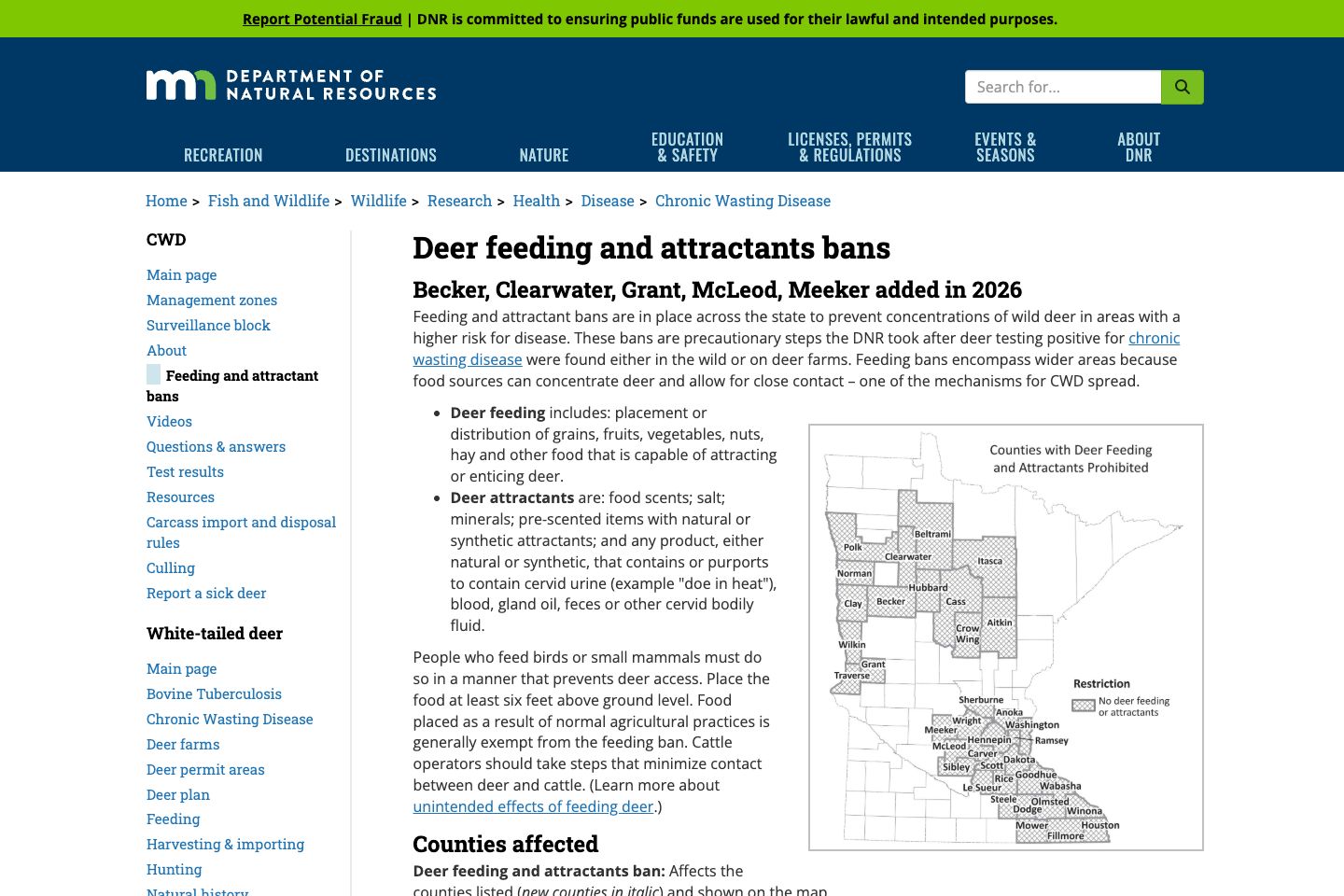
Natural deer urine and other cervid bodily-fluid attractants sit at the intersection of product labels and chronic wasting disease (CWD) rules that vary by state and often by county. Minnesota DNR’s feeding and attractants ban page defines deer attractants to include food scents, salt, minerals, pre-scented items with natural or synthetic attractants, and any product, natural or synthetic, that contains or purports to contain cervid urine (example “doe in heat”), blood, gland oil, feces, or other cervid bodily fluid (Minnesota Department of Natural Resources). That Minnesota ban covers a long county list that added Becker, Clearwater, Grant, McLeod, and Meeker in 2026, alongside Aitkin, Anoka, Beltrami, Carver, Cass, Clay, Crow Wing, Dakota, Dodge, Fillmore, Goodhue, Hennepin, Houston, Hubbard, Itasca, Le Sueur, Mower, Norman, Olmsted, Polk, Ramsey, Rice, Scott, Sherburne, Sibley, Steele, Traverse, Wabasha, Washington, Wilkin, Winona, and Wright (Minnesota Department of Natural Resources). Wisconsin’s online deer regulations allow scents used only to attract deer by odor statewide, but the scent may not be placed or deposited in a manner that makes it accessible for consumption by deer; scents greater than two ounces must be removed daily at the end of shooting hours, while two ounces or less need not be removed daily (Wisconsin Department of Natural Resources). Wisconsin separately maps baiting and feeding bans that reset with CWD detections; Washburn County’s baiting and feeding ban was stated to expire November 9, 2026 without additional detections (Wisconsin Department of Natural Resources). Manufacturer labels that say “natural doe urine” do not override a state or county ban; the agency definition of attractant controls whether the bottle is legal where you hunt (Minnesota Department of Natural Resources).
Key Takeaways
- Minnesota attractant definition explicitly includes products that contain or purport to contain cervid urine, blood, gland oil, feces, or other cervid bodily fluid (Minnesota Department of Natural Resources).
- Minnesota county list includes 2026 additions Becker, Clearwater, Grant, McLeod, Meeker (Minnesota Department of Natural Resources).
- Wisconsin: odor-only scents OK statewide if not consumable by deer; >2 oz remove daily; ≤2 oz may stay (Wisconsin Department of Natural Resources).
- Wisconsin baiting/feeding ban map is separate from the scent rule and tracks CWD detections (Wisconsin Department of Natural Resources).
- Bird/small-mammal feeding in Minnesota ban counties must keep food at least six feet above ground to prevent deer access (Minnesota Department of Natural Resources).
- Always verify the live DNR page for your county before opening a urine bottle (Minnesota Department of Natural Resources; Wisconsin Department of Natural Resources).
What Minnesota bans as an attractant
Minnesota’s page groups feed (grains, fruits, vegetables, nuts, hay, and other enticing food) separately from attractants, and attractants expressly cover cervid urine products and other bodily-fluid claims whether labeled natural or synthetic (Minnesota Department of Natural Resources). Normal agricultural food placement is generally exempt; cattle operators are told to minimize deer-cattle contact (Minnesota Department of Natural Resources).
How Wisconsin treats scents versus bait
Wisconsin’s scent rule is an odor-access rule: statewide odor attractants are legal if deer cannot consume them, with a two-ounce daily-removal threshold (Wisconsin Department of Natural Resources). Baiting and feeding bans are a different regulatory track tied to CWD-positive wild or captive deer and adjoining-county buffers, so a county can ban bait piles while still allowing non-consumable scents under the statewide scent text (Wisconsin Department of Natural Resources; Wisconsin Department of Natural Resources).
Label claims versus agency definitions
If a label says “synthetic” but the product “purports to contain” cervid urine, Minnesota’s attractant definition still reaches it in ban counties (Minnesota Department of Natural Resources). Conversely, a “natural urine” label does not create permission where the county is listed on the DNR ban page (Minnesota Department of Natural Resources).
Field checklist before you hunt
Open the Minnesota feed-ban page or Wisconsin scent and bait pages for the season you are hunting, match your county, decide whether any urine, gland, or blood product is banned outright or only restricted by placement and ounce limits, and leave the bottle home when the attractant definition covers it (Minnesota Department of Natural Resources; Wisconsin Department of Natural Resources; Wisconsin Department of Natural Resources).
Bottom line
Treat natural deer urine as a regulated attractant: Minnesota bans cervid-urine and related bodily-fluid products in listed counties, Wisconsin allows odor scents only when deer cannot consume them and caps unattended volume at two ounces, and neither state’s rules are rewritten by a bottle label (Minnesota Department of Natural Resources; Wisconsin Department of Natural Resources).
The other side of it
A Wisconsin hunter could fairly point out that his state still allows odor-only scents statewide, so the rules are narrower than the scary version going around camp. The article also spells out what’s banned far better than it shows how much risk a bottle actually carries, leaning on agency rationale rather than measured cases. Meanwhile, the guy who thinks a ‘synthetic’ label gets him off the hook in a Minnesota ban county is about to learn what ‘purports to contain’ means.
Keep reading
Latest deer news
Comments