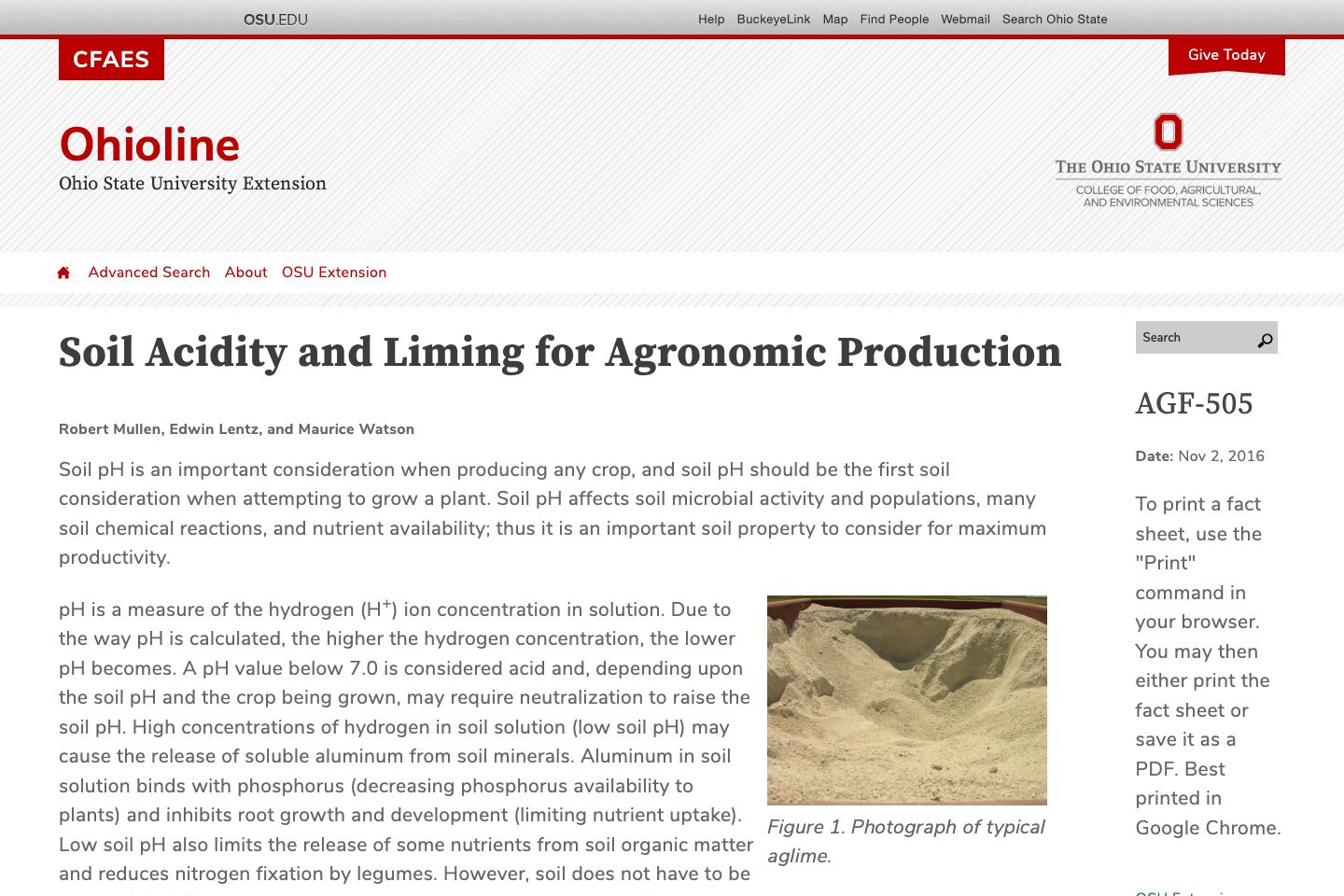
Soil pH is the first fertility lever for clover and brassica deer plots. Ohio State University Extension states soil pH should be the first soil consideration when growing a plant because it affects microbial activity, chemical reactions, and nutrient availability (Ohio State University Extension). A pH below 7.0 is acid and may require neutralization with aglime depending on crop needs (Ohio State University Extension). Tri-State style guidance reproduced in the fact sheet lists desired pH targets including alfalfa at 6.5 to 6.8, other legume forages at 6.0 to 6.8, and corn, soybeans, and small grains around 6.0 to 6.5 on mineral soils (Ohio State University Extension). Buffer pH (often SMP buffer) reveals how much potential acidity lime must neutralize, and lime-rate tables are keyed to buffer pH and target pH for an 8-inch incorporation depth (Ohio State University Extension). Eastern Ohio soils from sandstone and shale parent materials are usually acidic; western Ohio glacial carbonate soils start higher (Ohio State University Extension).
Key Takeaways
- Check soil pH first; values below 7.0 are acid and may need lime (Ohio State University Extension).
- Legume forage targets often 6.0-6.8; alfalfa commonly 6.5-6.8 (Ohio State University Extension).
- Buffer pH measures potential acidity that lime must neutralize (Ohio State University Extension).
- Lime rate tables assume about 8-inch incorporation depth (Ohio State University Extension).
- Eastern Ohio sandstone/shale soils are often acidic (Ohio State University Extension).
Why deer plots fail on low pH
Ohio Extension ties pH to nutrient availability and microbial activity that legumes need for nitrogen fixation partners (Ohio State University Extension). Acid soils lock nutrients and punish clover and many brassicas even when nitrogen bags look full (Ohio State University Extension). Parent material matters: eastern Ohio sandstone/shale soils are often acidic, while western glacial carbonate soils start higher (Ohio State University Extension).
Target pH by forage class
Desired pH tables put alfalfa near 6.5-6.8, other legume forages near 6.0-6.8 with birdsfoot trefoil limed to 6.0, and corn/soybeans/small grains near 6.0-6.5 on mineral soils (Ohio State University Extension). Deer managers planting clover mixes should aim at the legume forage band, not a corn-only target (Ohio State University Extension).
Buffer pH drives tonnage
Water pH shows active acidity; buffer pH shows potential acidity held on soil surfaces that lime must neutralize to reach the desired level (Ohio State University Extension). Rate tables based on SMP buffer and desired pH for 8-inch incorporation translate that buffer reading into lime needed (Ohio State University Extension). Guessing tons without buffer data over- or under-limes (Ohio State University Extension).
What builds acidity on hunted ground
High-yielding forage harvest removes basic cations; ammonium fertilizers release hydrogen when oxidized to nitrate; both acidify soil over time (Ohio State University Extension). Equivalent lime pounds needed to neutralize acidity from various nitrogen sources at 100 lb N/A are tabulated in the fact sheet (Ohio State University Extension). Food-plot nitrogen programs therefore create ongoing lime demand (Ohio State University Extension).
How do you lime a food plot without wasting money?
Mississippi State’s wildlife food plot lime guide puts it plainly: below a pH of 6.0, a big share of the fertilizer you spread can’t be used by the forage (MSU Extension lime guide). Brassicas tolerate a pH of 5.5 to 7.0 in MSU’s P2111 manual (MSU Extension P2111). In MSU’s deer vetch trial, forage yield and crude protein both climbed with lime, and climbed most with lime plus fertilizer (MSU Extension lime guide).
- Sample right. Pull 10 to 12 cores from the top 6 inches of a 1- to 10-acre plot, mix them, and use crop code 95 for wildlife mixtures on the MSU form. Test at establishment and about every two years after. If a recommendation comes back over about 4 tons per acre, retest (MSU Extension lime guide).
- Check the RNV. MSU’s rates assume 100% relative neutralizing value. A weaker lime takes more tons, so 3 tons at 67% equals 2 tons at 100% (MSU Extension lime guide).
- Buy bulk on bigger plots. On plots of about an acre or more, bulk aglime costs far less than pelletized or liquid lime. Those suit small or hard-to-reach plots but may need more frequent testing (MSU Extension lime guide).
- Give it time. Lime reacts slowly, so test and spread months before a September seeding (MSU Extension lime guide).
Raising pH also frees up molybdenum, a micronutrient clover needs to form nodules and fix nitrogen (University of Maryland Extension via UD Weekly Crop Update).
Field checklist
Soil-test before seeding clover or brassicas, read both water pH and buffer pH, pick the legume target from the crop table, and spread aglime timed for incorporation to about 8 inches when tillage is used (Ohio State University Extension). On no-till plots, expect slower correction and plan earlier applications (Ohio State University Extension). Re-test after major lime events before blaming seed (Ohio State University Extension).
Bottom line
Lime clover and brassica deer plots to legume-forage pH targets using buffer-pH rate tables - do not guess tons from water pH alone (Ohio State University Extension).
The other side of it
Those target tables were built around alfalfa, corn and soybeans on Ohio farm ground, not a shaded clover plot on a ridge, and the rate tables assume lime worked about 8 inches deep. A no-till hunter can follow the math perfectly and still wait a long time for the pH to move. None of that excuses the fellow who blames the seed bag every fall without ever mailing in a soil sample.
Keep reading
Latest deer news
Sources
- Soil Acidity and Liming for Agronomic Production | Ohioline
- Getting the Most Bang for Your Buck: A Guide for Liming and Fertilizing Wildlife Food Plots | Mississippi State University Extension Service
- Supplemental Wildlife Food Planting Manual for the Southeast
- Forage Crops and Micronutrients | Weekly Crop Update
Comments