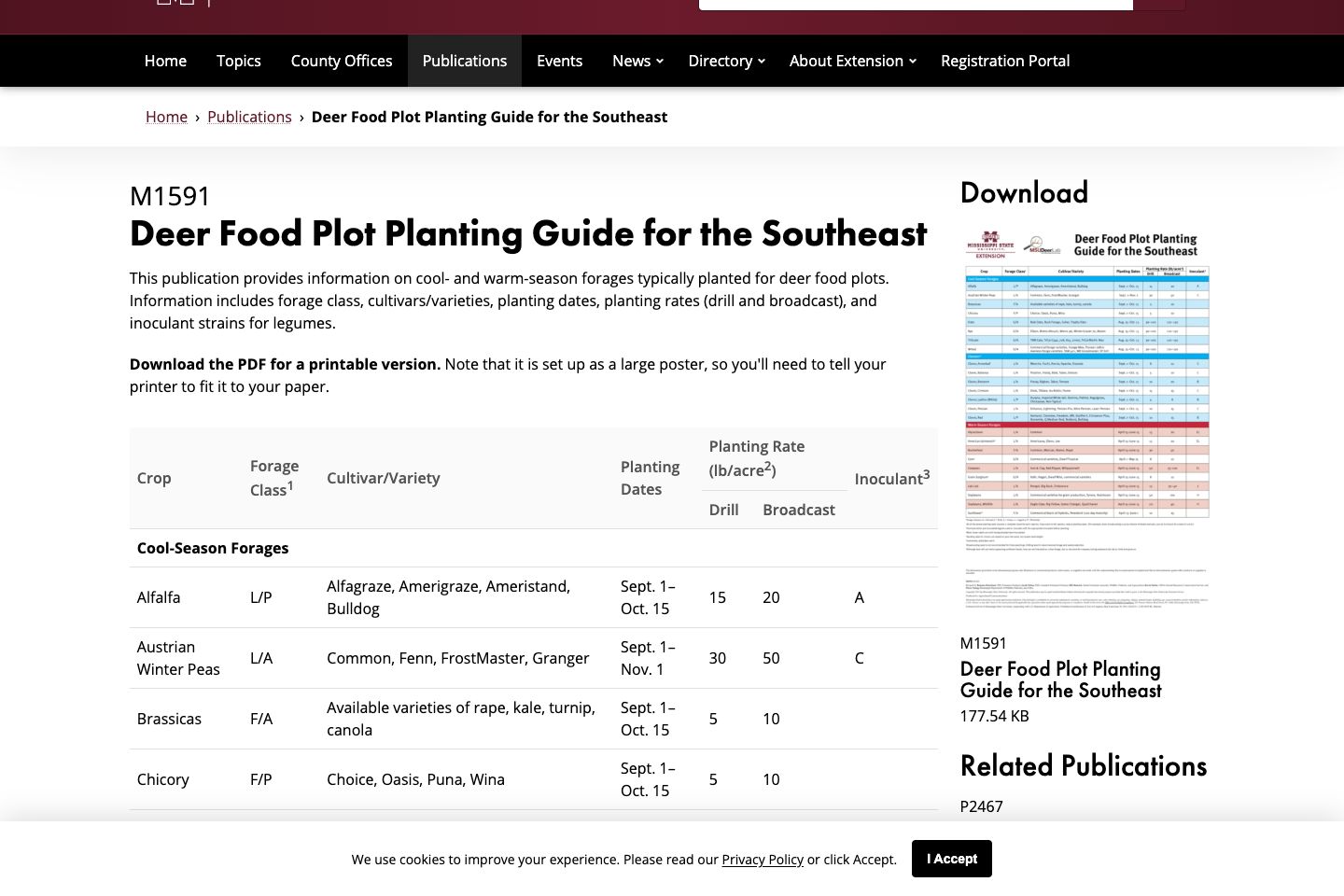
Ladino white clover is the long-season perennial carpet on Southeast deer plots when residual height is protected. Mississippi State University Extension’s Deer Food Plot Planting Guide (M1591) classes ladino L/P perennial, lists Durana, Imperial White-tail, Domino, Patriot, Regalgraze, Chickasaw, and Non-Typical, and sets pure-stand rates at 4 lb drilled or 8 lb broadcast pure live seed for September 1 through October 15 (Mississippi State University Extension). The MSU white-clover forage page adds the height rule that matters under deer pressure: in continuous systems, graze when the canopy reaches 6 inches down to a 2-inch minimum on 15- to 30-day intervals (Mississippi State University Extension Forages). Supplemental Wildlife Food Planting Manual P2111 describes ladino as a short-lived perennial that produces from October through June and tolerates poor drainage on silty loam to fertile clay (MSU Extension P2111). Residual height is how those months stay green instead of turning into bare dirt by January (Mississippi State University Extension Forages).
Key Takeaways
- M1591: 4 drilled / 8 broadcast PLS; L/P; Sept 1-Oct 15 (Mississippi State University Extension).
- Graze at 6 inches; leave 2 inches; 15-30 day intervals (Mississippi State University Extension Forages).
- P2111: Oct-June production; poor-drainage tolerant (MSU Extension P2111).
- Rotational or limit grazing preferred; alone it carries medium-high bloat risk for cattle (Mississippi State University Extension Forages).
- North MS long-lived perennial; south MS often short-lived (Mississippi State University Extension Forages).
- Mixture rates cut per footnote 2; inoculant B (Mississippi State University Extension).
The 6-to-2 inch rule
MSU’s forage guidance is explicit for continuous grazing: start when white clover reaches 6 inches and stop at a 2-inch floor, returning every 15 to 30 days (Mississippi State University Extension Forages). Deer plots that are the only green acreage on a property often never see that rest - animals keep the canopy under 2 inches and kill stolons (Mississippi State University Extension Forages). Rotational grazing, limit grazing (1 to 2 hours per day in livestock systems), or simply planting enough competing forage acres are the tools that protect residual height (Mississippi State University Extension Forages).
Why light seed rates still build a carpet
At 4/8 lb PLS, ladino is the lightest cool-season clover column on M1591 beside balansa’s 5/10 lb annual rate (Mississippi State University Extension). Stolons, not seed mass, fill the canopy - which is why overgrazing to bare ground undoes the seeding investment faster than a thin first emergence (Mississippi State University Extension Forages; Mississippi State University Extension). P2111 lists drill 4 lb / broadcast 5 lb at about 1/2 inch; keep coated-seed math on the PLS basis M1591 footnote 5 requires (MSU Extension P2111; Mississippi State University Extension).
Season window and geography
Productivity on the forage page runs March to June and October to November, with yields near 2 to 4 tons per acre (Mississippi State University Extension Forages). P2111 stretches the forage story from October through June for deer and rabbits (MSU Extension P2111). Northern Mississippi stands behave as longer-lived perennials; southern stands often act short-lived or annual (Mississippi State University Extension Forages). Plan reseeds in the south even when residual height is perfect (Mississippi State University Extension Forages).
Site and companions
White clover prefers loam and clay-loam and is well adapted to wet clay bottoms; MSU does not recommend mixing it into bermudagrass or bahiagrass sods (Mississippi State University Extension Forages). P2111 companions include cool-season annual grasses and red clover; high-production varieties may be planted alone (MSU Extension P2111). Keep pH near or above 6 and feed potassium - white clover is highly K-responsive (Mississippi State University Extension Forages).
Disease and grass competition
Sclerotinia, crown and stem rot, rhizoctonia, fusarium, and root-knot nematodes can thin stands (Mississippi State University Extension Forages). P2111 notes spring grass control and September light disking or mowing with phosphorus-potassium fertilizer to encourage reseeding (MSU Extension P2111). Residual height management fails if grass thatch shades the stolons all spring (MSU Extension P2111).
Height checklist
Seed 4/8 lb PLS in the Sept window, inoculate, lock a 2-inch residual floor, rotate pressure so the canopy can return to 6 inches, and reseed southern plots when stolons thin (Mississippi State University Extension; Mississippi State University Extension Forages).
Mowing heights that protect the same residual
P2111 notes that reseeding of ladino stands can often be enhanced by light disking and/or mowing in September plus phosphorus-potassium fertilizer, and that spring grass control is often required (MSU Extension P2111). Mowing that scrapes below the same 2-inch residual floor used for continuous grazing removes stolons the forage page is trying to keep (MSU Extension P2111). Treat September maintenance cuts as residual-height events - leave a green floor - rather than as a bare-dirt reset unless the stand is already failed (MSU Extension P2111).
Bottom line
Protect ladino by grazing from about 6 inches down to a 2-inch residual on 15-30 day rests - light 4/8 lb PLS seedings only persist when stolons are not scraped bare (Mississippi State University Extension Forages; Mississippi State University Extension).
The other side of it
The obvious hole is that the 6-to-2 inch rule comes from MSU’s forage page, written for grazing systems where somebody controls the animals and can pull them off. Deer don’t rotate on command, so on most hunting ground the only real lever is planting enough other acres, and in south Mississippi the stand may act like an annual regardless. Good luck explaining a 15-day rest period to a doe that’s already standing in the middle of your clover.
Keep reading
Latest deer news
Comments