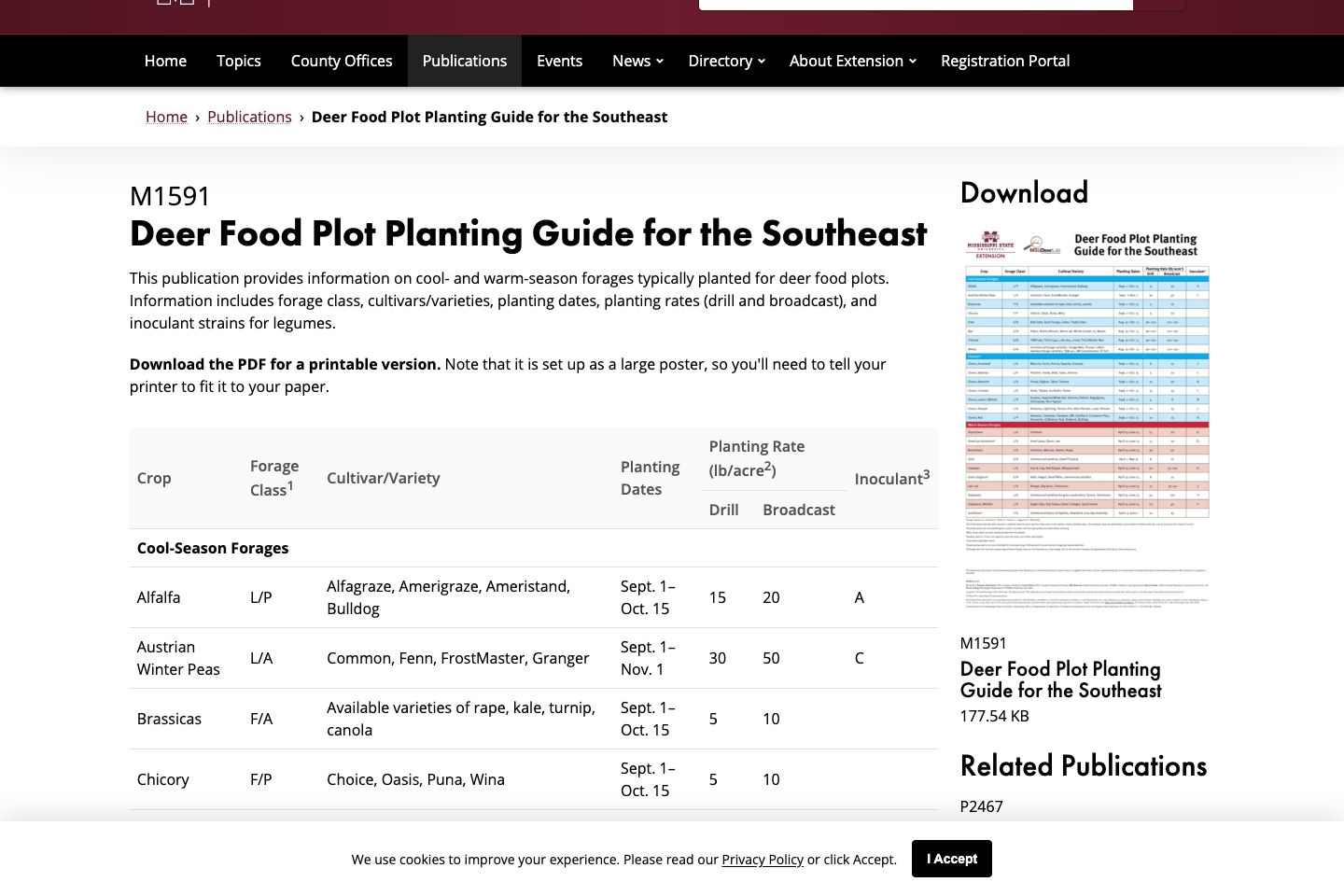
Lablab is the drought-tolerant warm-season vine Mississippi State University Extension plants with a tower crop, not as a flat monoculture on wet ground. M1591 classes lab lab L/A annual, lists Rongai, Big Buck, and Endurance, and sets 15 lb drilled or 30-40 lb broadcast for April 15 through June 15 with inoculant J (Mississippi State University Extension). Footnote 8 states sunflowers are not intended as deer forage but as structure for cowpeas, vining soybeans, and lab lab to climb (Mississippi State University Extension). P2111 describes lablab as a very drought-tolerant, fast-growing, erect warm-season legume that is weakly perennial, does not readily reseed, is highly preferred by deer, and grows on well-drained sandy upland sites without wet-soil tolerance (MSU Extension P2111). Climbing structure is therefore part of the seeding plan, not an optional decoration (Mississippi State University Extension; MSU Extension P2111).
Key Takeaways
- M1591: Rongai, Big Buck, Endurance; 15/30-40 lb; Apr 15-Jun 15; inoc J (Mississippi State University Extension).
- Sunflowers = climbing structure per footnote 8 (Mississippi State University Extension).
- P2111: drought-tolerant; well-drained sandy uplands; no wet soils (MSU Extension P2111).
- Highly preferred by deer; weakly perennial; poor reseeder (MSU Extension P2111).
- Planting dates Apr 1-Jun 1 on P2111; pH about 5.5-7.5 (MSU Extension P2111).
- Cut rates when mixing with sunflower or sorghum towers (Mississippi State University Extension).
Why towers matter
M1591’s sunflower footnote exists specifically so cowpeas, vining soybeans, and lab lab have structure (Mississippi State University Extension). Grain sorghum or corn can serve similar tower roles in warm-season mixes (MSU Extension P2111).
Rates and inoculation
Use M1591’s 15/30-40 lb complete-stand columns for lab lab monoculture goals, then cut rates when sunflower seed shares the plan under footnote 2 (Mississippi State University Extension). Inoculant J is the M1591 strain for lab lab (Mississippi State University Extension).
Site selection
P2111’s well-drained sandy upland requirement and wet-soil intolerance decide where lablab belongs (MSU Extension P2111). Bottomland wet openings should go to other warm-season legumes such as jointvetch or alyceclover on M1591’s spring table (Mississippi State University Extension; MSU Extension P2111).
Preference and reseeding
High deer preference is why lablab is popular in south Texas-style plantings P2111 references, but weak reseeding means budget purchased seed each year (MSU Extension P2111). Weakly perennial behavior is not a substitute for a true perennial clover plan (MSU Extension P2111).
Sunflower rate reminder
M1591 sunflower complete-stand rates are 10 lb drilled or 25 lb broadcast for April 15 through June 1 (Mississippi State University Extension). Cut both sunflower and lab lab when they share a strip so towers emerge without smothering the vine seeding (Mississippi State University Extension).
Structure rule
Plant lablab at 15/30-40 lb with inoculant J on dry uplands, always pair with sunflower or another tower crop per M1591 footnote 8, and reseed yearly because natural regeneration is poor (Mississippi State University Extension; MSU Extension P2111).
Drought niche versus wet flats
P2111 places lablab on well-drained sandy uplands and says it does not tolerate wet soils (MSU Extension P2111). That is the opposite niche from persian clover’s poor-drainage story - do not plant lablab where water stands (MSU Extension P2111).
Bottom line
Give lablab climbing structure - usually sunflowers per M1591 footnote 8 - on well-drained uplands at 15/30-40 lb with inoculant J, and do not plant it on wet flats (Mississippi State University Extension; MSU Extension P2111).
The other side of it
Here’s the wrinkle: P2111, one of the article’s two sources, describes lablab as an erect legume, and the footnote it leans on mostly says sunflowers aren’t meant as deer forage, so ‘always pair it with towers’ is more of a reading than a rule. Every pound of sunflower seed is a pound you didn’t spend on the lablab deer actually prefer. Then again, the guy who skips the towers is usually the same one wondering why his plot looks like a doormat by midsummer.
Keep reading
Latest deer news
Comments