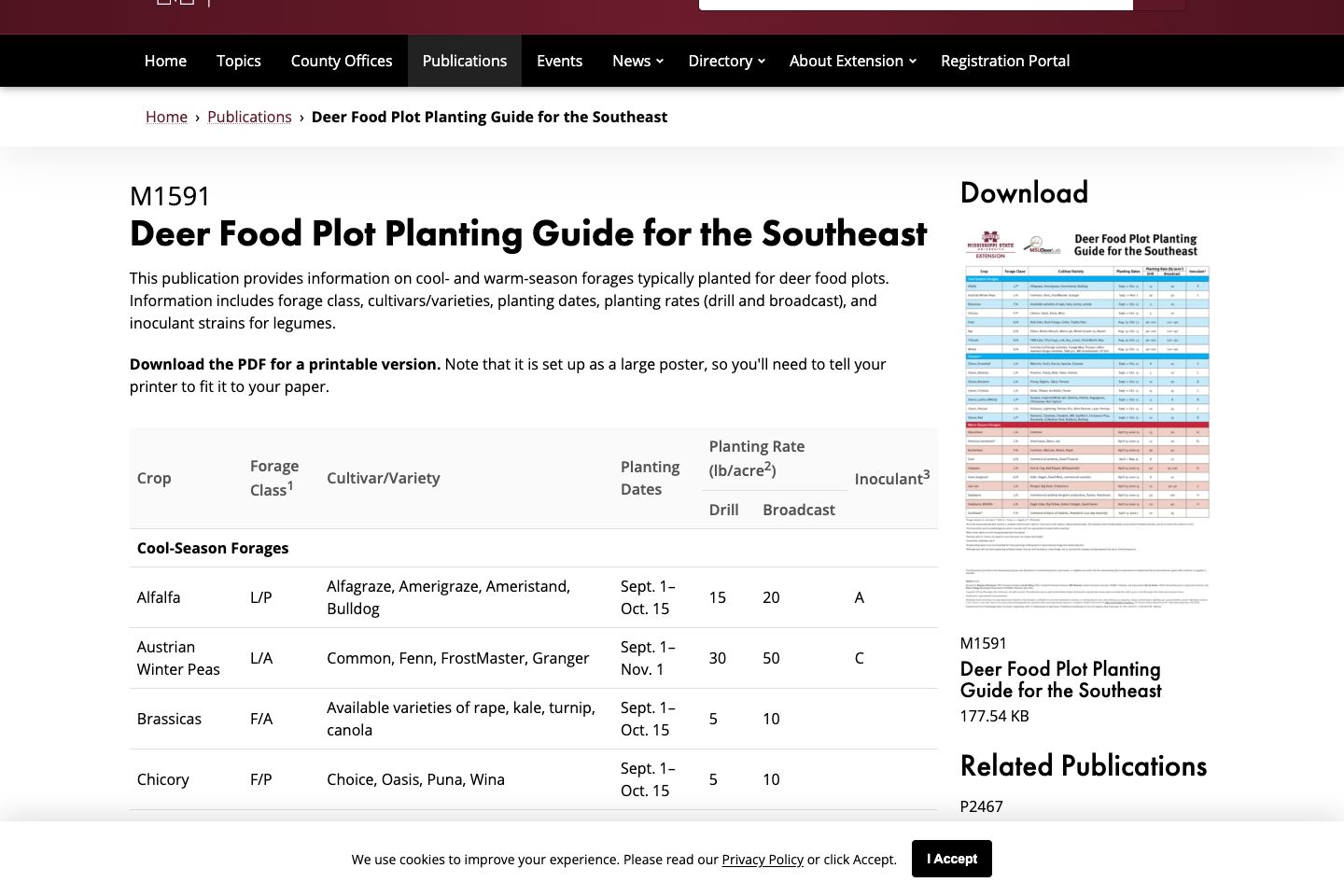
Southern deer managers reach for warm-season legumes when cool-season clover and brassica plots fade. Mississippi State University Extension’s Deer Food Plot Planting Guide for the Southeast places cowpeas (Iron & Clay, Red Ripper, Whippoorwill) in the April 15 to June 15 warm-season window at 50 pounds per acre drilled and 75 to 100 pounds per acre broadcast (MSU Extension). Lab lab (Rongai, Big Buck, Endurance) sits in the same April 15 to June 15 block at 15 pounds per acre drilled and 30 to 40 pounds per acre broadcast (MSU Extension). Both carry the EL/J inoculant-group footnotes that tell managers to buy pre-inoculated legume seed or inoculate with the appropriate inoculant before planting (MSU Extension). The guide states that listed rates assume a complete stand for each species, so managers must reduce rates when mixing; the wheat-and-oats example uses 60 pounds of each instead of full monoculture rates in a 50/50 blend (MSU Extension). Seeding rates for clovers on the same table are based on pure live seed rather than coated weight (MSU Extension). Warm-season neighbors on that table include alyceclover at 15 drilled / 20 broadcast, American jointvetch at 15/20, buckwheat at 30/50, grain sorghum at 8/12 with drilling preferred, wildlife soybeans at 20/40, and sunflower at 10/25 in a slightly shorter April 15 to June 1 window (MSU Extension).
Key Takeaways
- Cowpeas: Apr 15–Jun 15; 50 lb/A drilled; 75–100 lb/A broadcast (MSU Extension).
- Lab lab: Apr 15–Jun 15; 15 lb/A drilled; 30–40 lb/A broadcast (MSU Extension).
- Inoculate or buy pre-inoculated legume seed (EL/J footnotes) (MSU Extension).
- Reduce each species rate when mixing; rates assume complete stands (MSU Extension).
- Named varieties: Iron & Clay/Red Ripper/Whippoorwill; Rongai/Big Buck/Endurance (MSU Extension).
- Forage companions can give cowpeas and lab lab structure to climb (MSU Extension).
Calendar follows soil warmth, not the cool-season clock
Cowpeas and lab lab share the April 15 to June 15 forage block with alyceclover, jointvetch, buckwheat, grain sorghum, and soybeans on the MSU table (MSU Extension). Corn is listed earlier (April 1 to May 15) and sunflower slightly shorter (April 15 to June 1), so managers should not force warm-season legumes into March cool-season clover drills (MSU Extension). Planting inoculated cowpea or lab lab seed into cold soil before that window wastes rhizobia and seed money (MSU Extension). Grain sorghum on the same table carries a footnote that broadcasting is not recommended and that drilling in rows improves forage and seed production, a placement lesson that also applies when you want climbing legumes to find structure (MSU Extension).
Drill versus broadcast rate jumps
Cowpeas jump from 50 pounds drilled to 75-100 broadcast; lab lab jumps from 15 to 30-40 (MSU Extension). Broadcast needs more seed because placement and depth control are poorer than a drill (MSU Extension). Wildlife soybeans on the same table move from 20 drilled to 40 broadcast, and commercial soybeans from 50 to 100, showing the same broadcast premium pattern (MSU Extension). If you blend cowpeas with lab lab or alyceclover, cut each rate using the complete-stand footnote rather than stacking full monoculture rates (MSU Extension).
Inoculation footnotes are operational, not optional
MSU footnotes instruct managers to purchase pre-inoculated legume seed or inoculate with the appropriate inoculant before planting (MSU Extension). Cowpeas and lab lab fail quietly without matching rhizobia when soil lacks the right bacterial group (MSU Extension). Pair that instruction with USDA NRCS guidance that cowpea-group Bradyrhizobium is distinct from clover-group Rhizobium trifolii, so a leftover clover inoculant packet will not rescue a cowpea stand (MSU Extension; USDA NRCS).
Variety picks on the MSU list
Cowpea varieties named are Iron & Clay, Red Ripper, and Whippoorwill; lab lab varieties are Rongai, Big Buck, and Endurance (MSU Extension). Match seed tags to those forage and wildlife classes rather than garden snap beans or random tropical legumes that lack rate data on the deer-plot table (MSU Extension). Neighboring wildlife soybean cultivars on the same guide (Eagle Claw, Big Fellow, Game Changer, Quail Haven) show how MSU separates grain soybeans from browse-oriented wildlife lines (MSU Extension).
Structure for climbing vines
MSU notes that forage can also serve as structure for cowpeas, vining soybeans, or lab lab to climb (MSU Extension). Pairing lab lab with a sturdy warm-season companion keeps vines off the mud and in the browse zone where deer can reach them (MSU Extension). Grain sorghum drilled in rows is one neighbor on the same warm-season table that can provide that architecture when managers want screening plus climbing legumes (MSU Extension).
Mixing math and pure-live-seed footnotes
All planting rates on the MSU table assume a complete stand; the wheat-and-oats broadcast example uses 60 pounds of each for a 50/50 mix instead of full monoculture rates (MSU Extension). Apply the same logic when cowpeas share a bag with lab lab or alyceclover (MSU Extension). Clover seeding rates elsewhere on the guide are based on pure live seed, not coated weight, so coated warm-season legumes also deserve a PLS check before you trust the bag label (MSU Extension).
Southern deer-plot checklist
Hit the April 15 to June 15 window, choose drill versus broadcast rates from the table, inoculate with the correct group, cut rates if you blend species, and give climbing lab lab a structural companion (MSU Extension). Keep alyceclover, jointvetch, and wildlife soybean rates nearby so a multi-species warm-season blend stays intentional rather than accidental overseeding (MSU Extension).
Bottom line
Plant southern cowpeas at 50 drilled / 75-100 broadcast and lab lab at 15 / 30-40 lb/A in the April 15-June 15 window, inoculated, with rates cut when mixed, per MSU Extension (MSU Extension).
The other side of it
Every number here comes from one Mississippi State table built for the Southeast, and those rates assume a full monoculture stand. The guide’s only worked mixing example is wheat and oats, so cutting rates for a cowpea and lab lab blend is still the manager’s judgment call, not a published figure. That’s still a better plan than the guy who empties every half-used bag into one spreader and calls the result a blend.
Keep reading
Latest deer news
Comments