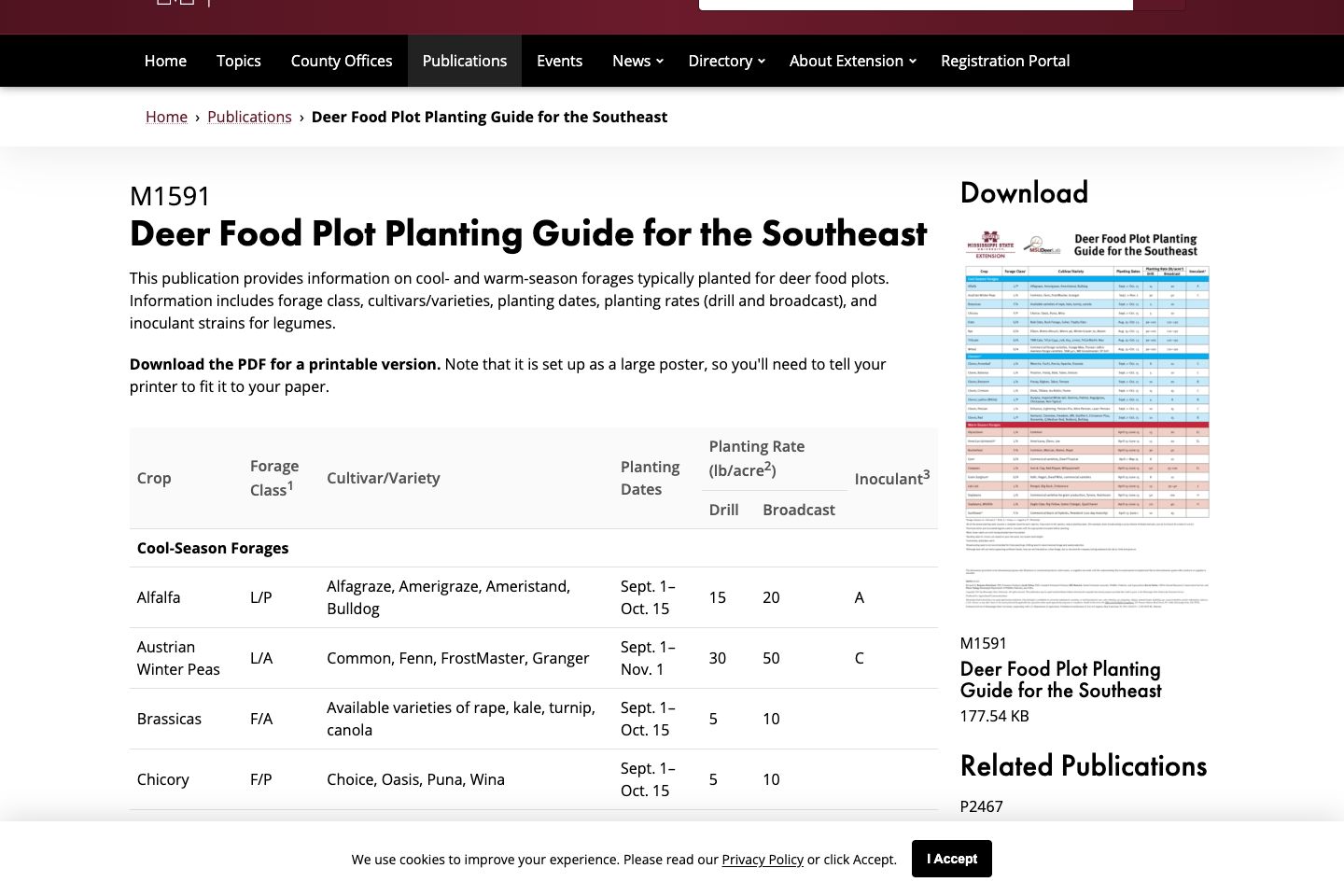
American jointvetch - deer vetch on many bags - is the warm-season reseeding legume Mississippi State University Extension places where deer pressure is high and moist to dry soils both appear. M1591 lists American Jointvetch as L/A annual with Americana, Glenn, and Lee for April 15 through June 15 at 15 lb drilled or 20 lb broadcast, inoculant EL, and footnote 6 notes it is commonly called deer vetch (Mississippi State University Extension). P2111’s Aeschynomene americana profile describes a warm-season annual reseeding legume to about 6 feet tall whose foliage is highly palatable, withstands heavy grazing pressure by deer, and feeds dove, quail, and turkey on seed (MSU Extension P2111). It also warns Aeschynomene can become invasive in moist soil units, waterfowl impoundments, or rice fields (MSU Extension P2111). The niche is high-browse summer forage with eyes open for wet-unit invasiveness (MSU Extension P2111; Mississippi State University Extension).
Key Takeaways
- M1591: Americana, Glenn, Lee; 15/20 lb; Apr 15-Jun 15; inoc EL; aka deer vetch (Mississippi State University Extension).
- P2111: highly palatable; withstands heavy deer grazing; reseeding annual to ~6 ft (MSU Extension P2111).
- Soils: light dry uplands and poorly drained moist soils (MSU Extension P2111).
- pH about 5.0-6.5; cover 1/4-1/2 inch (MSU Extension P2111).
- Companion: alyceclover (MSU Extension P2111).
- Invasive risk in impoundments/rice - site carefully (MSU Extension P2111).
Why it belongs on pressured ground
P2111’s heavy-grazing-pressure language is the deer-manager pitch: foliage stays useful when cowpeas would be deleted (MSU Extension P2111). M1591’s deer-vetch footnote ties the common name to that use (Mississippi State University Extension).
Dual soil story
Unlike lablab’s dry-upland-only niche, jointvetch spans light-textured dry uplands and poorly drained moist soils (MSU Extension P2111). That flexibility is why Americana jointvetch shows up on mixed Southeast properties (MSU Extension P2111; Mississippi State University Extension).
Rates and inoculation
Align on 15 lb drilled or 20 lb broadcast with EL inoculant across M1591 and P2111 (Mississippi State University Extension; MSU Extension P2111). Cover 1/4 to 1/2 inch on a firm seedbed (MSU Extension P2111). Cut rates when mixing with alyceclover under footnote 2 (Mississippi State University Extension).
Invasiveness caution
Do not plant into moist soil units managed for waterfowl, impoundments, or rice where P2111 flags invasive risk (MSU Extension P2111). Upland and typical deer openings are the intended niche (MSU Extension P2111).
Reseeding management
Early spring mowing and disking can enhance reseeding depending on grazing pressure (MSU Extension P2111).
Niche rule
Plant Americana/Glenn/Lee jointvetch at 15/20 lb with EL inoculant for high-browse summer forage across wet-to-dry soils, keep it out of waterfowl impoundments, and pair with alyceclover when a mix is desired (Mississippi State University Extension; MSU Extension P2111).
Fertility after emergence
P2111 applies about 100 lb/ac of 0-20-20 postemergence once the stand is established rather than dumping nitrogen on a fixing legume (MSU Extension P2111). Reapply yearly or as needed in fall to support reseeding stands (MSU Extension P2111).
Herbicide lane
P2111 lists preemergence Pursuit or Prowl and postemergence Select or Poast Plus options for warm-season weeds in jointvetch; verify current labels before any spray (MSU Extension P2111). Grass control protects the browse canopy deer are supposed to find (MSU Extension P2111).
Height and seed users
Stands can reach about 6 feet, with dove, quail, and turkey taking seed while deer focus on foliage (MSU Extension P2111). That dual use fits mixed-species properties that hunt birds and deer on the same openings (MSU Extension P2111).
Bottom line
Use American jointvetch (deer vetch) at M1591’s 15/20 lb rates with EL inoculant for heavy-browse summer forage, and avoid waterfowl impoundments where P2111 warns it can invade (Mississippi State University Extension; MSU Extension P2111).
The other side of it
The catch is baked right into the pitch: the same tolerance for wet ground that makes jointvetch flexible is what lets it invade moist-soil units and impoundments, and a reseeding annual doesn’t always respect the line you drew on the property map. Both sources are Mississippi State guides written with the Southeast in mind. And the fellow who seeds it in the low corner next to the duck hole will swear the deer planted it there.
Keep reading
Latest deer news
Comments