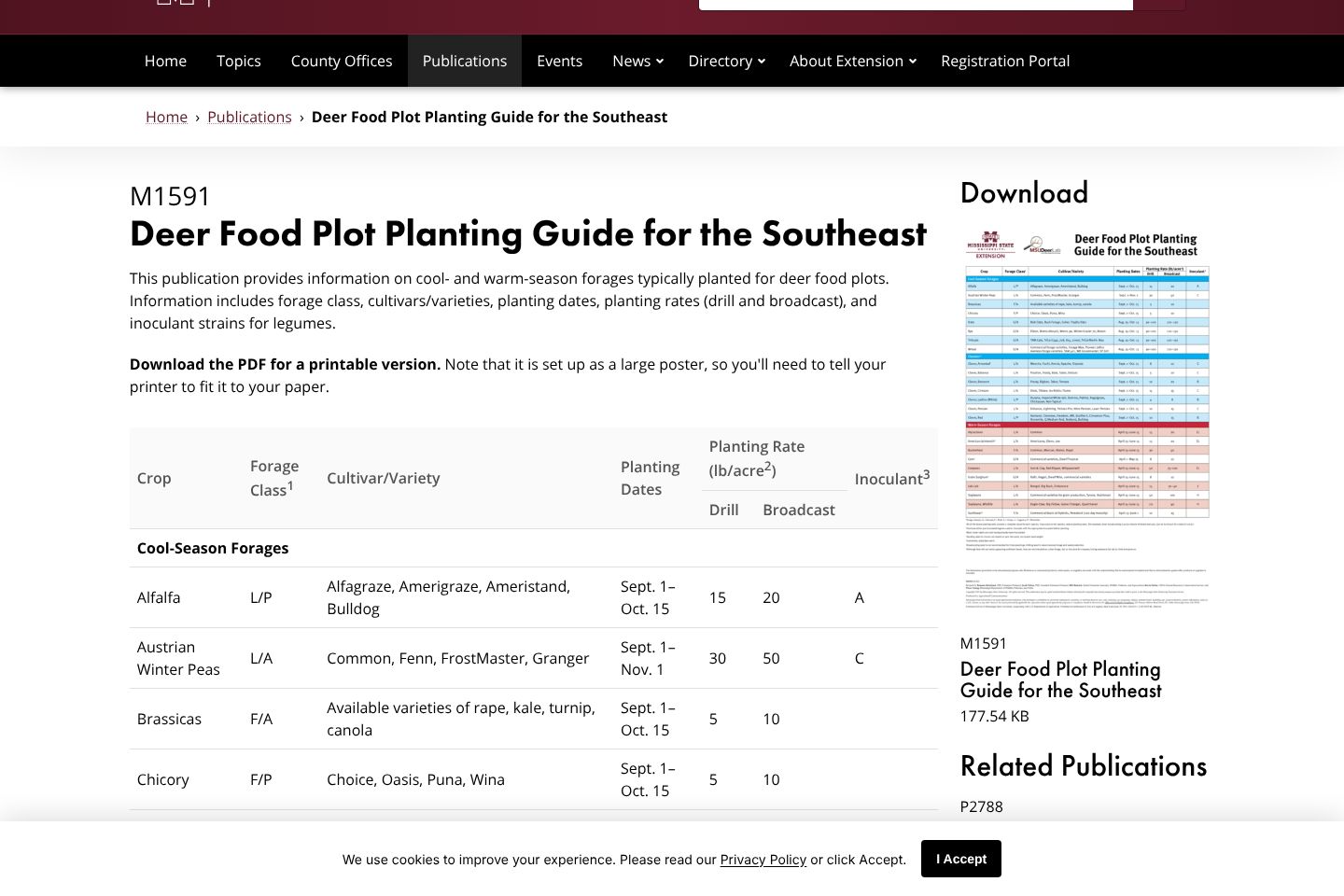
Mississippi State University Extension’s Deer Food Plot Planting Guide (M1591) lists crimson clover as an L/A (legume/annual) cool-season forage with cultivars Dixie, Tibbee, Au-Robin, and Flame, planted Sept. 1-Oct. 15 at 15 lb/acre drilled or 25 lb broadcast on a pure-live-seed basis (Mississippi State University Extension). That 15/25 column is among the heaviest clover rates on the M1591 cool-season block - far above ladino white at 4/8 or balansa at 5/10 (Mississippi State University Extension). A pure crimson stand therefore delivers a one-season annual flush at full rate; the same poster requires cutting every species’ rate when you mix, with a worked grain example of 60 lb wheat plus 60 lb oats instead of full 120-150 lb of either alone (Mississippi State University Extension). Monoculture versus blend is a rate-and-life-cycle choice on that poster, not a preference slogan (Mississippi State University Extension).
Key Takeaways
- Crimson: L/A annual; Dixie, Tibbee, Au-Robin, Flame (Mississippi State University Extension).
- Window: Sept. 1-Oct. 15 (Mississippi State University Extension).
- Pure stand: 15 drilled / 25 broadcast PLS (Mississippi State University Extension).
- Heavier than ladino 4/8 or balansa 5/10 on the same guide (Mississippi State University Extension).
- Footnote 2: reduce each species in mixtures (Mississippi State University Extension).
- Most clover seed sold pre-inoculated; rates are PLS not coated weight (Mississippi State University Extension).
Why crimson rates favor a deliberate monoculture choice
At 15/25 lb PLS, crimson occupies more seed mass per acre than lighter annual clovers on M1591 (Mississippi State University Extension). Running a full crimson column alone matches the guide’s complete-stand assumption for that row (Mississippi State University Extension). If the plot goal is a single-season crimson-dominated flush before spring die-out of the annual class, that full column is the poster path (Mississippi State University Extension).
When blends require cutting crimson hard
Footnote 2 states all listed rates assume a complete stand of each species and that mixed plantings must reduce rates, illustrated with a 50/50 wheat-oat broadcast using 60 lb of each (Mississippi State University Extension). Dropping crimson into a blend without cutting the 15/25 column stacks a heavy annual on companions and fights that footnote (Mississippi State University Extension). Pairing crimson with oats or wheat also means cutting the grain columns (90-100 drilled / 120-150 broadcast) proportionally so nurse grain does not smother the clover (Mississippi State University Extension).
Annual class versus perennial partners
MSU marks crimson L/A, while ladino white and red clovers on the same table are L/P perennials at 4/8 and 10/15 lb (Mississippi State University Extension). A mixed-legume plot that expects summer carry from perennial crowns cannot treat crimson’s annual row as if it were Durana-class ladino (Mississippi State University Extension). Use crimson for the cool-season annual fraction; keep L/P species on their own reduced rates if multi-year crowns are the goal (Mississippi State University Extension).
Inoculant and PLS checks before the drill
Crimson’s inoculant column is C; footnotes say purchase pre-inoculated seed or inoculate before planting, and that most clover seed is already inoculated (Mississippi State University Extension). Seeding rates are pure live seed, not coated bag weight (Mississippi State University Extension). Coated bags need PLS math before you lock a 15 or 25 lb setting (Mississippi State University Extension). Brassicas on the same cool-season slate run only 5/10 lb - another reason not to confuse rate columns when bags sit open on the tailgate (Mississippi State University Extension).
Bottom line
Choose a crimson monoculture only when you want M1591’s full 15/25 lb PLS annual flush on the Sept. 1-Oct. 15 window; in mixed legume or grain blends, cut crimson and companions per footnote 2 instead of stacking complete-stand columns (Mississippi State University Extension).
The other side of it
Everything here comes off one seeding poster, which tells you how much seed to drop but nothing about which plot deer actually eat harder. A heavy seeding rate is a seed-bill fact, not proof of better forage, and someone who has watched a mixed legume plot carry deer long after a crimson stand died out in spring has a fair point. And the guy who dumps a full bag of everything into one hopper and calls it a blend is the reason footnote 2 exists.
Keep reading
Latest deer news
Comments