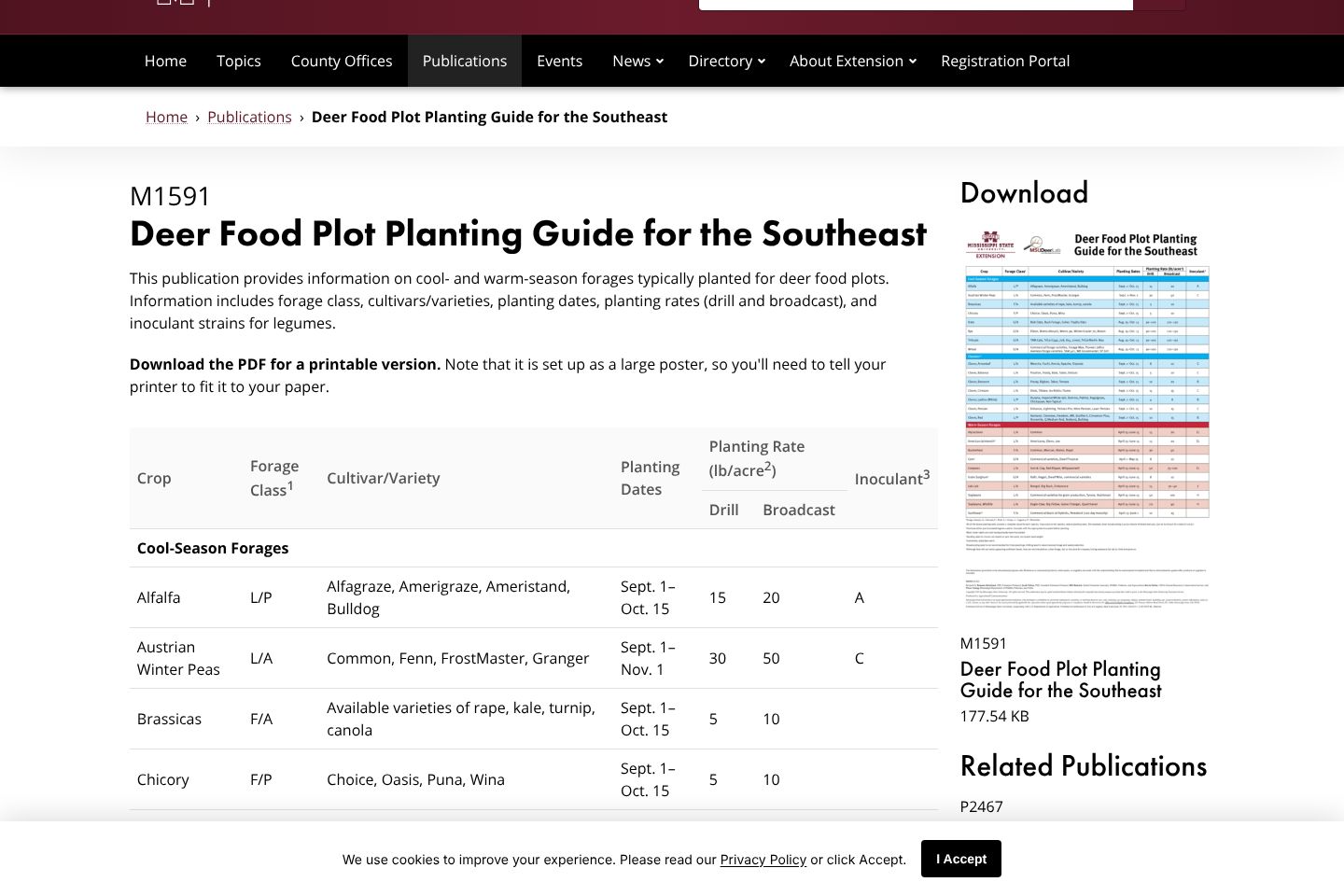
Forage chicory earns a multi-year slot on deer ground only when rest periods protect the taproot. Mississippi State University Extension’s M1591 poster classes chicory F/P (forb perennial), lists Choice, Oasis, Puna, and Wina, and sets 5 lb drilled or 10 lb broadcast for September 1 through October 15 (Mississippi State University Extension). P2111’s forage chicory profile says newly planted plots can produce for about three years, with fall planting, sparse winter leaves, then rapid spring growth until late-summer bloom (MSU Extension P2111). The MSU chicory forage page recommends rotational grazing, 25 to 30 days of rest, and a 2 to 3 inch stubble after each graze (Mississippi State University Extension). Continuous deer use that never leaves that stubble turns a three-year forb into a one-season salad (Mississippi State University Extension; MSU Extension P2111).
Key Takeaways
- M1591: Choice, Oasis, Puna, Wina; 5/10 lb; Sept 1-Oct 15; F/P (Mississippi State University Extension).
- P2111: about 3 years of production from a new planting (MSU Extension P2111).
- Rest 25-30 days; leave 2-3 inch stubble (Mississippi State University Extension).
- Drought-tolerant on well to moderately drained soils; pH 5.5+ (Mississippi State University Extension).
- High N need: 100-150 lb N/ac/yr split across the season if pure chicory (Mississippi State University Extension).
- Mow late spring to cut seed stalks and keep leaf (Mississippi State University Extension).
Three-year clock versus continuous browse
P2111’s three-year production claim assumes a managed stand, not a single kill plot hammered daily (MSU Extension P2111). MSU’s 25-30 day rest and 2-3 inch residual are the persistence levers (Mississippi State University Extension). If deer never leave residual leaf, crown reserves never refill and year-two spring growth collapses (Mississippi State University Extension).
Rates: poster versus P2111
M1591 lists 5/10 lb complete-stand rates for deer plots (Mississippi State University Extension). P2111 lists drill 2 lb / broadcast 4 lb at 1/4 to 1/2 inch, with mixtures at 2 to 3 lb chicory plus about two-thirds of companion rates (MSU Extension P2111). The MSU forage page sits near 3 to 4 lb drilled alone or 2 to 3 lb in mixes (Mississippi State University Extension). Use the deer-poster column for monocultures built to M1591, and cut rates when chicory shares oats or clover (Mississippi State University Extension; MSU Extension P2111).
Nitrogen and acid tolerance
Chicory tolerates acid soils at pH 5.5 or higher but carries a high nitrogen requirement - about 100 to 150 lb N per acre per year split in early spring, early summer, and early fall, never exceeding 200 lb (Mississippi State University Extension). At planting, about 35 lb N helps establishment, or 15 to 20 lb when a nitrogen-fixing legume shares the mix (Mississippi State University Extension). Starving N while expecting a three-year leafy stand is a common failure mode (Mississippi State University Extension).
Seasonal growth pattern
Yield runs March to October with the peak in April and May at roughly 3 to 5 tons per acre (Mississippi State University Extension). Spring-seeded chicory may need 80 to 100 days before first graze (Mississippi State University Extension). Winter leaf is minimal - managers who judge stand life from January bare ground often quit too early (MSU Extension P2111; Mississippi State University Extension).
Mixture logic
MSU suggests including a cool-season legume in chicory mixes for nitrogen fixation (Mississippi State University Extension). P2111 companions include oats, wheat, and clovers (MSU Extension P2111). That legume partner does not remove the need for rotational rest on the chicory fraction (Mississippi State University Extension).
Persistence rule
Budget up to three years only if you leave 2-3 inches, rest 25-30 days, feed N on pure stands, and avoid making chicory the sole green acre under continuous deer use (Mississippi State University Extension; MSU Extension P2111).
Bottom line
Chicory can last near three years on deer ground when 25-30 day rests and a 2-3 inch stubble are real - continuous browse without residual height burns the stand out in a single season (Mississippi State University Extension; MSU Extension P2111).
The other side of it
Those rest periods and stubble heights come from a forage page written around rotational grazing, where a farmer can shut a gate. Deer don’t read gates, and the article never says how a hunter is supposed to give a plot thirty days off without a fence. The real lever is probably more green acres nearby, so the chicory isn’t the only thing on the menu. Naturally, the guy whose stand died in year one blames the seed bag, not the deer he invited to eat it every night.
Keep reading
Latest deer news
Comments