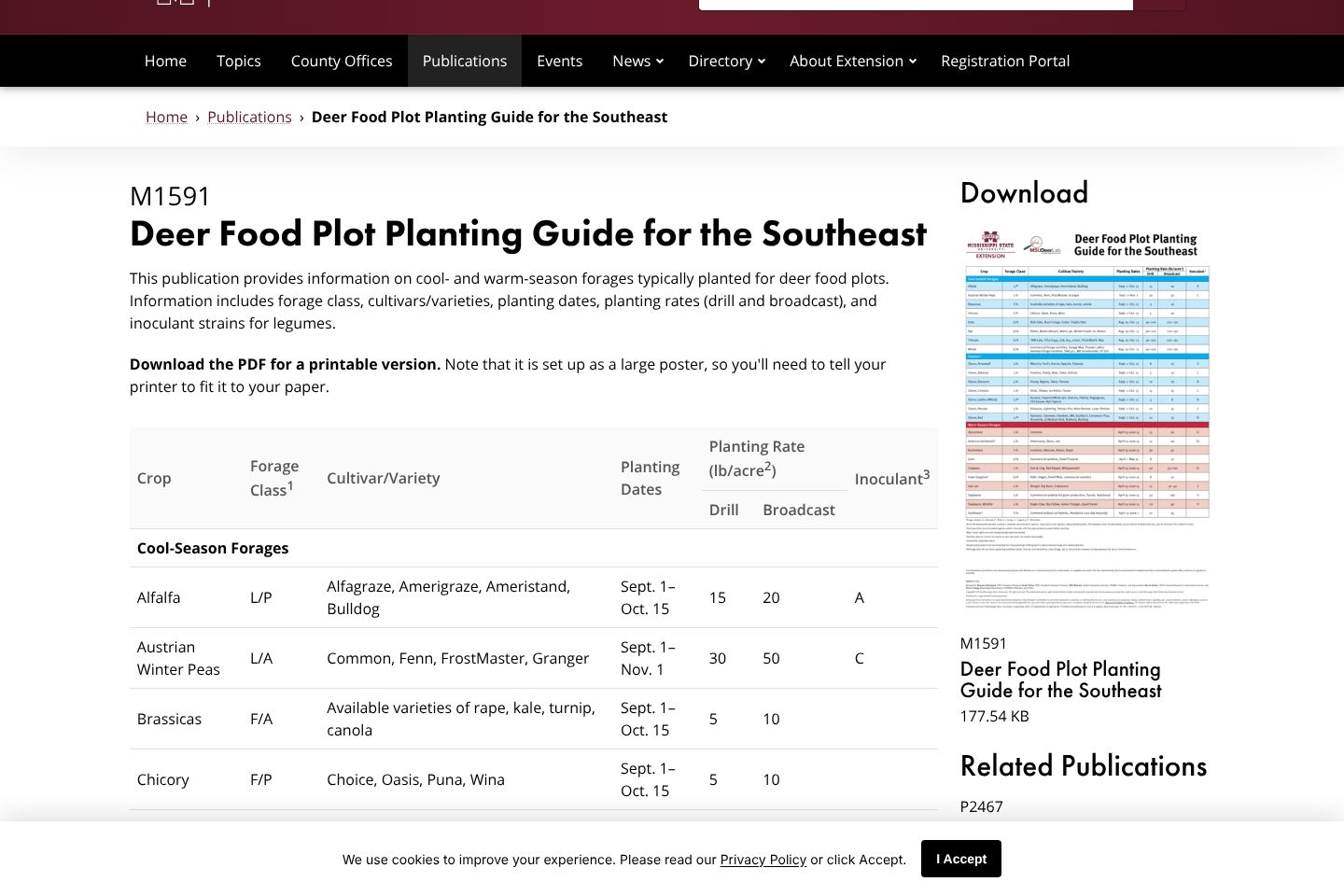
Buckwheat is the short-cycle warm-season cover Mississippi State University Extension uses when a gap between cash crops or season plantings needs green biomass fast. M1591 classes buckwheat F/A annual with Common, Mancan, Manor, and Royal for April 15 through June 15 at 30 lb drilled or 50 lb broadcast (Mississippi State University Extension). P2111 describes a warm-season annual grain that deer, rabbits, and turkeys eat as foliage and that doves, quail, turkeys, and songbirds eat as seed, planted May 1 to June 1 at 40 lb drilled or 60 lb broadcast (MSU Extension P2111). Management notes say it can mature quickly in 65 to 80 days, that high temperatures hurt seed production so early planting is best, and that lodging is common (MSU Extension P2111). Quick cover between plantings is the primary deer-plot job; seed is a bonus if heat cooperates (MSU Extension P2111; Mississippi State University Extension).
Key Takeaways
- M1591: 30 drilled / 50 broadcast; Apr 15-Jun 15 (Mississippi State University Extension).
- P2111: 40/60 lb; May 1-Jun 1; matures 65-80 days (MSU Extension P2111).
- Foliage for deer/rabbits/turkeys; seed for birds (MSU Extension P2111).
- pH 6.0-7.0; cover 1/4-1/2 inch (MSU Extension P2111).
- Early planting beats heat for seed; lodging common (MSU Extension P2111).
- Companions: sunflower, millets, grain sorghum (MSU Extension P2111).
Why the short cycle matters
A 65-80 day crop can occupy May-July then exit before a September cool-season seeding (MSU Extension P2111; Mississippi State University Extension). That bridge is the cash-crop or dual-season logic (MSU Extension P2111).
Rate bands
M1591’s 30/50 lb deer-poster rates sit near P2111’s 40/60 lb wildlife rates (Mississippi State University Extension; MSU Extension P2111). Use the guide matching your objective and still cut mixtures under footnote 2 (Mississippi State University Extension).
Heat and lodging
High temperatures hurt seed; early planting inside the May window is best (MSU Extension P2111). Lodging is common - plan that stems may go down before a perfect seed harvest (MSU Extension P2111). Cover and foliage still pay even when seed is light (MSU Extension P2111).
Fertility
P2111 example: soil test or about 100 lb/ac 0-20-20 and 150 lb/ac 34-0-0 once the stand is established (MSU Extension P2111).
Mixtures
Sunflower, millets, and grain sorghum are listed companions (MSU Extension P2111). Strip plantings keep quick buckwheat cover beside longer sorghum heads (MSU Extension P2111).
Bridge rule
Plant buckwheat at roughly 30-50 lb (M1591) or 40-60 lb (P2111) early in the warm window for 65-80 day green cover between cash or season crops, and treat seed as a heat-sensitive bonus (Mississippi State University Extension; MSU Extension P2111).
No herbicide dependency
P2111 lists no recommended herbicides for buckwheat, so cultural timing and seedbed prep carry more of the weed fight (MSU Extension P2111). Fast canopy is part of that cultural control story when chemistry is limited (MSU Extension P2111).
Variety overlap
M1591 names Common, Mancan, Manor, and Royal; P2111 expands with Japanese, Silverhull, Common Gray, Tokyo, and others (Mississippi State University Extension; MSU Extension P2111). Pick locally available seed inside those lists rather than chasing novelty bags (MSU Extension P2111).
Soil width
P2111 calls buckwheat widely adapted to fertile and infertile soils but best on well-drained sites with pH about 6.0-7.0 (MSU Extension P2111). Poorly drained flats are better alyceclover or jointvetch ground (MSU Extension P2111).
Bottom line
Use buckwheat at M1591’s 30/50 lb rates as a 65-80 day green bridge between plantings - early May seeding beats heat for seed, while foliage and cover still pay if lodging hits (Mississippi State University Extension; MSU Extension P2111).
The other side of it
Buckwheat does its best work from May through July, which is a lovely time to grow deer food and a lousy time to hunt over it. Lodging is common, and with no herbicides listed, a weedy seedbed stays weedy. Some hunters would rather leave that summer gap alone and put the money into the fall planting they’ll actually sit over. But go ahead and call it a cover crop when it’s really a summer trail-cam feeder.
Keep reading
Latest deer news
Comments