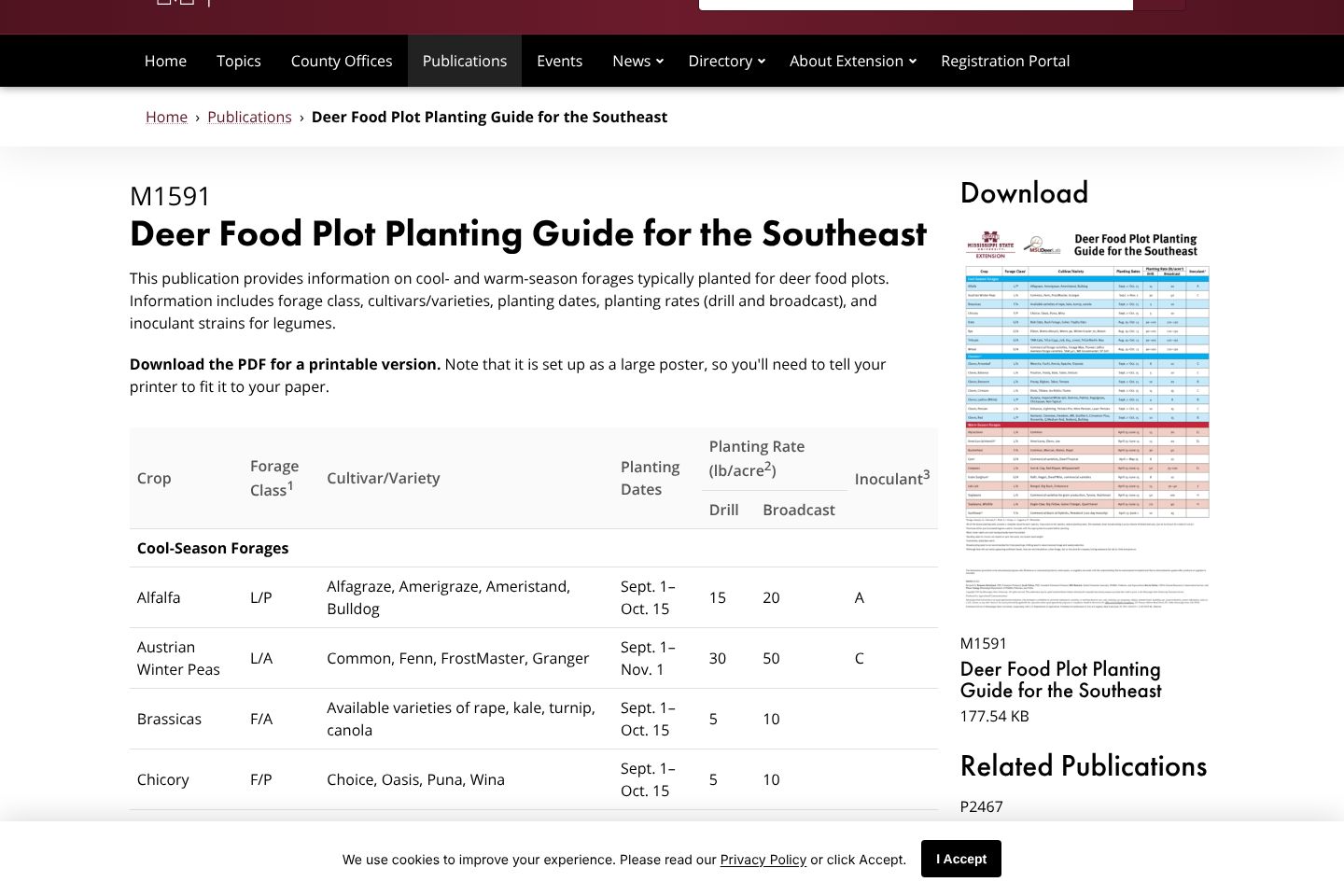
Berseem clover is the short-rotation nitrogen tool on Southeast deer-plot calendars when you need one cool season of forage plus a green-manure flush, not a multi-year crown stand. Mississippi State University Extension’s Deer Food Plot Planting Guide (M1591) classes berseem L/A annual, lists Frosty, Bigbee, Tabor, and Temara, and sets pure-stand rates at 10 lb drilled or 20 lb broadcast for September 1 through October 15 (Mississippi State University Extension). The companion MSU forage profile describes a winter annual that thrives in central and southern Mississippi, tolerates wet alkaline Black Belt soils, and delivers high crude protein with very low bloating potential (Mississippi State University Extension Forages). USDA-NRCS Plant Materials guidance puts vigorous berseem near 100 to 200 pounds of nitrogen per acre and flags it as a wildlife food-plot species attractive to deer (USDA NRCS Plant Guide). That combination - annual class, N credit, and deer attraction - is why berseem fits one-season bailouts better than perennial ladino or red clover when the next warm-season crop must own the acreage (Mississippi State University Extension; USDA NRCS Plant Guide).
Key Takeaways
- M1591: Frosty, Bigbee, Tabor, Temara; 10 drilled / 20 broadcast; Sept 1-Oct 15; L/A (Mississippi State University Extension).
- MSU forage: wet/alkaline Black Belt; Aug 25-Oct 15 window; CP 18-23%; start graze 8-10 in, leave 3 in (Mississippi State University Extension Forages).
- USDA NRCS: about 100-200 lb N/acre under vigorous growth; deer/rabbit food-plot use (USDA NRCS Plant Guide).
- Low-growing-point cultivars such as Big Bee and Frosty handle closer harvest better (USDA NRCS Plant Guide).
- Cut mixture rates per M1591 footnote 2; inoculate (strain B on the poster) (Mississippi State University Extension).
- Plan the warm-season exit - berseem is annual, not a crown perennial (Mississippi State University Extension).
Why berseem is the bailout species
USDA-NRCS summarizes berseem as an outstanding nitrogen source producing around 100 to 200 lb N per acre with biomass that can exceed 6,000 lb per acre under vigorous conditions (USDA NRCS Plant Guide). That N flush is the bailout: after a failed perennial clover or a bare cool-season window, one berseem season rebuilds fertility while feeding deer (USDA NRCS Plant Guide). MSU’s deer poster keeps the crop inside the same Sept 1-Oct 15 cool-season band as other clovers, so you do not invent a separate calendar (Mississippi State University Extension). Because the forage class is annual, you can till or chemically terminate and move to cowpeas, soybeans, or sorghum without fighting living crowns (Mississippi State University Extension; USDA NRCS Plant Guide).
Rates that match the poster and the forage page
M1591 assumes a complete stand at 10 lb drilled or 20 lb broadcast on a pure-live-seed basis for clovers (Mississippi State University Extension). The MSU berseem forage page aligns closely: drill 10 to 15 lb or broadcast 20 lb from late August into mid-October, and drop to about 12 lb when berseem shares a cool-season grass mix (Mississippi State University Extension Forages). USDA-NRCS lists a similar drill band of 8 to 14 lb and broadcast 15 to 25 lb at roughly 1/4 inch (USDA NRCS Plant Guide). If the plot is a 50/50 berseem-oat nurse, cut both species using M1591 footnote 2 instead of stacking full columns (Mississippi State University Extension).
Wet soils and Black Belt niches
MSU notes berseem grows well on wet and alkaline Black Belt soils where many Mid-South plots sit (Mississippi State University Extension Forages). USDA-NRCS adds that berseem performed better than crimson clover under wet soil conditions in 2020 trials at the Booneville, Arkansas Plant Materials Center (USDA NRCS Plant Guide). That is the rotation cue: choose berseem when drainage is marginal and you still need a one-season N and forage hit (USDA NRCS Plant Guide; Mississippi State University Extension Forages).
Grazing window and cultivar picks
MSU describes a short grazing season from November into December and again from March into June, with first-cut yields near 2 to 2.5 tons per acre under good conditions (Mississippi State University Extension Forages). Start grazing at 8 to 10 inches and leave a 3-inch stubble; rotational grazing is preferred (Mississippi State University Extension Forages). USDA-NRCS recommends low-growing-point cultivars such as Big Bee, Frosty, or Multcut so close harvest does not destroy the stand mid-season (USDA NRCS Plant Guide). Bigbee and Tibbee appear on the MSU forage cultivar line; Frosty and Bigbee also sit on the M1591 deer list (Mississippi State University Extension Forages; Mississippi State University Extension).
Fertility and inoculation without N waste
MSU wants pH above 6 and high phosphorus, potassium, and boron attention for berseem (Mississippi State University Extension Forages). USDA-NRCS notes that applying nitrogen fertilizer restricts fixation, so the bailout works best when you skip N and let rhizobia deliver the credit (USDA NRCS Plant Guide). M1591 footnote 3 and the inoculant B column still require pre-inoculated seed or a fresh strain before planting (Mississippi State University Extension).
Rotation exit checklist
Confirm annual L/A class on M1591, lock 10/20 lb PLS or the cut mixture rate, pick Bigbee or Frosty for harvest tolerance, inoculate, plant inside the Sept window, graze with a 3-inch floor, then terminate for the warm-season crop once the N flush and deer use are spent (Mississippi State University Extension; Mississippi State University Extension Forages; USDA NRCS Plant Guide).
Bottom line
Use berseem at M1591’s 10/20 lb PLS rates as a one-season nitrogen and forage bailout - especially on wet Mid-South soils - then exit to warm-season plantings because the stand will not return as a perennial crown (Mississippi State University Extension; USDA NRCS Plant Guide).
The other side of it
The 100-to-200-pound nitrogen credit comes with the words vigorous growth attached, and a plot that needs bailing out is rarely vigorous ground. Berseem also wants pH above 6 plus phosphorus, potassium and boron, which is the very fertility a failed plot tends to lack. Its grazing season has a gap after December too, so deep-winter forage may be thin. Funny how a nitrogen bailout always sounds cheaper than a soil test.
Keep reading
Latest deer news
Comments