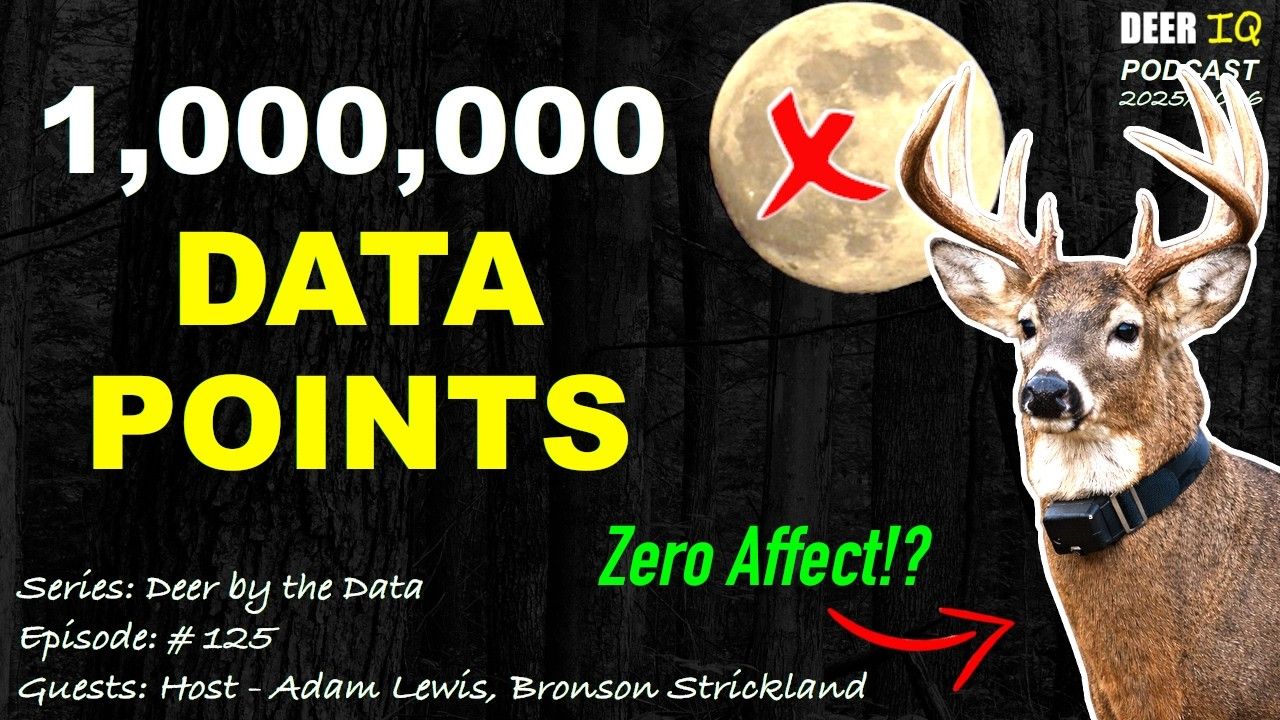
DEER IQ’s data series episode with Dr. Bronson Strickland puts moon-phase hunting lore against GPS-collar evidence from Mississippi State University Extension’s Lunar Legends study (DEER IQ / Play Podcasts episode notes; MSU Lunar Legends publication; MSU Lunar Legends PDF). The study tracked 48 bucks every 15 minutes across two Septembers-through-Februaries in central Mississippi and found no meaningful moon-phase or moon-position effect on daylight movement or bedding once rut and other factors were accounted for (MSU Lunar Legends PDF).
Key Takeaways
- 48 GPS-collared bucks, locations every 15 minutes, Sept-Feb across two years (MSU Lunar Legends).
- Moon phase alone did not change buck activity day or night in the analysis (MSU Lunar Legends PDF).
- Moon position and popular calendar combinations likewise showed no meaningful activity change (MSU Lunar Legends PDF).
- Rut increased travel by over 100 yards per hour with about 10% less daylight bedding - far larger than any moon blip (MSU Lunar Legends PDF).
- Plan hunts around season timing, weather you can feel, and access - not lunar stickers.
What DEER IQ is doing
The episode invites Strickland to walk through the collar study so hunters can hear the methods, not only a slogan (DEER IQ episode notes). RAD’s job is to point you at the Extension publication those claims rest on.
Study design in plain English
Researchers compared each buck to his own baseline so individual personality and rut pulses did not fake a moon signal (MSU Lunar Legends). They measured bedding percentage and yards moved per hour - the things that decide whether a hunter sees a deer.
Results hunters argue about
No effect from full/new/in-between phases. No effect from overhead/underfoot/rising/setting or apogee/perigee frames tested. Combinations from popular hunting calendars did not outperform usual activity. Dawn and dusk remained high-movement windows without needing a lunar excuse (MSU Lunar Legends PDF). A possible few-minutes bedding shift around moonrise/set is called out as trivial next to rut effects.
Deer University echo
MSU’s own Deer University podcast has covered the same lunar analysis with the lab team, reinforcing that hunter belief surveys and GPS results do not match (Deer University lunar episode node). When creators and labs agree, camp lore should move.
Practical calendar after the moon dies
Mark rut timing for your region. Watch wind and temperature swings you can measure. Protect virgin stand sites for high-odds days. Ignore phone widgets that sell “major feeding times” without methods.
Bottom line
DEER IQ’s million-data-point moon episode tracks with MSU Extension’s Lunar Legends finding: moon phase and position are not useful buck-movement predictors compared with the rut (DEER IQ episode notes; MSU Lunar Legends PDF).
Million points, plain meaning
Fifteen-minute fixes across months produce enormous tables. The headline “million data points” is marketing-friendly math on a real collar archive - still read the PDF methods before you trash your moon app in a group text (MSU Lunar Legends PDF; DEER IQ episode notes).
What the study deliberately removed
Rut pulses and firearm opener shocks can swamp any environmental signal. Comparing each buck to himself isolates moon claims from those shocks (MSU Lunar Legends). If a calendar product does not control for rut, it is not testing the same question.
Hunter belief versus collar truth
Deer University episodes note hunters still expect moon effects even after data releases (Deer University lunar episode). That gap is why DEER IQ keeps returning to the topic. Belief is sticky; GPS is not impressed.
Replacement planning stack
- Season dates. 2) Cold front and wind forecasts you understand. 3) Pressure maps of your public tract. 4) Food changes after harvest. 5) Moon sticker optional and ignored.
Edge cases people raise
“What about solunar major times at my latitude?” The MSU tests covered phase, position, and common combinations on Mississippi bucks - not every folklore variant on earth - but they undercut the core claim that lunar calendars predict visibility (MSU Lunar Legends PDF). If someone has peer-reviewed counter-data, read it; do not accept a screenshot.
Bottom-line for IQ listeners
Listen to Strickland on DEER IQ, then hunt the rut and the wind. Leave the moon to tides and werewolves (DEER IQ episode notes; MSU Lunar Legends PDF).
How to cite this without starting a flame war
Say: “MSU Extension collared 48 bucks and tested moon phase and position; they did not find useful movement predictors compared with the rut (MSU Lunar Legends PDF). DEER IQ interviewed Strickland on that dataset (DEER IQ episode notes).” Then ask the moon advocate for a methods section.
Night versus day nuance
The PDF notes phase effects failed in daylight and at night in their framing of activity metrics (MSU Lunar Legends PDF). That undercuts the “they move all night on a full moon so they bed all day” slogan as a planning rule for Mississippi bucks in the study.
Action checklist for the next cold front
Ignore moon widgets. Check wind. Check temperature drop. Check whether your stand has been burned. Pack layers. That list will outperform lunar majors on public land more often than your uncle admits (MSU Lunar Legends).
Field test you can run without GPS collars
For one season, ignore moon apps entirely. Log sit date, wind, temperature trend, rut phase estimate, and deer seen. Compare hit-rate to last year when you followed majors/minors. Most hunters who do this quietly stop paying for lunar features (MSU Lunar Legends PDF).
The other side of it
Forty-eight bucks in central Mississippi is a solid dataset, but it’s one region, and the article itself admits the tests didn’t cover every folklore variant or latitude. A northern hunter who sees different rut timing on his ground has a fair reason to want his own data before calling the question closed, and the study did flag a small bedding shift around moonrise and moonset, trivial or not. Still, ‘I saw a buck on a full moon once’ is not a methods section.
Sources
- 1 Million Data Points - The Moon's Affect on Buck Movement - Analyzing 1 Million Data Points w/guest Dr. Bronson Strickland | Series: Deer by the Data; IQ-5 — Deer IQ — Play Podcasts
- Lunar Legends: Does the Moon Influence Buck Activity? | Mississippi State University Extension Service
- Lunar Legends:
- Lunar Table Fables - Does the Moon Affect Buck Activity? | Deer University #401 | Natural Resources University
- The Moon's Affect on Buck Movement - Analyzing 1 Million Data Points Gives the Answer - YouTube
Comments