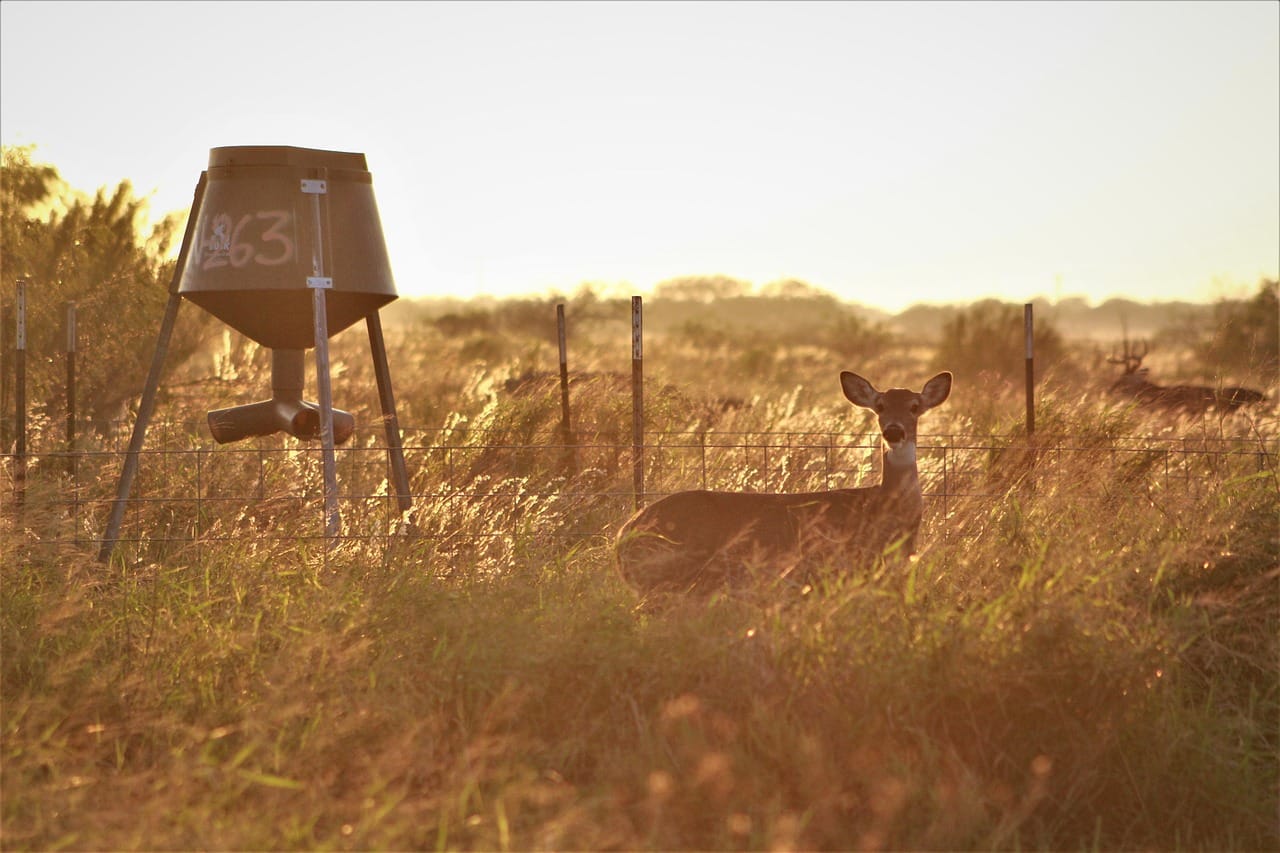
What is the best deer feeder? There is no single winner, because the right feeder depends on what you put in it and why. Researchers and land managers in Texas split feeders into a few types: spin (sling) feeders built to throw corn, gravity or free-choice feeders for protein pellets, and enclosed timed feeders with troughs. Before you buy any of them, check whether feeding deer is even legal where you hunt. In many places it is not.
Key Takeaways
- Spin or sling feeders are built for corn and may clog with other feeds, per Texas A&M’s Natural Resources Institute.
- Gravity and free-choice feeders are recommended for protein pellets.
- In one Texas A&M-Kingsville test, an enclosed, timed feeder with troughs was the most efficient way to deliver protein pellets.
- Corn attracts deer but is low in protein. Feed type matters as much as feeder type.
- Feeding is restricted or banned in many areas, often because of chronic wasting disease (CWD).
Feeder types: what is the best deer feeder for your feed?
Spin or sling feeders. Texas A&M Natural Resources Institute described the slinging corn feeder as designed “to sling corn out in a 30-40 foot radius at set times each day.” Directional sling feeders throw feed one way instead of in a circle. The institute warns that both types “were designed to broadcast corn and may get clogged if they are filled with other types of feed” (Texas A&M NRI).
Gravity and free-choice feeders. The same source says “Free choice and gravity fed feeders are best to use if you want to feed supplemental protein pellets.” A Texas Parks and Wildlife Department bulletin from 1991 calls the free-choice feeder “the most desirable but also the most expensive to maintain” for pellets (TPWD). It also notes that with automatic feeders, “a pellet 3/16 inch in size is normally necessary to eliminate the jamming of the feeder mechanism.”
Timed trough feeders. Edward L. Kozicky of the Caesar Kleberg Wildlife Research Institute at Texas A&M University-Kingsville tested delivery systems. He found “The most effective feed-delivery system I tested for supplemental feeding of protein pellets” was “an enclosed, controlled-time feeder with troughs” (CKWRI). His reasons: troughs reduce “ground contamination of pellets,” and enclosed timed feeders cut weather exposure “from 24 hours to 4 hours or less.” He estimated a controlled-time feeder “to be in the range of 90-95% efficient in delivering feed to deer, whereas free-choice feeders appeared to be less efficient.”
He also noted the trade-off: “Controlled-time feeders are more expensive,” but “Over a period of years, the cost of the feed, along with trips to inspect and resupply the feeder, becomes the major expense, not the feeder.”
Fencing out other animals. Kozicky wrote that “Deer will abandon a feeder to avoid feral pigs and javelinas,” and that “An exclosure around the feeder is needed to deter nontarget animals.” See feral hogs at deer bait sites.
Feed matters more than the feeder
TPWD’s bulletin calls corn “one of the poorest types of deer feed available” and says it is “low in protein (approximately seven to ten percent) and high in carbohydrates.” Texas A&M AgriLife wildlife specialist Ken Cearley says that for true supplementation, “A level of 16-20 percent crude protein in the deer diet supplement is generally considered best.” If you only want to draw deer in, “shelled corn will probably fill the bill” (AgriLife Extension).
Cearley also warns that “once started, you may become locked-in to a feeding program forever.” For the nutrition side, see protein requirements by season and why sudden feed changes kill deer.
What a feeder will and won’t show you
If you hunt over a feeder where it’s legal, know who uses it. A University of Georgia camera study, reported by the National Deer Association, found a hunter over corn feeders “would have been three times more likely to see a doe or yearling buck during legal hours than an adult buck during the pre-rut through the end of October.” The same report says “Adult bucks primarily used the feeders at night in all seasons” (National Deer Association).
Check the law first
Feeding is banned outright in large parts of some states. Wisconsin’s DNR says “There are 59 counties where deer baiting and feeding is prohibited” (Wisconsin DNR). Where hunting over bait is allowed there, Wisconsin bars bait “contained in or deposited by a feeder that is designed to deposit or replenish feed automatically, mechanically or by gravity” (Wisconsin DNR deer regulations). For other states, see deer baiting laws by state.
The National Deer Association’s Kip Adams writes that baiting and feeding mean “greatly enhancing the opportunity for disease transmission,” and that NDA “does not support supplemental feeding in known CWD and bovine TB areas” (NDA). See also supplemental feeding disease risk.
FAQ
What is the best deer feeder for corn? A spin or sling feeder, which Texas A&M NRI says was designed to broadcast corn.
What is the best deer feeder for protein pellets? Gravity or free-choice feeders are recommended. In Kozicky’s test, a timed, enclosed trough feeder was most efficient.
Can I use a gravity feeder to hunt over bait? Not in Wisconsin. Check your state’s rules.
Are deer feeders legal everywhere? No. Wisconsin bans feeding in 59 counties. Rules vary by state and can change mid-season.
The other side of it
A common counterargument is that the best deer feeder is no feeder: good habitat feeds deer without concentrating them at one spot. Cearley calls managing the habitat “the most gratifying and cost-effective way to provide for a deer herd’s dietary needs.” And the hunter who fills a spin feeder every Friday then wonders why his big buck only shows up on camera at 2 a.m. has built a very expensive night-vision doe buffet.
Keep reading
Texas's biggest bucks in the record book →
Latest deer news
Sources
- Leopold Live! Chapter 2: Food Stations Recap, Texas A&M Natural Resources Institute (Sept. 13, 2021)
- Supplemental Feeding, Texas Parks and Wildlife Department (J.R. Perkins, 1991)
- A Protein Pellet Feed-Delivery System for White-tailed Deer, Caesar Kleberg Wildlife Research Institute, Texas A&M University-Kingsville (Edward L. Kozicky)
- Feeding Deer: Supplementing or Baiting?, Texas A&M AgriLife Extension (Ken Cearley)
- Which Deer Visit Feeders and When? Research Results May Surprise You, National Deer Association (Lindsay Thomas Jr., Sept. 11, 2019)
- Baiting and feeding regulations, Wisconsin Department of Natural Resources
- Deer Hunting Regulations, Wisconsin Department of Natural Resources
- Can Baiting and Feeding Really Spread Deer Diseases Faster?, National Deer Association (Kip Adams, Aug. 9, 2023)
Comments