Can felons get a hunting license? Of the five states we checked, only Maine’s rules restrict the license itself, and only the firearms license. The license is the easy part. The hard part is the weapon. Federal law bars anyone convicted of a crime punishable by more than a year in prison from possessing a firearm, and Wisconsin puts it plainly: “A hunting license does not authorize a felon to possess a firearm for hunting” (Wisconsin DNR). Verified November 2026 for the 2026-27 season, covering federal law and Florida, Wisconsin, Maine, Kentucky and Texas only. This is general information, not legal advice.
Key Takeaways
- Federal law makes it unlawful for a person “who has been convicted in any court of, a crime punishable by imprisonment for a term exceeding one year” to possess firearms or ammunition (18 U.S.C. 922).
- A federal court in Texas says a felon “is not prohibited from hunting consistent with state regulations” (U.S. Probation, E.D. Tex.).
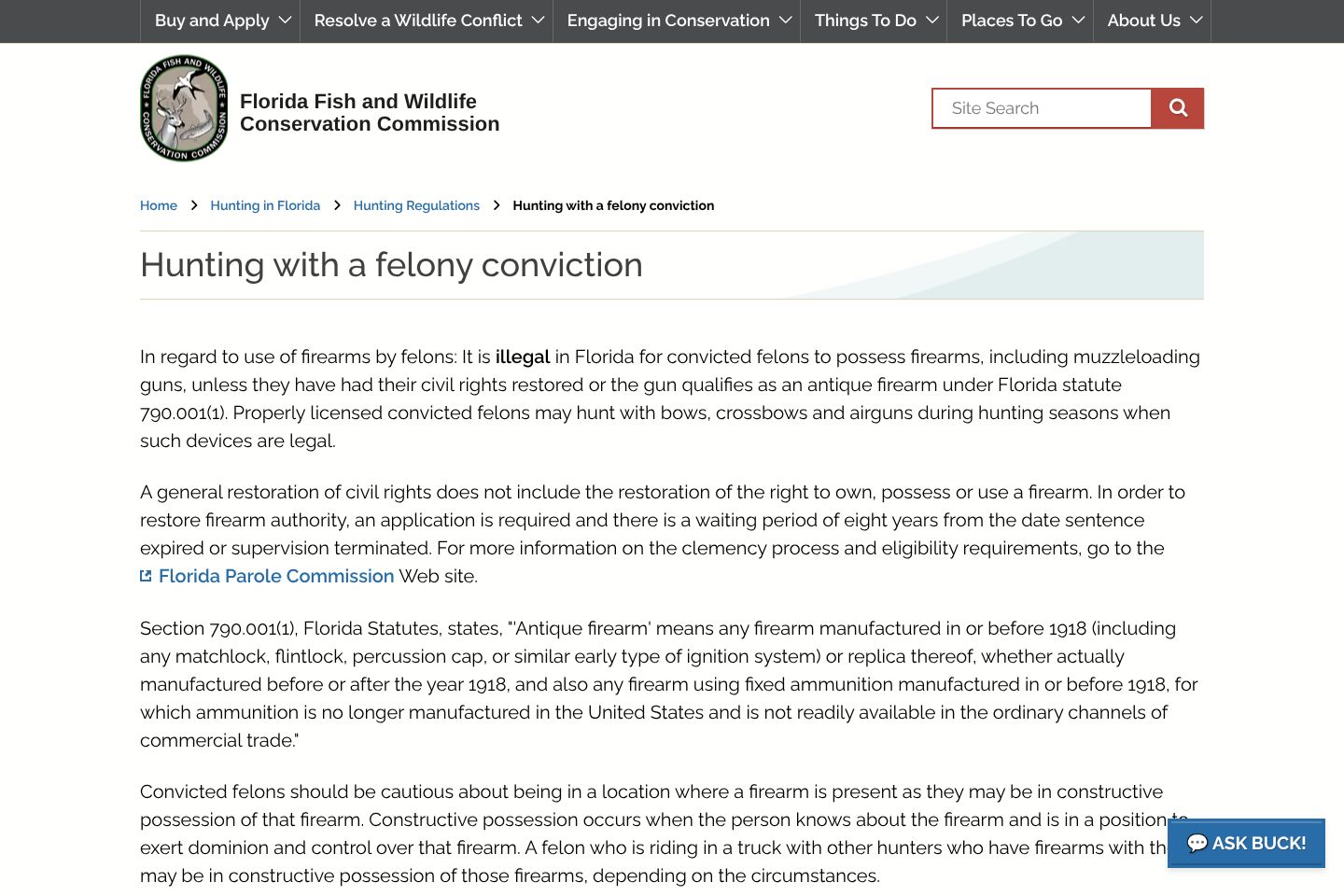
- Bows and crossbows are the usual legal path. Florida says properly licensed convicted felons “may hunt with bows, crossbows and airguns.”
- Muzzleloaders are where states split. Kentucky treats them as firearms. Florida and Texas allow only narrow antique or replica exceptions.
- Maine is the clear license exception: felons “cannot purchase or possess a firearms hunting license” unless they hold a permit to carry.
Can felons get a hunting license under federal law?
Federal law doesn’t regulate hunting licenses. States issue those. What federal law controls is the gun. Under 18 U.S.C. 922(g), it is unlawful for a person “who has been convicted in any court of, a crime punishable by imprisonment for a term exceeding one year” to possess a firearm or ammunition (18 U.S.C. 922, GovInfo).
The U.S. Probation Office for the Eastern District of Texas answers the hunting question directly. A person convicted of a federal felony is barred from firearms under 922(g)(1), “but is not prohibited from hunting consistent with state regulations.” Its FAQ adds that, if supervision conditions don’t forbid a dangerous weapon, “felons may hunt with bows and/or black powder rifles” (E.D. Tex. Probation FAQ). That is one federal office’s guidance. State law can be stricter, as Kentucky shows below.
Does a restored right or pardon change it?
It can. Federal law says a conviction “which has been expunged, or set aside or for which a person has been pardoned or has had civil rights restored shall not be considered a conviction” for firearms purposes, unless the pardon or restoration “expressly provides that the person may not ship, transport, possess, or receive firearms” (18 U.S.C. 921, GovInfo).
States read restoration narrowly. Florida warns that “A general restoration of civil rights does not include the restoration of the right to own, possess or use a firearm.” Restoring firearm authority there takes a separate application and “a waiting period of eight years from the date sentence expired or supervision terminated” (FWC).
Can a felon hunt with a muzzleloader?
Under federal law, the definition of “firearm” says: “Such term does not include an antique firearm.” An antique includes a replica of a pre-1899 design that “is not designed or redesigned for using rimfire or conventional centerfire fixed ammunition.” The exception does not cover “any muzzle loading weapon which can be readily converted to fire fixed ammunition by replacing the barrel, bolt, breechblock, or any combination thereof” (18 U.S.C. 921, GovInfo).
State law is a separate test, and the states don’t agree:
| State | Muzzleloader rule for felons (official source) |
|---|---|
| Kentucky | “Breech and muzzle-loading rifles, shotguns and handguns are all considered firearms.” |
| Florida | Illegal “including muzzleloading guns,” unless rights are restored or the gun is an antique under Fla. Stat. 790.001(1). |
| Texas | Allowed only for an antique or curio made before 1899, or a replica “that does not use rimfire or centerfire ammunition.” |
Can a felon hunt with a bow or crossbow?
In the states we checked, generally yes. Florida: “Convicted felons, as well as any hunter, may use a bow, crossbow or airguns during hunting seasons where allowed” (FWC). Texas counts “compound bows, crossbows, longbows, and recurved bows” as lawful archery equipment (TPWD). See Florida’s crossbow deer hunting rules and Kentucky’s archery equipment rules, and our crossbow vs bow hunting guide if you’re choosing gear.
Which states limit the license itself?
Maine does. Its wildlife agency says: “Convicted felons cannot purchase or possess a firearms hunting license in Maine unless they have been issued a permit to carry a firearm” (MDIFW). State law makes such a person “ineligible to obtain or possess any license or permit issued by the department that authorizes a person to hunt with a firearm” (12 M.R.S. 11103). An archery license is separate. MDIFW says it “allows a person to hunt with a bow and arrow or crossbow.” See Maine deer hunting license costs and requirements.
Wisconsin bars felons from hunting with firearms but frames it as a weapons rule, not a license ban. It is illegal to “Possess or use any firearm for hunting if you are a felon or have been prohibited from possessing a firearm under Wisconsin law” (Wisconsin DNR). See the Wisconsin license guide.
Can a felon get a hunting license in Texas?
TPWD treats it as a weapons question. Its means-and-methods page says it is unlawful to “possess a firearm if a convicted felon, with limited exception,” and points to Texas Penal Code Ch. 46 (TPWD). The federal probation office’s summary of Penal Code 46.04 says a felon can’t possess a firearm until “the fifth anniversary” of release from confinement or supervision, and after that “you can not possess a firearm other than at the premises at which you live.” It calls a violation “a third degree felony punishable up to 10 years imprisonment” (E.D. Tex. Probation FAQ). A deer lease isn’t where you live. For license types, see our Texas deer hunting license guide.
What about riding with hunters who have guns?
Be careful. Florida warns that “A felon who is riding in a truck with other hunters who have firearms with them may be in constructive possession of those firearms, depending on the circumstances.” It defines constructive possession as when “the person knows about the firearm and is in a position to exert dominion and control over that firearm” (FWC). Florida also says, “Hunters who are on probation, should consult with their probation officer before hunting.”
The other side of it
We checked federal law and five states, and the rest set their own rules. Felony definitions, restoration rules and muzzleloader exceptions vary, and probation conditions can forbid things state hunting law allows. Kentucky tells hunters who need clarification to “contact the county or commonwealth attorney in your county of residence” (KDFWR). Before the season, get an answer in writing from your state agency or a lawyer, and from your probation officer if you’re supervised. “It’s only a muzzleloader” has never been a legal defense in Kentucky, and it sounds even worse in front of a judge.
Keep reading
Florida's biggest bucks in the record book →
Latest deer news
Sources
- 18 U.S.C. 922, Unlawful acts, U.S. Government Publishing Office (GovInfo)
- 18 U.S.C. 921, Definitions, U.S. Government Publishing Office (GovInfo)
- FAQs | U.S. Probation and Pretrial Services, Eastern District of Texas, U.S. Probation Office, Eastern District of Texas
- Hunting with a felony conviction, Florida Fish and Wildlife Conservation Commission
- Weapons and Ammunition | General Hunting Regulations, Wisconsin Department of Natural Resources
- Hunting License Information, Maine Department of Inland Fisheries and Wildlife
- Title 12, 11103: Prohibition for convicted felons, domestic violence offenders and certain nonviolent juvenile offenders, Maine Legislature
- General Information | Kentucky Department of Fish and Wildlife Resources, Kentucky Department of Fish and Wildlife Resources
- Hunting Means and Methods, Texas Parks and Wildlife Department
Comments