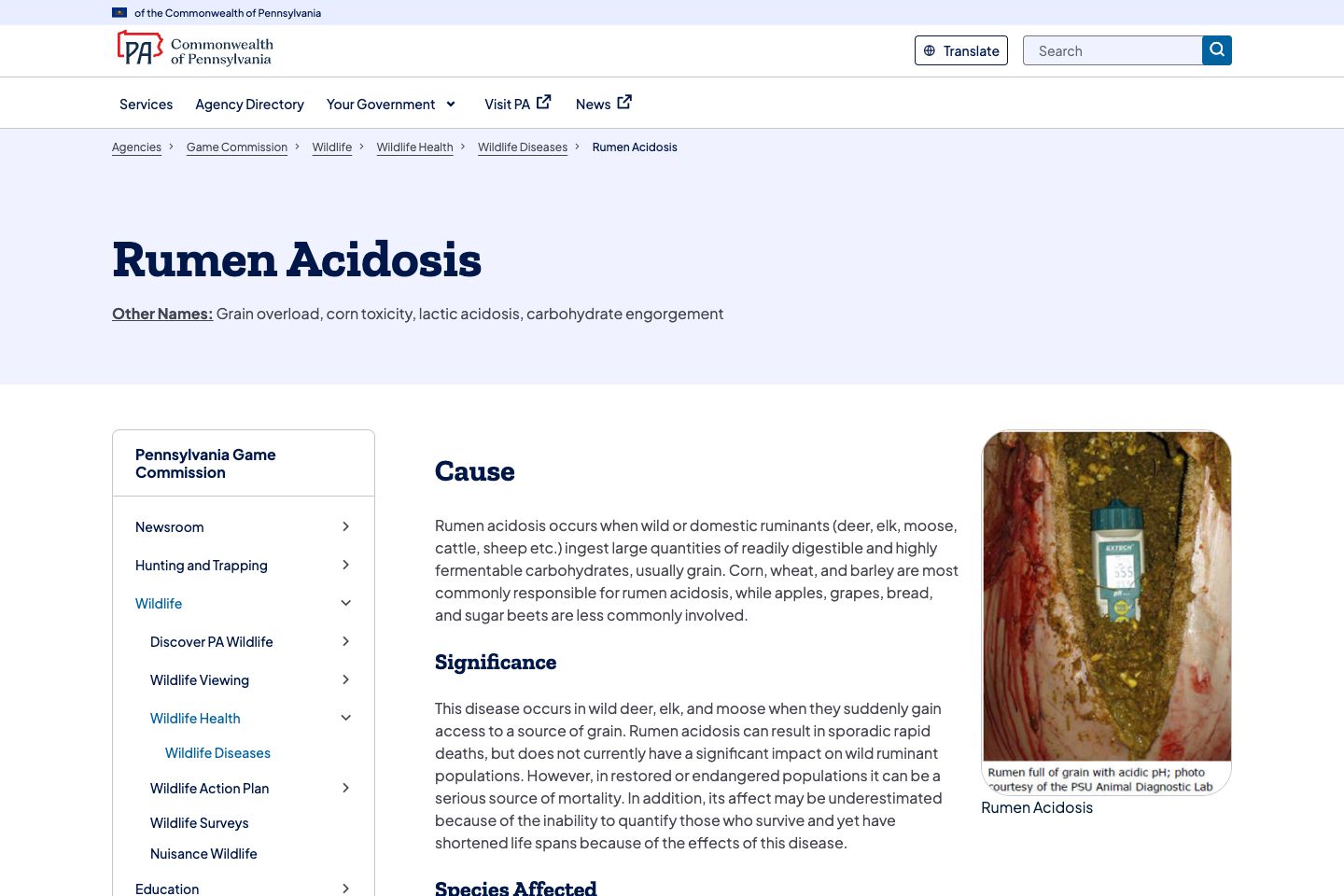
A deer’s rumen is a fermentation vat, not a simple stomach. When wild or captive deer suddenly switch from high-fiber browse to large amounts of corn or other starch, rumen microbes can crash into lactic acidosis - Pennsylvania Game Commission, Michigan DNR, and Wisconsin DNR all document deer and elk dying after abrupt high-carbohydrate feeding (PA Game Commission rumen acidosis; Michigan DNR corn toxicity; Wisconsin DNR corn toxicity).
Key Takeaways
- Sudden grain or corn dumps can kill deer via rumen acidosis / grain overload (PA Gamel Commission; MI DNR).
- Lactic acid drops rumen pH; deer may show diarrhea, dehydration, incoordination, and death within a day or two (PA Game Commission; MI DNR).
- Prevention means gradual diet change over weeks, not a single pile (MI DNR; WDFW wildlife feeding).
- Found-dead deer are usually past treatment; agencies emphasize prevention (PA Game Commission).
- Baiting and emergency winter feeding inherit the same rumen rules where they are legal.
What goes wrong in the rumen
Ruminants rely on fiber-digesting microbes. A sudden starch flood favors acid-producing bacteria; lactic acid accumulates, pH can fall to about 5 or lower, and the gut lining and systemic fluid balance fail (PA Game Commission; MI DNR). Michigan describes corn toxicity in deer and elk after animals gorge on spilled or provided grain without adaptation (MI DNR). Wisconsin mirrors the same pathology on its wildlife disease pages (WI DNR). Classic wildlife literature also describes rumen overload and rumenitis in white-tailed deer after abrupt concentrates (Journal of Wildlife Management rumen overload).
Field signs and timing
Agencies list depression, weakness, diarrhea, dehydration, and death often within 24-72 hours after the binge (PA Game Commission; MI DNR). Hunters finding multiple dead deer near a new feeder or spilled grain pile should think acidosis and stop the feed source, then call the agency disease desk rather than assuming CWD or EHD by default (PA Game Commission). Necropsy patterns (rumen contents, rumen wall damage) separate these cases from hemorrhagic disease when labs are involved (MI DNR).
Prevention that actually works
Michigan and Washington guidance is blunt: introduce high-energy feeds gradually over several weeks so microbial communities adapt (MI DNR; WDFW wildlife feeding). Overnight “kindness” piles after a blizzard are a common way people kill the deer they meant to help. Where recreational feeding or baiting is illegal, the rumen issue is moot because the pile should not exist; where it is legal, volume and ramp-up rate still matter (WI DNR; PA Game Commission). Standing food plots that deer ease into across weeks are physiologically safer than a sudden trailer dump of shelled corn beside a blind.
How long does a deer’s rumen take to adjust to new feed?
Plan on several weeks, per Michigan and Washington’s guidance above. Nobody has published an exact clock for wild deer. One Ecosphere study moved hand-raised mule deer and whitetails from pellets onto natural browse over two weeks and found their gut microbes differed on the two diets, but it didn’t time how long the switch took (Ecosphere). Grain isn’t the only trigger, either. Wyoming Game and Fish lists wet-spring green-up, new growth after a fire, moving deer to new range, and new foods like alfalfa or grain as shifts that can upset the gut before the microbes catch up (Wyoming Game and Fish).
Captive and rescue context
Wildlife rehabilitators and high-fence operators face the same microbiology. Abrupt concentrate diets without roughage transition recreate textbook rumenitis (JWM rumen overload). Free-ranging deer that discover uncovered corn storage or harvest spills can self-inflict the same overdose (MI DNR).
Hunter and landowner checklist
- Know whether baiting/feeding is legal before placing anything (WI DNR).
- If legal, ramp quantity slowly across weeks (MI DNR).
- Keep farm grain secure so deer cannot binge (MI DNR).
- Report clustered dead deer near new feed to the agency (PA Game Commission).
- Do not assume antibiotics or home remedies will save a downed wild deer; prevention is the working tool (PA Game Commission).
Food plots vs dump piles
Perennial clover or brassica plots that deer sample across weeks rarely recreate the single-night corn overdose agencies describe, because intake ramps with familiarity and plot biomass (MI DNR; WI DNR). The danger case is concentrated starch: uncovered bins, silage bags, or bait piles placed overnight before a sit (MI DNR). Washington’s feeding page likewise frames sudden artificial diets as a welfare risk, not a kindness (WDFW). If your state bans recreational feeding partly for disease or ethics reasons, rumen acidosis is an additional biological argument for obeying that ban (PA Game Commission).
What not to confuse it with
EHD/bluetongue die-offs cluster near water in late summer and show different lesion patterns; CWD is a slow prion disease, not an overnight feeder kill (PA Game Commission; MI DNR). Timing next to a new grain source is the practical differentiator for field staff and hunters alike.
Bottom line
Sudden carbs kill through rumen acidosis; gradual fiber-to-energy transitions and secure grain storage prevent most hunter-caused cases (PA Game Commission; MI DNR; WI DNR).
Related: persimmon deer corn nearby and deer urine attractants and cwd.
The other side of it
Ramping up over several weeks sounds tidy, but a deer that finds a full feeder doesn’t know it’s supposed to start slow. You control how much goes out, not how much one doe eats in a night, and the agencies offer no actual ramp-up schedule. Several binges in the article also come from uncovered bins and harvest spills nobody meant as feed. Somehow the hunter with a fresh pile beside his blind is always sure his deer have tougher stomachs.
Keep reading
Latest deer news
Sources
- Rumen Acidosis | Game Commission | Commonwealth of Pennsylvania
- Corn Toxicity in Ruminants (Deer and Elk)
- Corn toxicity in ruminants | | Wisconsin DNR
- Wildlife feeding | Washington Department of Fish & Wildlife
- Rumen Overload and Rumenitis in White-Tailed Deer
- Food or family? How gut microbes respond to diet and phylogeny in two deer species
- Wyoming Game and Fish mule deer nutrition fact sheet (wgfd.wyo.gov)
Comments