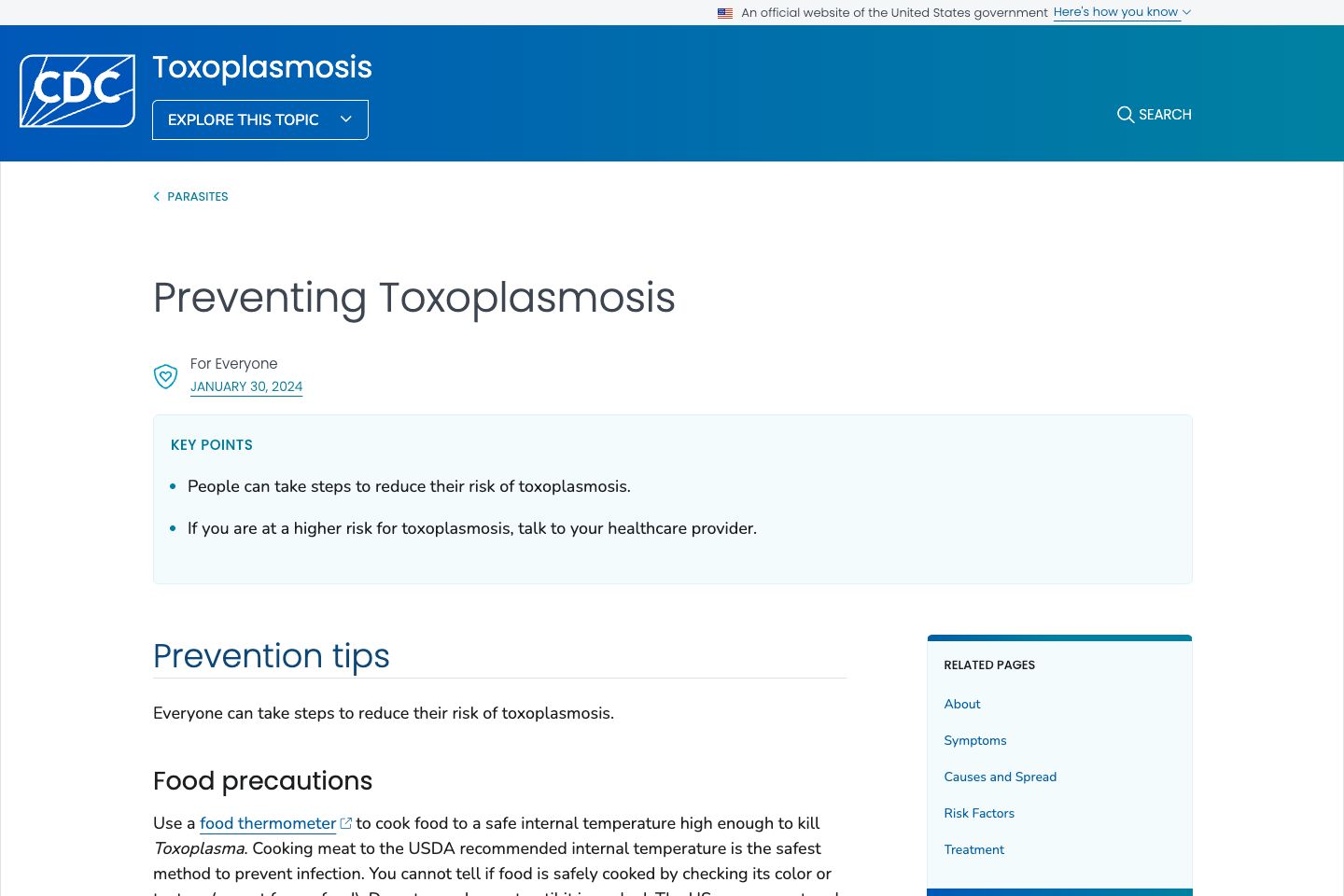
Toxoplasma gondii in undercooked venison is a documented hunter outbreak pathogen, not a theoretical kitchen myth. Cook venison, steaks and ground alike, to at least 160°F, the wild-game standard in Wisconsin DHS’s toxoplasmosis fact sheet (Wisconsin Department of Health Services). CDC’s general meat rule is lower for whole cuts. Its Preventing Toxoplasmosis page tells cooks to use a thermometer and follow USDA meat temperatures: whole cuts of meat to at least 145°F in the thickest part with a three-minute rest, and ground meat to at least 160°F (Centers for Disease Control and Prevention). Freezing meat for several days at sub-zero (0°F) temperatures before cooking can greatly reduce Toxoplasma infection chance, but CDC warns freezing does not reliably kill Trichinella or harmful bacteria (Centers for Disease Control and Prevention). Wisconsin DHS’s game-meat toxoplasmosis fact sheet takes a stricter wild-game line: cook all wild game meats to at least 160°F, and do not rely on freezing, microwaving, curing, smoking, or drying alone (Wisconsin Department of Health Services). That sheet cites an Iowa study finding about one of every two white-tailed deer could make you sick if not fully cooked (Wisconsin Department of Health Services). A 2020 CDC Emerging Infectious Diseases report described an acute toxoplasmosis outbreak among Canadian deer hunters who ate undercooked Illinois venison; six of ten hunters became symptomatic after rare or medium steaks at camp (Centers for Disease Control and Prevention).
Key Takeaways
- WI DHS wild game: cook to ≥160°F (Wisconsin Department of Health Services).
- CDC ground meat: ≥160°F (Centers for Disease Control and Prevention).
- CDC’s general rule for whole cuts is lower: ≥145°F + 3-minute rest (Centers for Disease Control and Prevention).
- Do not rely on freeze/smoke/cure/dry alone for game (Wisconsin Department of Health Services; Centers for Disease Control and Prevention).
- EID: undercooked deer meat outbreak in hunters (Centers for Disease Control and Prevention).
- Wash hands and tools after raw meat (Centers for Disease Control and Prevention; Wisconsin Department of Health Services).
Why agencies disagree on 145 versus 160 for steaks
CDC’s general meat chart allows 145°F whole cuts with rest; Wisconsin’s game sheet pushes 160°F for all wild game because of parasite load uncertainty in deer (Centers for Disease Control and Prevention; Wisconsin Department of Health Services). The 160°F line isn’t only a Wisconsin call. The federal FoodSafety.gov minimum-temperature chart lists venison, along with rabbit, at 160°F rather than the 145°F whole-cut beef number, and says to reheat leftovers to 165°F (FoodSafety.gov). Hunters feeding pregnant people or immunocompromised guests should follow the stricter 160°F game guidance (Wisconsin Department of Health Services).
Outbreak pattern to remember
The EID investigation tied illness to rare deer steak at an Illinois retreat; serology confirmed recent toxoplasmosis in all six symptomatic hunters (Centers for Disease Control and Prevention).
Cat-feces ecology in one sentence
WI DHS explains outdoor cats shed Toxoplasma that contaminates plants and water; deer ingest cysts; undercooked muscle passes them to people (Wisconsin Department of Health Services).
Kitchen controls beyond the thermometer
CDC adds hot soapy washes for utensils and boards, handwashing, and rinsed produce; WI DHS repeats hand and tool washing after raw game (Centers for Disease Control and Prevention; Wisconsin Department of Health Services).
Freezing is a helper not a guarantee
CDC’s sub-zero multi-day freeze reduces Toxoplasma risk but is not a substitute for cooking, especially with Trichinella still in the conversation on the WI sheet (Centers for Disease Control and Prevention; Wisconsin Department of Health Services).
Who is highest risk
WI DHS highlights birth-defect and miscarriage risk in pregnancy and deadly disease in weakened immune systems; cook past pink for those households (Wisconsin Department of Health Services).
Camp cook discipline after the EID outbreak
The Illinois retreat outbreak showed rare steak can infect multiple immunocompetent adults in one weekend (Centers for Disease Control and Prevention). Carry a thermometer to camp, cook whole wild-game cuts to the 160°F Wisconsin DHS game standard when guests include pregnancy or immune risk, and wash every board that touched raw loin before it touches cooked slices (Wisconsin Department of Health Services; Centers for Disease Control and Prevention; Centers for Disease Control and Prevention).
Bottom line
Cook ground venison to 160°F, treat wild-game steaks as 160°F when following Wisconsin DHS, and never serve rare camp steaks to a mixed-risk table (Centers for Disease Control and Prevention; Wisconsin Department of Health Services; Centers for Disease Control and Prevention).
The other side of it
CDC’s own page allows whole cuts at 145 with a three-minute rest, and the stricter 160 line comes from one state’s game sheet. The outbreak at the center of this story was six sick hunters from one camp, which is a warning rather than a census, so a healthy adult table following CDC isn’t being reckless. But the camp cook who judges doneness by poking a steak with his finger isn’t in the 145 camp or the 160 camp. He’s in the guessing camp.
Keep reading
Latest deer news
Sources
- Centers for Disease Control and Prevention (cdc.gov)
- Risk of Toxoplasmosis from Game Meat
- Acute Toxoplasmosis among Canadian Deer Hunters Associated with Consumption of Undercooked Deer Meat Hunted in the United States - Volume 26, Number 2—February 2020 - Emerging Infectious Diseases j...
- FoodSafety.gov (foodsafety.gov)
Comments