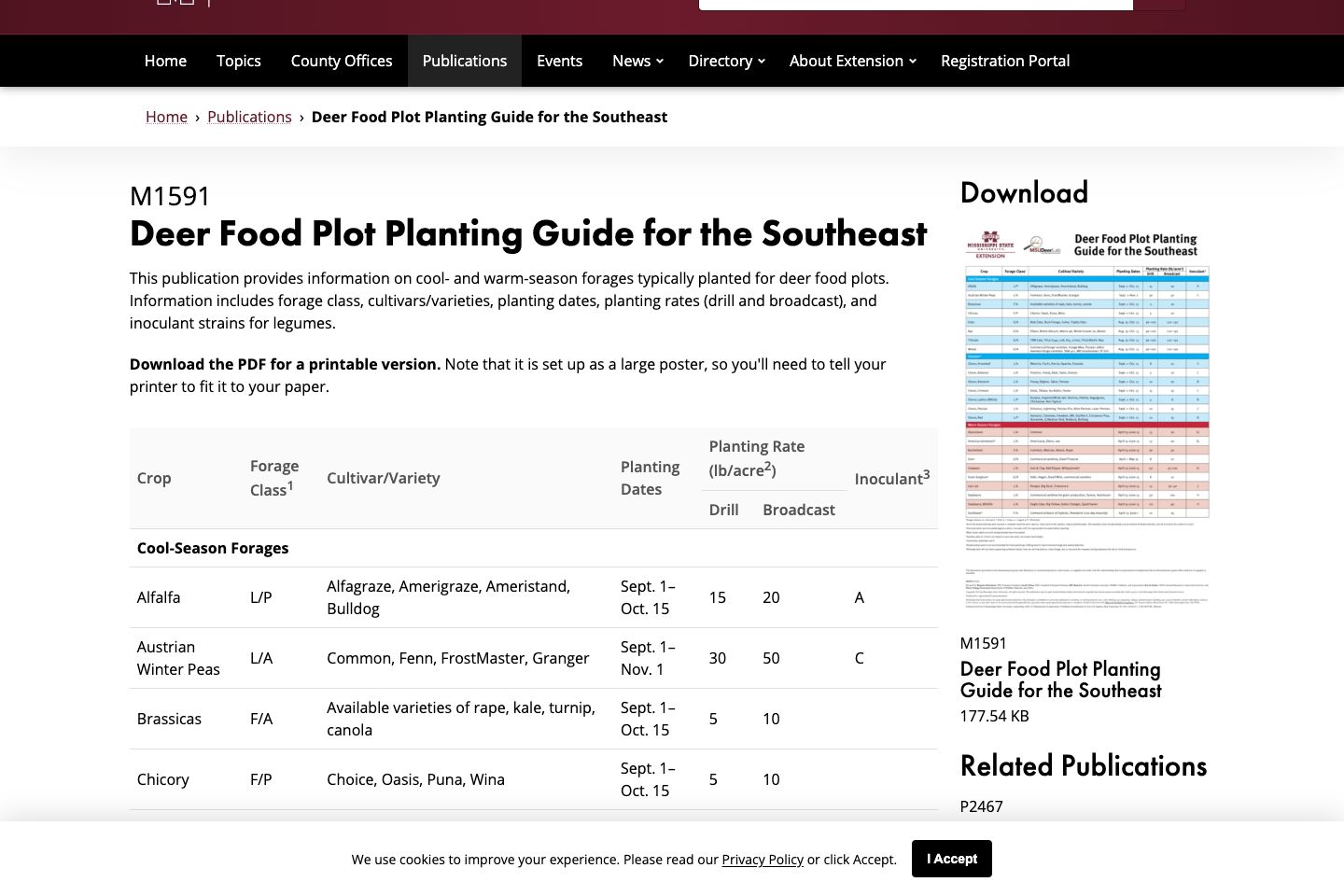
Grain sorghum earns its late-season keep when seed heads still stand after frost has flattened tender forages. Mississippi State University Extension’s M1591 lists grain sorghum as G/A annual with Kafir, Hegari, Dwarf Milo, and commercial varieties at 8 lb drilled or 12 lb broadcast for April 15 through June 15, and footnote 7 says broadcasting is not recommended because drilling in rows improves forage and seed production (Mississippi State University Extension). P2111 describes a hardy warm-season annual with tall, medium, and dwarf varieties that feed dove, quail, turkey, and songbirds, drilled at 8 lb in 36-inch rows with broadcast discouraged (MSU Extension P2111). After first frost, those standing heads are the inventory - milo and related types hold seed when leafy cowpeas are gone (MSU Extension P2111; Mississippi State University Extension). Leaving those heads uncut is a management choice as much as a planting choice (MSU Extension P2111).
Key Takeaways
- M1591: 8 drilled / 12 broadcast; Apr 15-Jun 15; drill preferred (footnote 7) (Mississippi State University Extension).
- P2111: 8 lb in 36-inch rows; broadcast not recommended (MSU Extension P2111).
- Varieties: Kafir, Hegari, Dwarf Milo, Egyptian Wheat, commercial 90-115 day (Mississippi State University Extension; MSU Extension P2111).
- Well-drained; moderately drought-tolerant; pH about 5.6-7.0 (MSU Extension P2111).
- Companions: millet, corn, cowpeas, wildlife soybeans, lablab, sunflower (MSU Extension P2111).
- Side-dress nitrogen after emergence per P2111 example (MSU Extension P2111).
Why drill for head yield
Footnote 7 and P2111 agree that rows beat broadcast for seed production (Mississippi State University Extension; MSU Extension P2111). Late-season head availability therefore starts with row planting in the April 15-June 15 window rather than a spinner spreader pass (Mississippi State University Extension).
Frost as a calendar filter
Frost ends many leafy warm-season legumes while sorghum heads that matured on 90- to 115-day varieties can remain as standing seed (MSU Extension P2111). Dwarf milo suits shorter structure; taller Egyptian Wheat-type entries add cover with seed on the same P2111 variety list (MSU Extension P2111; Mississippi State University Extension).
Fertility for filled heads
P2111’s example program uses about 150 lb/ac of 0-20-20 at planting plus 200 lb/ac of 34-0-0, with one-third of the nitrogen at planting and two-thirds as a four-leaf side-dress (MSU Extension P2111). Underfed sorghum makes empty heads that disappoint after frost even if the row spacing was perfect (MSU Extension P2111).
Strip plantings with leafy partners
Companions include browntop millet, corn, cowpeas, wildlife soybeans, lablab, and sunflower (MSU Extension P2111). Alternating strips keep leafy browse and standing grain in the same field so frost does not empty the entire opening at once (MSU Extension P2111).
Deer versus bird use
P2111 emphasizes dove, quail, turkey, and songbirds for sorghum seed, with less frequent duck use (MSU Extension P2111). Deer still use plantings opportunistically; the frost story is about seed still being present when soft forages are not (MSU Extension P2111).
Waterfowl contrast
P2111 discusses mechanical manipulation for waterfowl plantings of grain crops (MSU Extension P2111). That is a different objective from leaving milo heads standing for post-frost upland and deer use (MSU Extension P2111).
Maturity class choice
Commercial 90-day classes are more likely to fill before average first frost than 115-day classes planted at the end of June (MSU Extension P2111; Mississippi State University Extension). Match maturity to your county frost date when head availability is the KPI (MSU Extension P2111).
Bottom line
Drill grain sorghum at M1591/P2111’s 8 lb row rate in spring so filled heads remain available after first frost when leafy warm-season forages are gone (Mississippi State University Extension; MSU Extension P2111).
The other side of it
The weak spot is in the article’s own sources. P2111 pitches sorghum seed at doves, quail, turkey and songbirds, and says deer only use it opportunistically, so a strip of standing heads after frost may be feeding more feathers than whitetails. Nothing here measures how much grain is actually left by the time deer get around to it. Still, the guy who broadcast his milo off a spinner and called it a plot doesn’t get to blame the birds.
Keep reading
Latest deer news
Comments