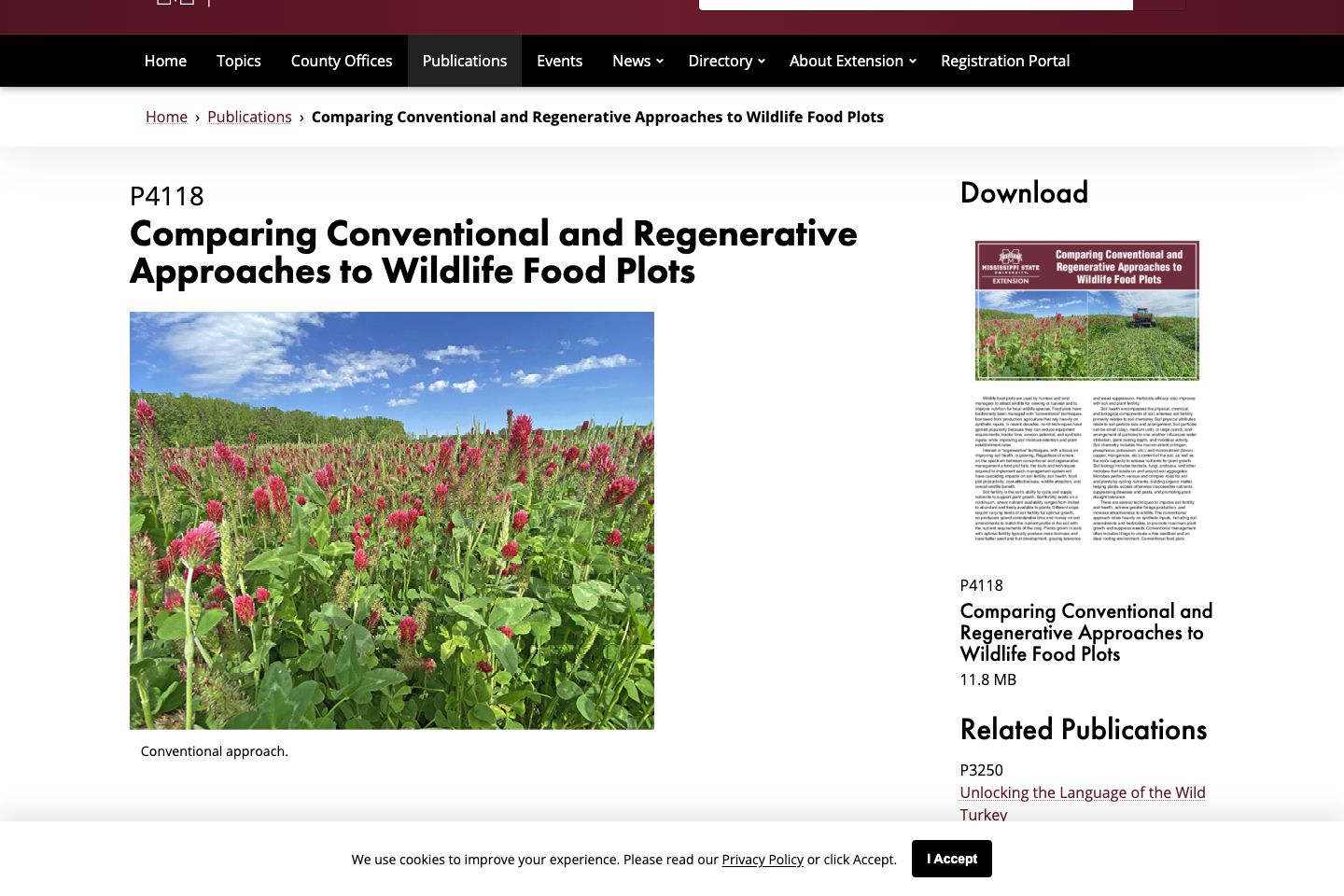
Years of disking the same deer plot leave more than a fine seedbed - they leave a biological debt. Mississippi State University Extension Publication 4118 states that conventional management often includes tillage to create a fine seedbed, and lists concerns associated with tillage as loss of soil organic matter, reduced soil microbial activity, and poor soil structure that leads to compaction and erosion (Mississippi State University Extension P4118). The same publication’s regenerative section explains why: tillage can destroy microbe networks and the aggregates they create, injects oxygen that drives microbes to consume and deplete organic matter, and contrasts with no-till systems that retain microbe networks, aggregation, and surface residue (Mississippi State University Extension P4118). After repeated tillage seasons, the recovery path is the same document’s first regenerative principle - minimize tillage - paired with living roots and residue so biology can rebuild (Mississippi State University Extension P4118).
Key Takeaways
- P4118 tillage concerns: loss of organic matter, reduced microbial activity, poor structure/compaction/erosion (Mississippi State University Extension P4118).
- Soil biology (bacteria, fungi, protozoa) cycles nutrients, builds organic matter, and helps plants access nutrients (Mississippi State University Extension P4118).
- Regenerative principle 1: minimize tillage - tillage destroys microbe networks and aggregates (Mississippi State University Extension P4118).
- No-till builds organic matter, retains thatch, and holds moisture better than conventional tillage (Mississippi State University Extension P4118).
- Organic matter stores roughly 2,000 lb N/ac to 12 in per 1% OM (much plant-unavailable until microbes cycle it) (Mississippi State University Extension P4118).
- Soil-health gains are not overnight - complex relationships take years (Mississippi State University Extension P4118).
What tillage does to the living soil
P4118 defines soil biology as bacteria, fungi, protozoa, and other microbes on and around soil aggregates that cycle nutrients, build organic matter, help plants access otherwise inaccessible nutrients, suppress diseases and pests, and promote drought tolerance (Mississippi State University Extension P4118). Conventional tillage is framed as a seedbed tool that simultaneously carries those biological costs when repeated (Mississippi State University Extension P4118).
Oxygen flush and organic-matter burn
When tillage injects oxygen, microbial populations can surge and, without adequate food sources, consume and deplete soil organic matter (Mississippi State University Extension P4118). That is the opposite of the regenerative goal of retaining residues so microbes have a food source and build organic matter (Mississippi State University Extension P4118).
Aggregates and infiltration
Microbes help build soil aggregates - the crumby particles that give healthy soil a porous appearance - and spaces between aggregates channel water (Mississippi State University Extension P4118). Frequent tillage destroys those networks and aggregates, leading to compacted soils and poor infiltration (Mississippi State University Extension P4118).
Diversity under conservation tillage
P4118 notes soil microbial diversity increases with conservation tillage, particularly no-till, versus deep tillage, improving microbes’ ability to use different carbon compounds and usually accompanying higher organic matter (Mississippi State University Extension P4118). Moving toward conservation tillage can also reduce synthetic fertilizer need by increasing organic-matter retention (Mississippi State University Extension P4118).
Recovery after years of tillage
Minimize tillage going forward; use no-till drilling or top-sowing where objectives allow; keep living roots and thatch year-round so biology has habitat and food (Mississippi State University Extension P4118). Dedicating acres to warm- or cool-season plots can cut tillage to once per year instead of twice (Mississippi State University Extension P4118). Expect multi-year timelines, not a single season miracle (Mississippi State University Extension P4118).
Bottom line
After years of tillage, P4118’s message is blunt: expect lower organic matter, weaker microbial activity, and poorer structure - then rebuild by minimizing tillage and feeding soil biology with roots and residue (Mississippi State University Extension P4118).
The other side of it
Nothing here measured a deer plot. P4118 makes a general case about soil biology, and its own recovery advice only gets some plots down to one tillage pass a year, not zero. A hunter on a short lease could fairly argue a clean seedbed this fall beats soil that might recover over years he won’t be around for. Of course, the guy who discs until the plot looks like a ball infield is mostly farming for the trail camera.
Keep reading
Latest deer news
Comments