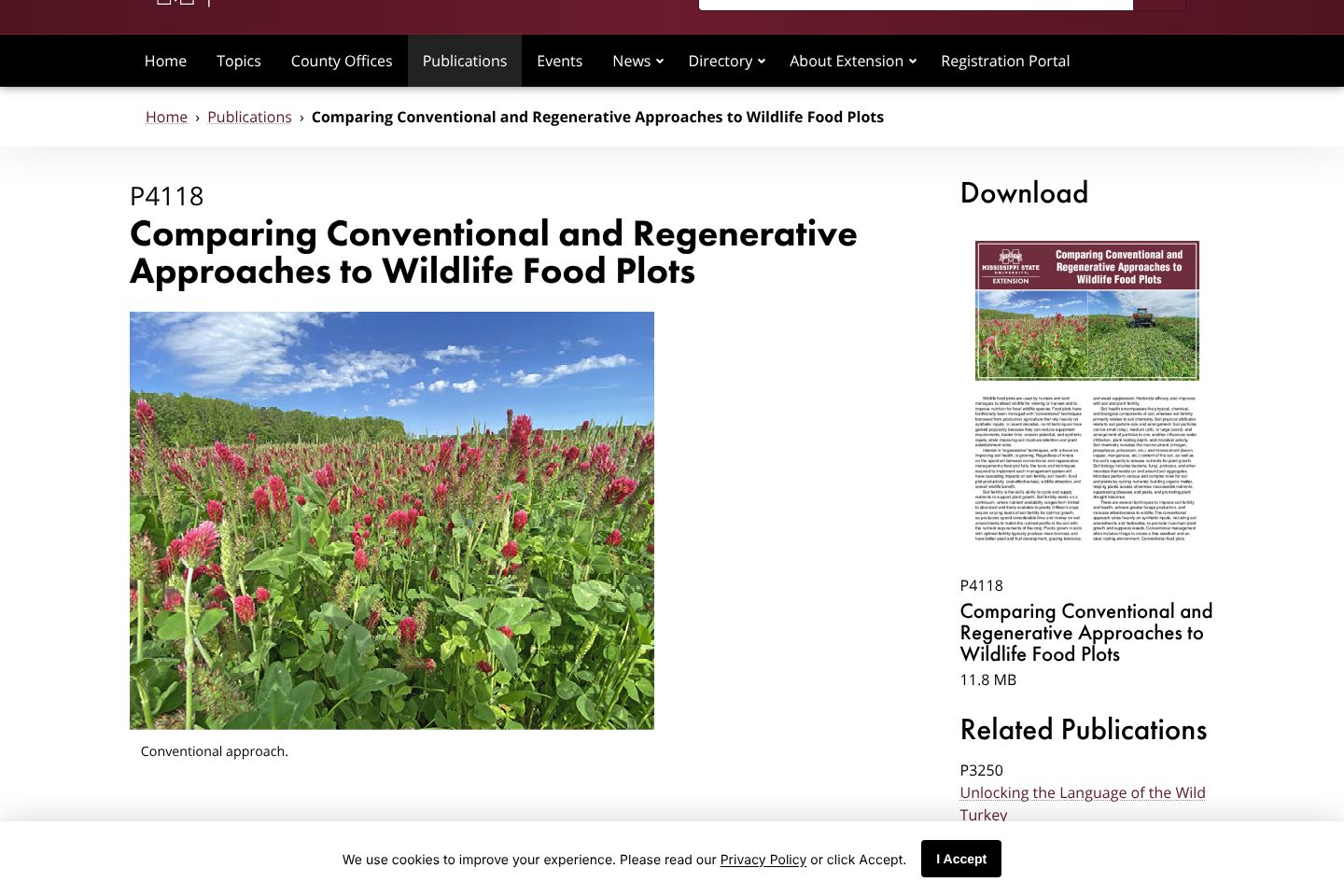
Plot resilience is less about how many bags you dump and more about complementary plant functions feeding soil biology. Mississippi State University Extension P4118 lists “plant diverse blends” as regenerative principle 4: different species interact with soil and neighbors uniquely - buckwheat scavenges phosphorus, deep-tap brassicas can loosen compaction and lift nutrients, and diversity supports a buffet for wildlife while cultivating microbial diversity (Mississippi State University Extension P4118). USDA NRCS Enhancement E340C for multi-species cover crops requires a minimum of four different species and calls for increasing rotation diversity by adding missing crop types such as cool-season grass, cool-season broadleaf, warm-season grass, and warm-season broadleaf (USDA NRCS E340C). Scoring a mix against those functional groups - not marketing species counts alone - is how diversity becomes resilience (Mississippi State University Extension P4118; USDA NRCS E340C).
Key Takeaways
- P4118: diverse blends cultivate diverse soil microbes that feed diverse plants (Mississippi State University Extension P4118).
- Example: buckwheat unlocks soil P; deep brassicas alleviate compaction (Mississippi State University Extension P4118).
- NRCS E340C: multi-species cover mix minimum of 4 different species (USDA NRCS E340C).
- Fill missing functional types: CSG, CSB, WSG, WSB (USDA NRCS E340C).
- Blend species should be favored by focal wildlife or serve a soil-health purpose (Mississippi State University Extension P4118).
- Diversity across the property (FSI, fire) still matters more than one plot alone (Mississippi State University Extension P4118).
Why species count is not enough
P4118’s regenerative example plot contains 14 species specifically to cultivate and feed a diversity of soil microbes (Mississippi State University Extension P4118). Adding three nearly identical clovers does less than pairing a grass scavenger with a legume fixer and a deep-rooted brassica (Mississippi State University Extension P4118). Some plants do not work well in blends because of competitive tendencies - local Extension or SARE’s Managing Cover Crops Profitably can help sort those (Mississippi State University Extension P4118).
Functional-group scorecard
Use NRCS E340C’s crop-type language as a checklist: cool-season grass, cool-season broadleaf, warm-season grass, warm-season broadleaf - and require at least four species in a multi-species cover enhancement context (USDA NRCS E340C). Score a proposed deer mix by how many of those niches it fills for the planting window you actually have (USDA NRCS E340C). A four-species mix that is all cool-season grasses fails the missing-type test even if the bag says “diverse” (USDA NRCS E340C).
Complementary jobs inside the mix
Buckwheat’s mild root acids can unlock phosphorus for later plants; brassicas and some radishes may send taproots deep, reduce some soil-borne pathogens, and bring nutrients upward (Mississippi State University Extension P4118). Cereal rye can suppress pests and weeds through shading and allelopathy when used in rotation (Mississippi State University Extension P4118). Cowpeas and alfalfa can attract insects that create bugging opportunities for turkeys (Mississippi State University Extension P4118).
Wildlife and soil dual purpose
P4118 warns that blend species should be favored by focal wildlife or have a soil-health purpose - diversity for its own sake is not the goal (Mississippi State University Extension P4118). Monocultures can still deliver outstanding tonnage of key nutrients when managed well, but deer and turkeys require diverse diets (Mississippi State University Extension P4118).
Resilience practice
Keep living roots year-round and soil covered with thatch so diverse mixes actually feed biology instead of leaving bare soil between plantings (Mississippi State University Extension P4118). Pair plot diversity with larger-scale habitat work rather than expecting one food plot to carry the property (Mississippi State University Extension P4118).
Bottom line
Score cover and food-plot mixes by functional diversity - P4118’s plant-diverse-blends principle plus NRCS E340C’s ≥4-species multi-species cover standard - so resilience comes from complementary roots and microbes, not a bigger species count on a bag (Mississippi State University Extension P4118; USDA NRCS E340C).
The other side of it
A well-managed monoculture, the article concedes, can still put out outstanding tonnage of key nutrients, and for a guy who needs one plot to hold deer in front of a stand, tonnage may matter more than a functional scorecard. The NRCS four-species rule was written for a soil enhancement program, not for deer. Still, there’s always somebody who mixes three nearly identical clovers and calls it biodiversity, same as calling a few flavors of beef jerky a balanced diet.
Keep reading
Latest deer news
Comments