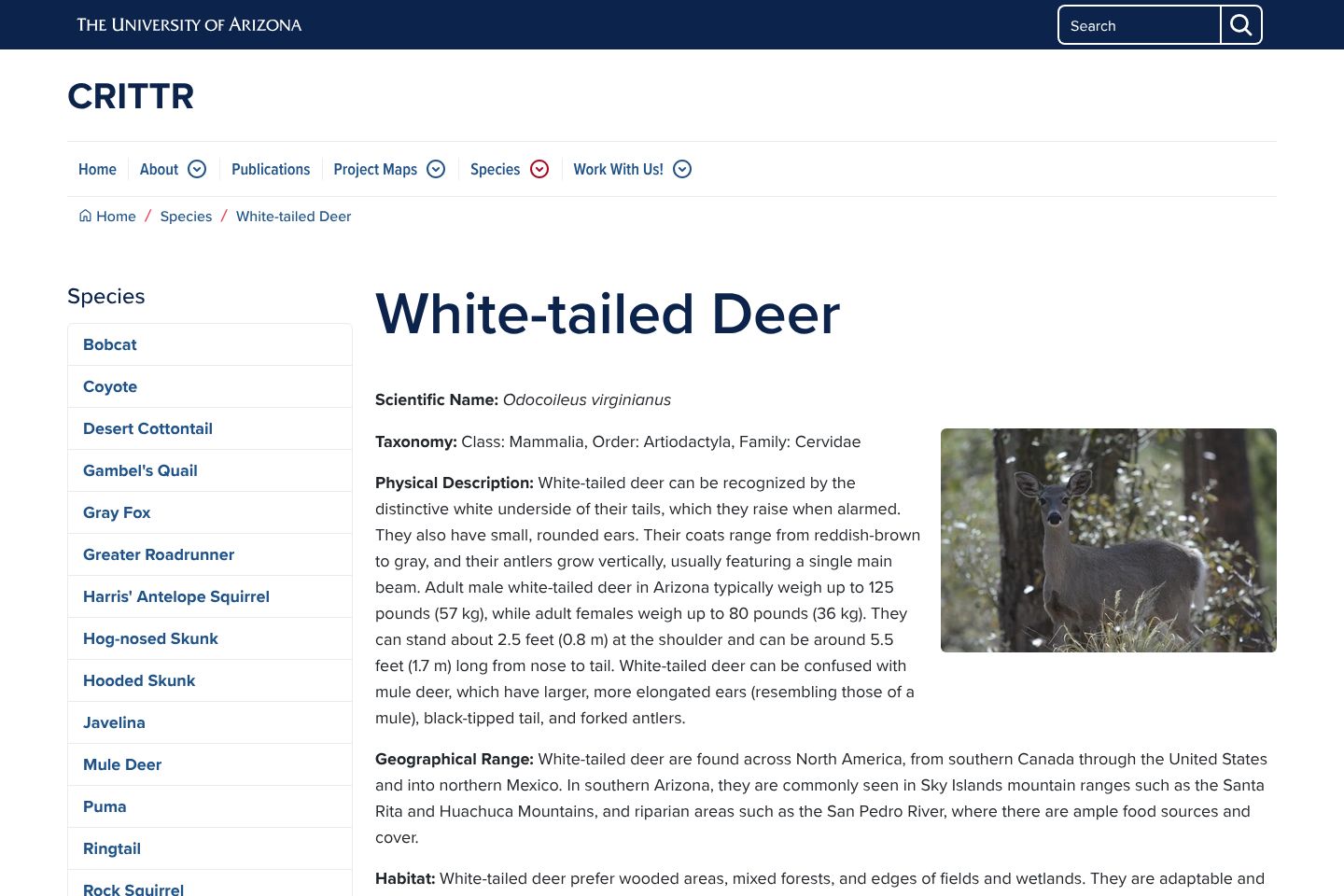
Coues deer hunting basics for whitetail hunters start with one fact: Coues deer are Arizona’s mountain whitetails, a small Odocoileus virginianus subspecies managed in the regulations as white-tailed deer. Arizona Game and Fish describes them as most common in the southeastern mountains and ranging onto the Mogollon Rim and White Mountains, in oak, chaparral and pine with clearings between roughly 4,000 and 10,000 feet (AZGFD white-tailed deer). You still have to read the current hunt regs and draw rules for antlered white-tailed deer tags (AZGFD regulations; AZ hunt guidelines).
Key Takeaways
- AZGFD treats Coues as white-tailed deer, in hunt structures that can separate whitetail and mule deer permits by unit (AZ hunt guidelines; AZGFD regulations).
- Their habitat centers on oak-grassland, chaparral and pine, with summer rain shaping where they’re densest (AZGFD white-tailed deer).
- Coues are smaller than most eastern whitetails. Adult bucks in Arizona typically weigh up to 125 pounds and does up to 80, per the University of Arizona’s species page (UA CRITTR white-tailed deer).
- A flagging white tail and a conventional run help separate them from stotting mule deer at a distance (AZGFD white-tailed deer).
- Glassing ridges and sneaking oak pockets beat the timber still-hunting habits most of us bring from the Midwest.
How is a Coues deer different from an eastern whitetail?
Same genus, different scale and different country. Coues are smaller, and a flagging white tail plus a normal running gait help you tell them from stotting mule deer at a distance (AZGFD white-tailed deer).
They still scrape and still respond to calling. But open-country eyesight and vertical escape routes run the show, so you’ll borrow more from mule deer hunters than from Midwestern timber hunters (AZGFD white-tailed deer; AZ hunt guidelines).
Where do Coues deer live?
AZGFD places Coues mainly from four to ten thousand feet in central and southeastern Arizona, and denser where summer rains are reliable (AZGFD white-tailed deer). Expect vertical hunts.
On Google Earth, look for north slopes with oak stringers and saddles between glassing knobs. Summer monsoon green-up shifts where deer are, so what you see scouting in spring may not match the January breeding window noted in AZGFD’s life-history summary (AZGFD white-tailed deer).
Drought matters too. AZGFD notes harvest swings with drought and fawn survival (AZGFD white-tailed deer). In dry years, hunt closer to reliable water and mast and accept lower density.
How do you get a Coues deer tag in Arizona?
Arizona’s hunt guidelines describe separate mule deer and white-tailed deer hunts where populations support them, with draw and season frameworks that change by unit (AZ hunt guidelines). Seasons can include early, standard and limited December opportunities depending on how the unit is managed.
Before you build points or apply as a group, read which units offer antlered white-tailed deer hunts versus mule deer or any-antlered options (AZ hunt guidelines; AZGFD regulations). Coues country isn’t a leftover tag after your home season. It’s its own draw system, and you should open the current regulations booklet before you pack.
Match your physical prep to the month you draw. A January rut hunt and a December snow hunt are different trips (AZGFD white-tailed deer; AZGFD regulations).
How do you hunt Coues deer?
Glass early, glass late, and plan stalks that keep you off the skyline. Coues use cover expertly once they’re jumped (AZGFD white-tailed deer).
Pick a shaded rock with a wide view and grid the opposite slope for an hour before you move. A Coues that flags and vanishes into the oaks isn’t gone. It’s waiting for you to stand up and skyline yourself. Midday beds on shaded benches reward patience more than random hiking does, so sit longer than food-plot habits taught you. Binoculars in the 10x class and a rangefinder matter more than a rattling bag built for Midwestern timber.
Coues leave scrapes and respond to soft calling, but on open slopes aggressive rattling cuts both ways. Soft contact calls after you’ve closed the distance usually beat long-range theatrics (AZGFD white-tailed deer).
How far are Coues deer shots?
Most ethical shots still happen inside distances you’ve practiced from field positions. The speed of a vanishing buck tempts rushed shots across canyons. Range the opposite slope while you’re glassing, so when a buck steps out you already know the number (AZGFD white-tailed deer).
Steep country multiplies recovery risk. Pass on low-percentage angles over cliffs, and mark hits with GPS.
How do you get a Coues deer off the mountain?
Plan the pack-out before you shoot across a canyon. Small deer cool faster, but steep packs still threaten meat quality. Bone out on clean tarps and keep the quarters shaded (AZGFD regulations).
Mountain lions share Coues country. University of Arizona Extension says whitetail and mule deer are their principal prey in Arizona (UA Extension, Mountain Lions). Bring a partner for downhill packs and for hauling meat after dark, and leave a trip plan with camp. Carry more water than your pride wants to. Steep stalks in November sun still dehydrate you, and a stalk blown by cramps costs more than the extra weight.
How are Coues deer scored?
Small frames still make Pope and Young and Boone and Crockett Coues entries when typical scores clear the species minimums. Both clubs list Coues deer as their own category (B&C minimum entry scores; P&Y entry requirements). Measure after the 60-day drying period like any other whitetail record candidate (B&C records policies), and don’t compare inches directly to Midwestern giants without noting the subspecies.
The other side of it
Glass-first is good advice, but it isn’t the whole playbook. These deer still scrape and answer soft calling, and in a drought year they may be bunched near reliable water where sitting tight beats grinding the opposite slope for an hour, so a Midwestern hunter’s stand patience transfers better than this primer gives it credit for. Just don’t be the flatlander who hauls a climber up the scree and then wonders where all the climbing trees went.
Keep reading
Latest deer news
Sources
- AZGFD white-tailed deer (azgfd.com)
- AZGFD regulations (azgfd.com)
- AZ hunt guidelines (azgfd.com)
- White-tailed Deer | CRITTR, University of Arizona
- Mountain Lions | University of Arizona Cooperative Extension
- Minimum Entry Scores for North American Big Game | Boone and Crockett Club
- Policies of the B&C Big Game Records Program | Boone and Crockett Club
- Entry Requirements and Procedure | Pope and Young Club
Comments