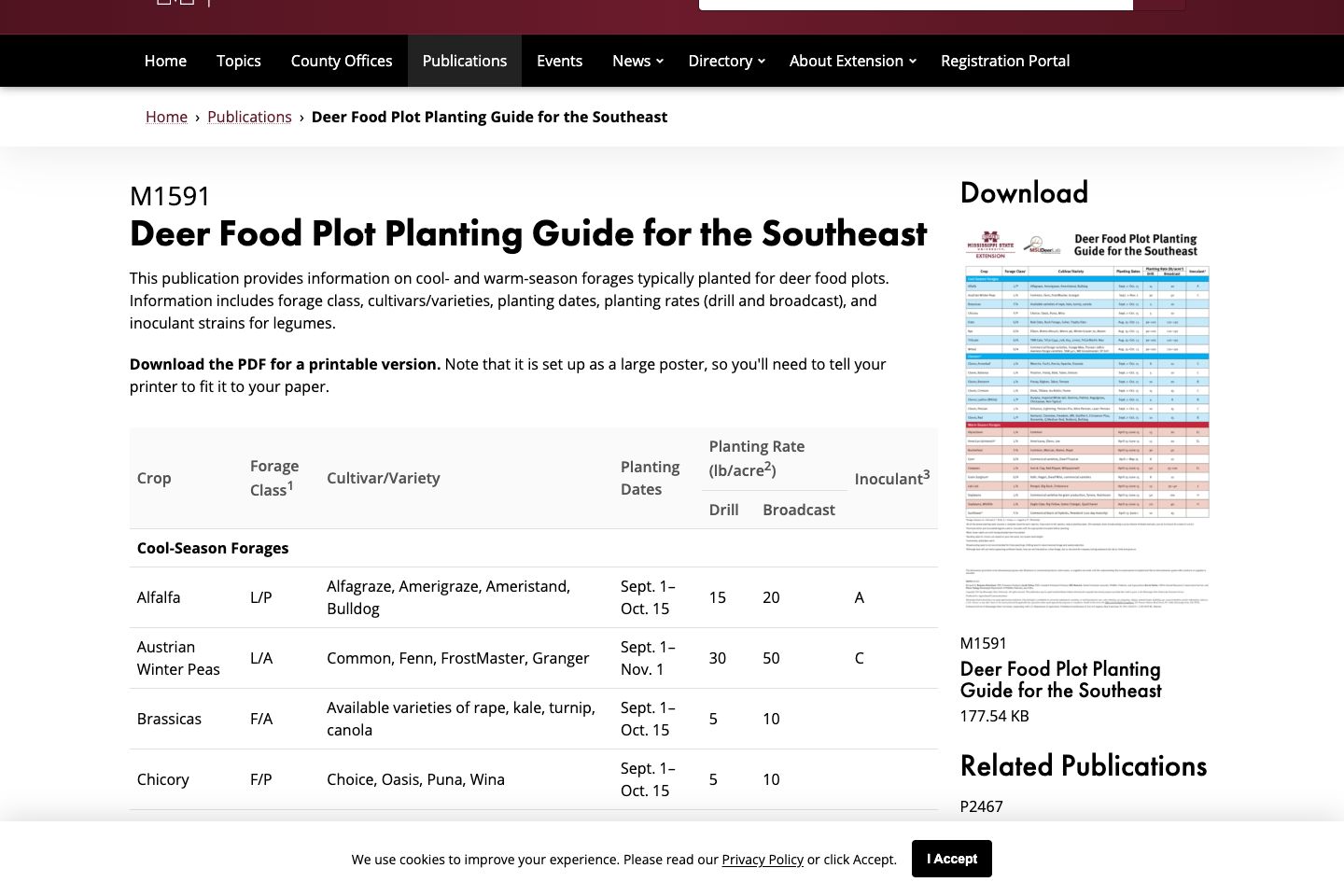
Austrian winter peas are a cool-season annual legume Mississippi State University Extension lists for Southeast deer food plots (Mississippi State University Extension). MSU’s Deer Food Plot Planting Guide (M1591) classes them L/A (legume/annual), names cultivars such as Common, Fenn, FrostMaster, and Granger, and sets planting dates from September 1 through November 1 (Mississippi State University Extension). Stand-alone planting rates are 30 lb per acre drilled or 50 lb per acre broadcast, with inoculant strain C (Mississippi State University Extension). Those full rates assume a complete stand of peas alone; mixtures require proportional cuts so total seed does not smother companions (Mississippi State University Extension). Peas fit the cool-season slate beside brassicas, chicory, small grains, and clovers that MSU tables for the same fall window (Mississippi State University Extension).
Key Takeaways
- Plant Austrian winter peas Sept 1-Nov 1 in the Southeast guide (Mississippi State University Extension).
- Drill 30 lb/acre or broadcast 50 lb/acre for a pure stand (Mississippi State University Extension).
- Use inoculant strain C or pre-inoculated seed (Mississippi State University Extension).
- Cut rates in blends; MSU’s 50/50 wheat-oat example halves each species (Mississippi State University Extension).
- Peas are annual legumes, not a perennial clover replacement (Mississippi State University Extension).
- Match the cool-season companions MSU lists for the same fall dates (Mississippi State University Extension).
Where peas sit in the cool-season table
MSU groups Austrian winter peas with other cool-season forages planted from late summer into fall (Mississippi State University Extension). Neighboring rows include brassicas at 5 lb drilled or 10 broadcast, chicory at the same 5/10 rates, and small grains (oats, rye, triticale, wheat) at 90-100 lb drilled or 120-150 broadcast (Mississippi State University Extension). Clovers fill another block with species-specific rates, from ladino white clover at 4/8 lb to crimson at 15/25 lb (Mississippi State University Extension). Peas therefore compete for the same calendar as grains and clovers, which is why blend math matters (Mississippi State University Extension).
Inoculant and seed quality
Footnote 3 on the MSU poster tells planters to buy pre-inoculated legume seed or to inoculate with the correct strain before planting (Mississippi State University Extension). Austrian winter peas are mapped to inoculant group C on that table (Mississippi State University Extension). Wrong rhizobia leave a legume plot that looks planted but fixes little nitrogen, which defeats the point of including peas beside hungry small grains (Mississippi State University Extension). Most clover seed arrives pre-inoculated per MSU footnote 4, but peas still need their own check (Mississippi State University Extension).
Mixture math that keeps peas from dominating
MSU footnote 2 states that listed rates assume a complete stand for each species and that mixed plantings must reduce rates (Mississippi State University Extension). The worked example broadcasts a 50/50 wheat and oat mix at 60 lb of each for a 120 lb total instead of 120-150 lb of either alone (Mississippi State University Extension). Apply the same logic when peas share a drill with oats or rye: if peas are one-third of the seed goal, start near one-third of 30 lb drilled rather than dumping the full 30 lb on top of a full grain rate (Mississippi State University Extension). Over-seeding grains on top of full pea rates crowds seedlings and wastes seed (Mississippi State University Extension).
How do you mix winter peas with rye?
Rye is the most common partner. MSU’s P2111 manual says Austrian winter peas grow well in grass mixes and give deer and turkeys foliage from fall to spring, with seed maturing May to June. Peas there like loam to clay soil with a pH of about 5.6 to 7.0 (MSU Extension P2111). Rye’s window opens August 15 and the peas’ opens September 1, so a joint seeding lands between September 1 and October 15 (Mississippi State University Extension).
Cut both rates. As a RAD example, not an MSU recipe, a roughly half-and-half broadcast would start near 25 lb of peas and 60 to 75 lb of rye per acre, then get adjusted to what your own stand counts show (Mississippi State University Extension).
Cultivar and calendar choices
Named cultivars on the MSU line include Common, Fenn, FrostMaster, and Granger (Mississippi State University Extension). The September 1 to November 1 window is wider than the brassica Sept 1-Oct 15 band and overlaps the Aug 15-Oct 15 small-grain window, so late-October pea plantings can still pair with wheat or rye that were drilled earlier (Mississippi State University Extension). Outside the Southeast, shift dates with local extension frost calendars rather than forcing M1591 dates onto northern winters (Mississippi State University Extension).
What peas are not
Peas are annuals (A) in MSU’s forage-class key, unlike perennial (P) entries such as alfalfa, chicory, ladino clover, or red clover (Mississippi State University Extension). They will not replace a multi-year white-clover stand; they fill a fall-to-spring protein gap and then exit (Mississippi State University Extension). Warm-season corn, soybeans, and cowpeas on the same poster belong to spring plantings and should not be mixed into the cool-season pea drill (Mississippi State University Extension).
Bottom line
Treat Austrian winter peas as a cool-season annual legume at 30 lb drilled or 50 broadcast, inoculate to strain C, and cut those rates whenever they share a blend with grains or clovers (Mississippi State University Extension).
The other side of it
Every rate here comes from one Mississippi State poster built for the Southeast, and the article admits northern planters have to move the dates to local frost calendars. The one-third-of-30-pounds blend math is the article’s own stretch from a wheat-and-oat example, not an MSU pea recipe, so a plotter who trusts his own stand counts has a fair case. Somewhere a guy is still broadcasting a full bag of peas over a full rate of rye and calling it insurance.
Keep reading
Latest deer news
Comments