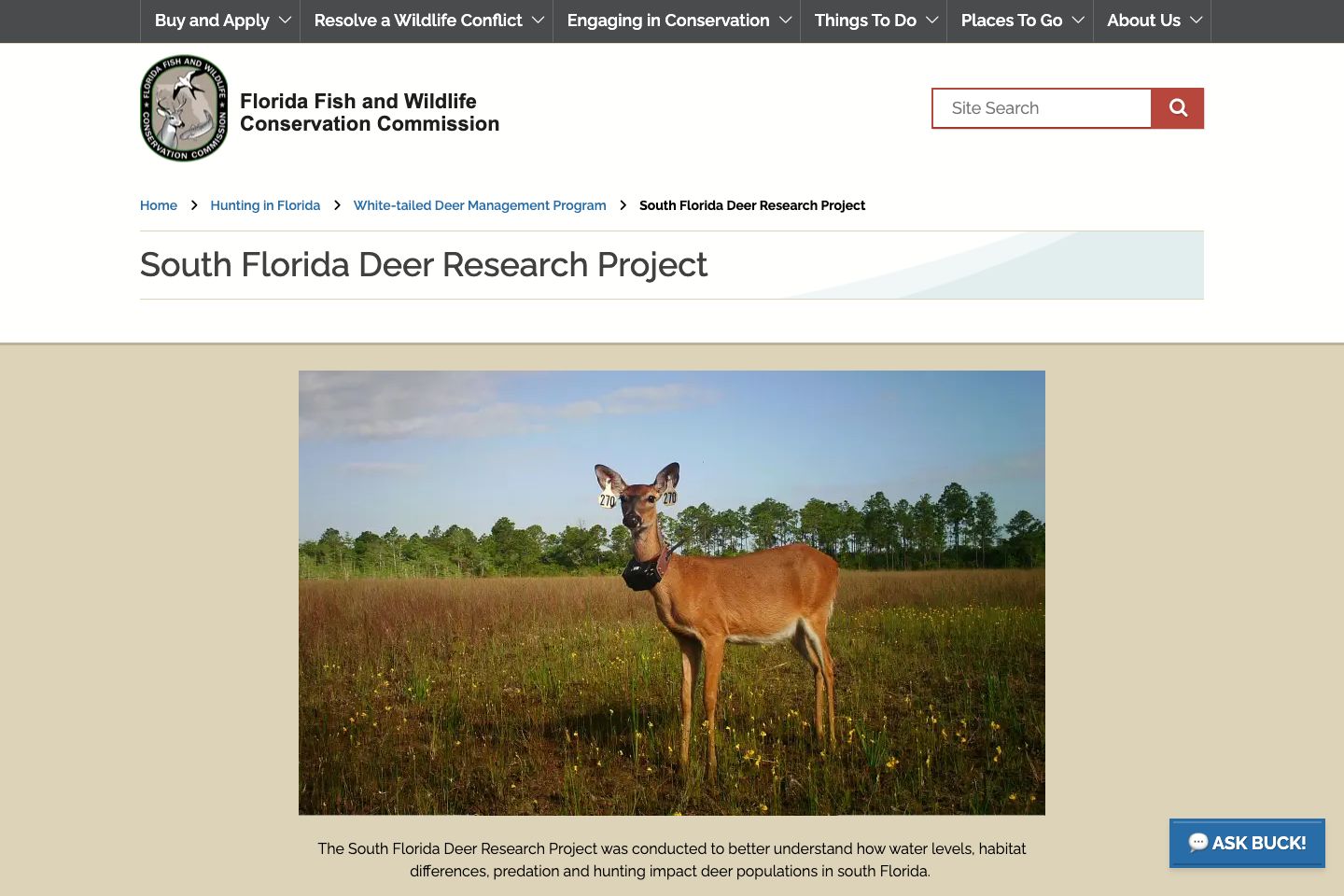
Hunters talk about “home range” as if every buck owns a fixed 640-acre box. GPS collar studies show something more useful: size depends on sex, season, habitat quality, and water or predator pressure, and individuals differ widely even on the same property.
Florida Fish and Wildlife Conservation Commission’s South Florida Deer Research Project fitted 263 adult deer (172 females, 91 males) with GPS collars across the Florida Panther National Wildlife Refuge and Big Cypress National Preserve study units, collecting more than 590,000 locations between capture seasons in 2015-2017 (FWC South Florida Deer Project). Average annual home range was about 2.7 square miles for males and 0.6 square miles for females (FWC South Florida Deer Project). Female ranges stayed relatively stable across seasons, while male seasonal ranges grew in the wet season - driven largely by rut movement (FWC South Florida Deer Project).
Key Takeaways
- Sex matters: bucks typically range larger than does (FWC South Florida Deer Project).
- Doe ranges can stay compact year-round when habitat meets needs (FWC South Florida Deer Project).
- Buck ranges expand with breeding-season travel (FWC South Florida Deer Project).
- Rich habitat can shrink ranges; poor or patchy habitat can expand them (MU Extension G9479).
- Hunt the animal’s seasonal map, not a single acreage myth.
What “home range” means in practice
A home range is the area an animal uses over a defined period to meet food, cover, water, and breeding needs - not a hard fence. Collars estimate it from location clouds. Annual ranges average across seasons; seasonal ranges show where a deer actually lives during October or January. That distinction matters when you hang a November stand based on a July camera card.
South Florida collar design and scale
The project ran 2014-2018 with intensive field work on Florida Panther NWR, the Bear Island Unit of Big Cypress, and North Addition Lands, partnering FWC with University of Georgia, Virginia Tech, the Jones Center, USFWS, and NPS (FWC South Florida Deer Project). Capture used net-gunning from helicopters, rocket nets, and darting; each collared adult also received ear tags and condition scoring before release at the capture site (FWC South Florida Deer Project). Parallel grids of 180 trail cameras collected about 477,000 wildlife photos used with collar movement models to estimate density without bait - important in a landscape where bait draws predators and floods remove feed (FWC South Florida Deer Project).
Seasonal stability versus rut expansion
FWC reports that across sites and seasons, female home ranges remained stable, suggesting does could meet needs - including lactation energy - inside a similar footprint (FWC South Florida Deer Project). Males’ seasonal home ranges were larger in the wet season (May-October) than the dry season (November-April), mainly because males moved considerably more during the rut (FWC South Florida Deer Project). For hunters elsewhere, the transferable lesson is not the calendar months - it is that breeding travel, not a fixed property line, often explains why a buck disappears from one food plot while remaining inside a larger annual range.
Water, risk, and path choice inside a range
Researchers found evidence that rising water levels reduced survival, especially for females, and pushed deer toward edges and roads where predation risk rose (FWC South Florida Deer Project). Predation - chiefly Florida panther - was the leading cause of mortality among collared deer, while legal hunting had minimal population impact under the study’s antler restrictions and refuge rules (FWC South Florida Deer Project). Even if your state has coyotes instead of panthers, the collar pattern still applies: risk and flood or snow barriers reshape travel routes inside a home range long before they erase the range.
Density estimates that sit beside range size
Using cameras plus GPS-informed detection models, average adult density estimates were about 9.1 deer per square mile on North Addition Lands, 13.8 on Bear Island, and 16.6 on Florida Panther NWR - higher than aerial surveys known to miss deer under thick canopy (FWC South Florida Deer Project). High-quality cover mosaics can support more deer in smaller individual ranges than sparse forage landscapes. MU Extension likewise notes that home-range size responds to habitat quality and arrangement: deer in fragmented or lower-quality landscapes often travel farther between bedding and food (MU Extension G9479).
Hunting applications without mythology
- Does: Expect tighter annual ranges; pattern food and cover inside a compact footprint when habitat is complete (FWC South Florida Deer Project).
- Bucks: Expect seasonal expansion during breeding travel; a buck leaving a 40-acre food plot may still live inside a multi-square-mile annual range (FWC South Florida Deer Project).
- Scouting: Remap bedding-to-feed links each month. Collar studies show seasonal shifts; your cameras should too (FWC South Florida Deer Project; MU Extension G9479).
- Access: Enter from the downwind edge of the range you actually documented, not from the road that bisects every deer on the property (FWC South Florida Deer Project).
Limits of any single study
South Florida hydrology, panthers, and subtropical breeding calendars differ from the Upper Midwest. Use FWC numbers as a worked example of sex and season effects, then ground-truth with local agency reports and your own multi-week location data (FWC South Florida Deer Project; MU Extension G9479). Other GPS analyses also describe sedentary versus mobile adult bucks - averages hide the individual you are hunting.
Bottom line for stand decisions
Home range is a research tool that should humble acreage bragging. Does often live small when habitat is complete; bucks stretch during breeding; both respond to water, forage, and risk. Build sits from seasonal evidence on your ground, not from a one-size mile figure repeated at camp (FWC South Florida Deer Project; MU Extension G9479).
Related: yearling buck dispersal and nocturnality under pressure.
The other side of it
The fair knock on collar studies is that a few dozen deer in one study area can’t tell you where the buck on your farm beds. True. They still beat the theory that every buck on the lease lives in the same thicket because somebody saw one there once.
Keep reading
Latest deer news
Comments