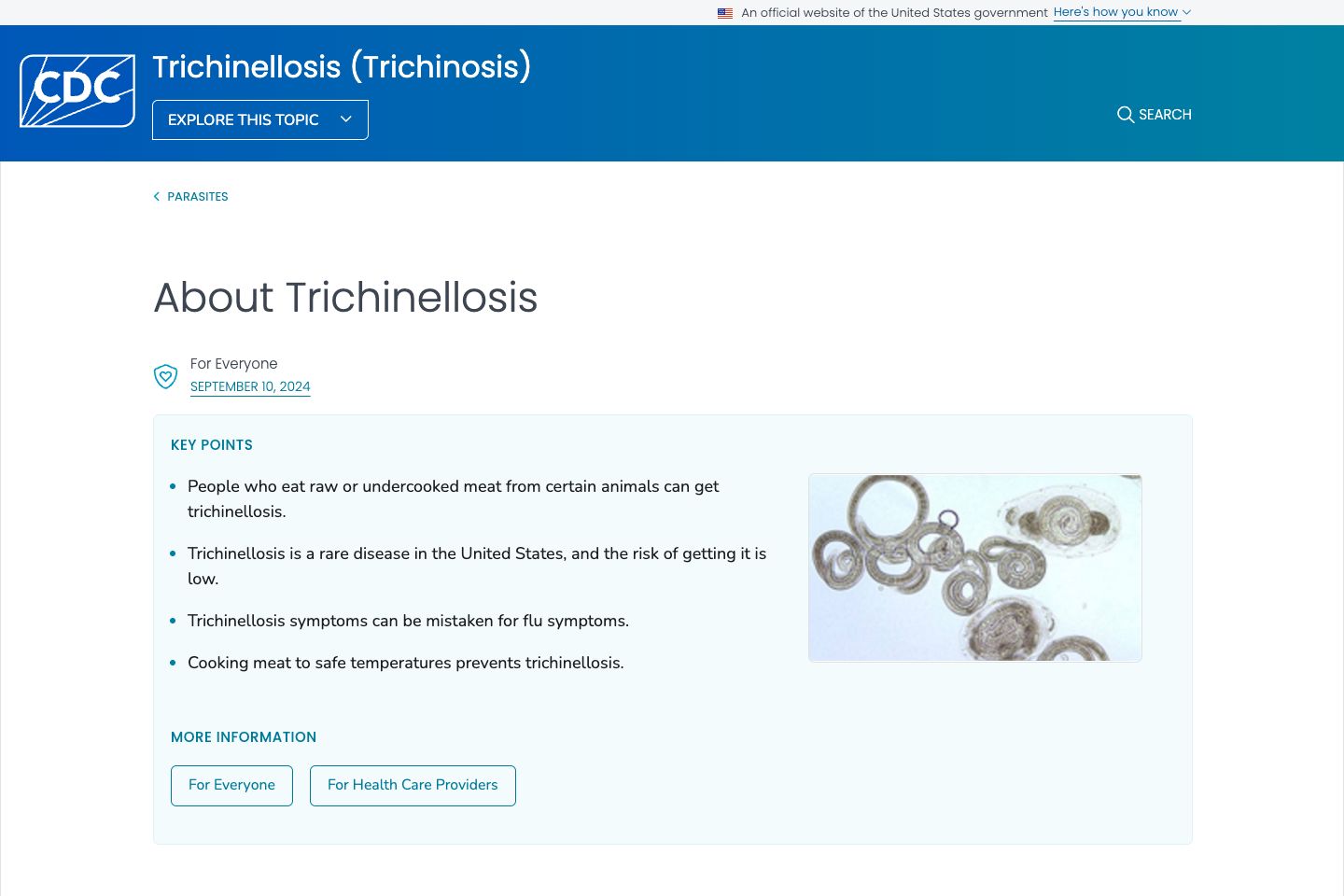
Trichinellosis comes from eating raw or undercooked meat containing Trichinella larvae. CDC materials emphasize wild game risk especially for carnivores and omnivores such as bear and wild pig, and they still advise cooking wild game thoroughly because freezing does not reliably kill all Trichinella species (CDC about trichinellosis; CDC prevention). Deer are herbivores and uncommon hosts, so pork-era folklore about venison is misplaced - but “uncommon” is not “impossible,” and CDC hunter guidance still centers on temperature, not species myths (CDC about trichinellosis; MMWR trichinellosis surveillance).
Key Takeaways
-
CDC identifies wild game, especially bear and wild pig, as important modern U.S. sources of trichinellosis (CDC about trichinellosis; MMWR trichinellosis surveillance).
-
Cook wild game to safe internal temperatures; freezing is not a universal kill step for all Trichinella species (CDC prevention).
-
Deer are not typical Trichinella reservoirs the way swine or bears are, so classic pork trichina folklore does not transfer cleanly to venison (CDC about trichinellosis).
-
Rare documented links to deer meat appear in surveillance discussions; treat them as reminders to cook, not as proof venison is high risk (MMWR trichinellosis surveillance; CDC about trichinellosis).
-
Separate trichina cooking rules from CWD tissue-avoidance rules - both can apply to the same carcass for different reasons (CDC prevention).
What Trichinella is
Trichinella nematodes encyst in muscle. Humans get sick by eating those larvae. CDC’s about page covers symptoms and the shift from pork-dominated outbreaks to wild game-associated cases in recent decades (CDC about trichinellosis). Surveillance summaries document that pattern with case counts and implicated meats (MMWR trichinellosis surveillance).
Why pork rules mislead deer hunters
Commercial pork systems reduced Trichinella through production changes. Old family rules about cooking pork well done linger in deer camps and get pasted onto venison without biology. Deer, as herbivores, rarely encounter the carcass diets that infect bears and feral swine (CDC about trichinellosis). That ecological difference matters.
It does not authorize steak tartare from the cooler. CDC prevention still says cook wild game properly and warns that freezing may fail against some species (CDC prevention.
What to tell the camp
Lead with thermometer temperatures from CDC prevention guidance, not with “deer cannot get trichina” absolutism (CDC prevention; CDC about trichinellosis). Mention that bear and wild pig deserve extra respect when someone in camp also hunts those species (MMWR trichinellosis surveillance).
Ground mixed grinds that include multiple species inherit the highest-risk animal in the batch. Keep species separate if you share a grinder (CDC prevention.
Freezing myths
Some Trichinella types resist home freezing. CDC prevention language exists specifically so hunters do not treat a winter cold snap as sterilization (CDC prevention. Cook. Then freeze for storage if you want.
Cross-linking other venison safety topics
CWD prion precautions target brain and spinal tissues. Trichina precautions target larval nematodes in muscle. You can do everything right for one and fail the other (CDC about trichinellosis; CDC prevention. Teach both checklists.
Bottom line
Trichinella risk in the United States now tracks wild carnivores and omnivores more than grocery pork, and deer sit far down that list - yet CDC still wants wild game cooked to temperature because freezing is not a universal fix (CDC about trichinellosis; CDC prevention; MMWR trichinellosis surveillance).
Thermometer habits that match CDC prevention
CDC prevention guidance centers on cooking meat to temperatures that kill Trichinella rather than on guessing by color (CDC prevention; CDC about trichinellosis). Carry a calibrated instant-read thermometer in the camp kitchen. Whole muscle and ground products need attention; grinding distributes any larvae that were present.
When someone cites an old pork freezer rule, open the CDC prevention page and read the freezing caveat aloud (CDC prevention). That single habit ends most of the folklore loop.
Species risk ladder for mixed camps
Put bear and feral swine at the top of caution, other carnivore and scavenger meats next, and deer lower based on ecology and surveillance patterns (CDC about trichinellosis; MMWR trichinellosis surveillance). Lower does not mean raw. It means you stop telling new hunters that venison has the same trichina story as 1950s pork.
If your club processes bear and deer on the same weekend, sanitize grinders between species and package clearly (CDC prevention; MMWR trichinellosis surveillance).
Symptoms literacy without self-diagnosis
CDC describes gastrointestinal onset followed by muscle pain, fever, and facial swelling in classic trichinellosis (CDC about trichinellosis). Anyone with those symptoms after a wild-game feed should see a clinician and mention the meal. Do not crowd-source steroids on a forum.
Surveillance reports exist so public-health agencies can spot clusters; your job is cooking and honest history-taking when a doctor asks (MMWR trichinellosis surveillance; CDC prevention).
Keep CWD and trichina checklists side by side
On the cutting board: avoid specified risk tissues for CWD where advised, and cook muscle to trichina-safe temperatures per CDC (CDC prevention; CDC about trichinellosis). They solve different problems. Teaching only one checklist creates false confidence about the other.
Camp kitchen standard operating procedure
Post a one-page SOP: thermometer target from CDC prevention, no reliance on freezing alone, separate cutting boards for raw wild game, and a note that deer risk is lower than bear but not a free pass for undercooked sausage (CDC prevention; CDC about trichinellosis; MMWR trichinellosis surveillance).
Require every new cook to read the SOP before the first feed. Folklore travels faster than PDFs unless you put the PDF on the fridge.
Why herbivory lowers but does not erase concern
Trichinella cycles efficiently when meat eaters eat meat eaters. Deer mostly eat plants, so exposure opportunities shrink (CDC about trichinellosis). Occasional odd exposures and rare case reports are why public-health language stays measured instead of absolute (MMWR trichinellosis surveillance). Hunters should copy that tone: accurate ecology, disciplined cooking (CDC prevention).
Related: Venison nutrition vs beef and Deer organs to avoid in CWD zones.
The other side of it
If deer sit this far down the risk list and documented cases are rare, a hunter could fairly ask why venison needs the same sermon as bear. The article also keeps pointing to CDC’s thermometer target without ever printing the number, which is a strange gap in a piece about cooking to temperature. “Grandpa ate it pink and lived” is still a sample size of one, and Grandpa wasn’t running bear through the same grinder.
Keep reading
Latest deer news
Comments