Can you sell venison from a deer you shot? In every state we checked, no. Wisconsin, Minnesota, Maryland and South Carolina all ban selling meat from wild deer, even when the deer was taken legally. Federal law adds a second layer: the Lacey Act makes it a federal crime to sell wildlife across state lines if it was taken or sold in violation of state law. Farm-raised venison that goes through official inspection is a different category, and some states allow its sale. This guide covers what the official sources say. Check your own state’s wildlife agency before you sell any part of a deer. Verified November 2026.
Key Takeaways
- Wisconsin’s DNR lists “The meat or bones (other than the head bones) of a wild deer” as illegal to buy, sell or trade.
- Maryland law bars selling any game mammal “taken from the wild, in the State or in another state, territory, or country.”
- Minnesota’s guidance for processors says selling wild game meat “has a criminal penalty of a gross misdemeanor.”
- The federal Lacey Act covers wildlife “taken, possessed, transported, or sold in violation of any law or regulation of any State.”
- Farm-raised venison can be legal to sell where state law allows it, usually with official inspection and records.
The federal rule: the Lacey Act
The Lacey Act doesn’t ban selling venison by itself. It makes state wildlife laws enforceable across state lines. Under 16 U.S.C. 3372, it is unlawful “to import, export, transport, sell, receive, acquire, or purchase in interstate or foreign commerce” any “fish or wildlife taken, possessed, transported, or sold in violation of any law or regulation of any State” (16 U.S.C. 3372, govinfo).
In plain terms: if selling wild venison breaks your state’s law, moving or selling it across state lines can also be a federal offense.
State examples: wild venison sales are banned
Wisconsin
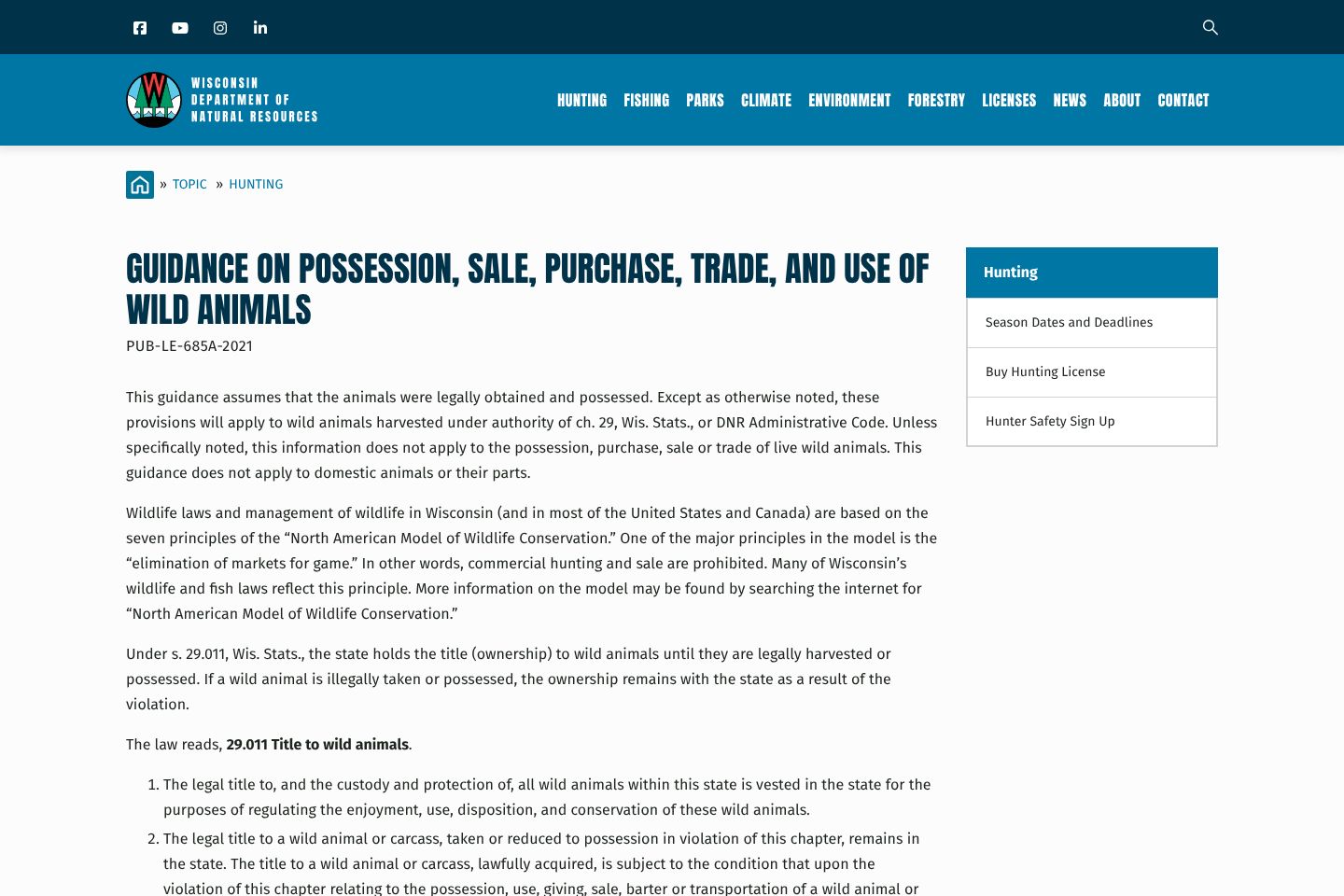
The Wisconsin DNR’s guidance on the sale and trade of wild animals lists what is illegal to buy, sell or trade, starting with “The meat or bones (other than the head bones) of a wild deer.” The DNR explains the reason: Wisconsin’s wildlife laws follow the North American Model of Wildlife Conservation, and one of its principles is the “elimination of markets for game.” In the DNR’s words, “commercial hunting and sale are prohibited” (Wisconsin DNR). You can give the meat away. The DNR says “The meat may be given to another person, but the person registering the deer must retain the registration confirmation number until the meat from the deer is consumed” (Wisconsin DNR).
Wisconsin does allow selling some parts. The DNR lists “All deer heads, hides, tails and antlers (including their sheds) from legally taken wild deer (excluding antlers in the velvet and spotted skins of wild deer)” as legal to sell.
Minnesota
A Minnesota Department of Agriculture fact sheet on DNR rules for wild game processors says “It is unlawful to buy or sell living animals and/or parts of the carcass including products such as sausage, raw meat cuts including steaks and roasts, ground meat or any other edible products from that carcass.” It says “Buy” or “Sell” includes barter and offers, and that “This type of violation is very serious and has a criminal penalty of a gross misdemeanor” (Minnesota Dept. of Agriculture).
Inedible parts are treated differently. The fact sheet says “Inedible portions of lawfully taken game, including bones, antlers, feather, hides, and hoofs may be bought or sold unless specifically prohibited by statute.” Processors must mark packages “Not for Sale.”
Minnesota’s current statute on inedible parts, Minn. Stat. 97A.512, says a person may buy or sell “the following inedible portions of lawfully taken or acquired big game animals,” listing “bones, including skulls; sinews; adipose tissue, hides, and skins; hooves; teeth; claws; and antlers.” It also says “A person may not buy or sell bear paws, unless attached to the hide, or bear gallbladders” (Minn. Stat. 97A.512).
Maryland
Maryland law says a person “may not sell, offer for sale, barter, or exchange, at any time within the State any game bird or game mammal taken from the wild, in the State or in another state, territory, or country” (Md. Code, Nat. Res. 10-404).
South Carolina
South Carolina makes it “unlawful to buy or sell, offer for sale, barter, or have in possession for sale” the “venison of any deer,” with limited exceptions. A first offense carries a fine of “not less than three hundred dollars nor more than five hundred dollars” or up to 30 days in jail (S.C. Code 50-11-1910).
What about farm-raised venison?
This is where it changes. Maryland allows sale of “domestically raised, officially inspected, and processed venison,” but the law excludes white-tailed and sika deer from that exception. Sellers must keep records of the venison’s origin for a year (Md. Code, Nat. Res. 10-404).
South Carolina lets a permitted food service establishment “purchase and sell exotic farm-raised venison which is processed through an official establishment, certified by the State Livestock-Poultry Health Commission or the United States Department of Agriculture” (S.C. Code 50-11-1920).
At the federal level, 9 CFR Part 352 covers voluntary USDA inspection of exotic animals. Its definitions say “Exotic animal means any reindeer, elk, deer, antelope, water buffalo, bison, buffalo, or yak,” and that deer “refers to the any farm-raised species of the family Cervidae” (9 CFR 352.1, govinfo). In other words, the federal inspection definition is written around farm-raised deer, not wild ones. Wisconsin’s DNR also lists “All carcasses, skins and parts from farm-raised deer with proper proof of source” as legal to sell.
What about donating venison or paying a processor?
Wisconsin’s DNR allows giving venison away, as noted above. Processing fees for donated deer are addressed in South Carolina’s statute, which lets “the department” set rules for processors to handle donated doe deer and “recover the fee of processing the deer from a person other than the individual who donated the deer.” For donation programs, see our guide to Hunters for the Hungry donation rules by state.
FAQ
Can I sell deer antlers or hides? In some states, yes. Wisconsin’s DNR and Minnesota’s statute 97A.512 both allow sale of certain inedible parts from legally taken deer, such as hides and antlers, with exceptions. Rules vary by state.
Can I trade venison for something else? Usually that counts as a sale. Minnesota’s definition includes “exchange for consideration, barter,” and Wisconsin’s DNR lists wild deer meat as illegal to buy, sell or trade.
Can restaurants serve venison? In South Carolina, a permitted food service establishment can buy and sell exotic farm-raised venison processed through an official establishment. It must first get a permit from the department. Rules in other states vary.
Does the Lacey Act apply to every sale? Its state-law section covers sales “in interstate or foreign commerce.” Selling within one state is mainly a matter of state law.
The other side of it
There’s a fair case against blanket bans. A hunter who legally fills several tags may have more meat than one family can eat, and a farmer can sell a steer, so why not a deer? The answer the states give is about the system, not the deer. Wisconsin’s DNR ties its ban to the “elimination of markets for game,” the idea that wild animals are a public resource and a paying market for them invites overharvest. You can disagree with that tradeoff and still follow the law while you lobby to change it. And the guy who calls his cash deal a donation with a suggested price should know Minnesota’s definition of a sale already includes “exchange for consideration, barter.”
This guide covers federal law and four states, not all 50. Laws change, and exceptions for processors, donations, parts and farm-raised deer vary by state. This is general information, not legal advice. Before selling, trading or bartering any part of a deer, check your state wildlife agency’s current regulations or ask a game warden.
Keep reading
Wisconsin's biggest bucks in the record book →
Latest deer news
Sources
- 16 U.S.C. 3372, Prohibited acts (Lacey Act), U.S. Government Publishing Office (govinfo)
- Guidance on Possession, Sale, Purchase, Trade, and Use of Wild Animals, Wisconsin DNR
- An Overview of Wild Game Laws for Wild Game Processors, Minnesota Department of Agriculture
- Maryland Code, Natural Resources 10-404, Maryland General Assembly
- South Carolina Code of Laws, Title 50 Chapter 11 (Sections 50-11-1910 and 50-11-1920), South Carolina Legislature
- 9 CFR 352.1, Definitions (Exotic Animals and Horses; Voluntary Inspection), 2025 edition, U.S. Government Publishing Office (govinfo)
- Minnesota Statutes 97A.512, Sale of inedible portions of big game animals (2026), Minnesota Office of the Revisor of Statutes
Comments