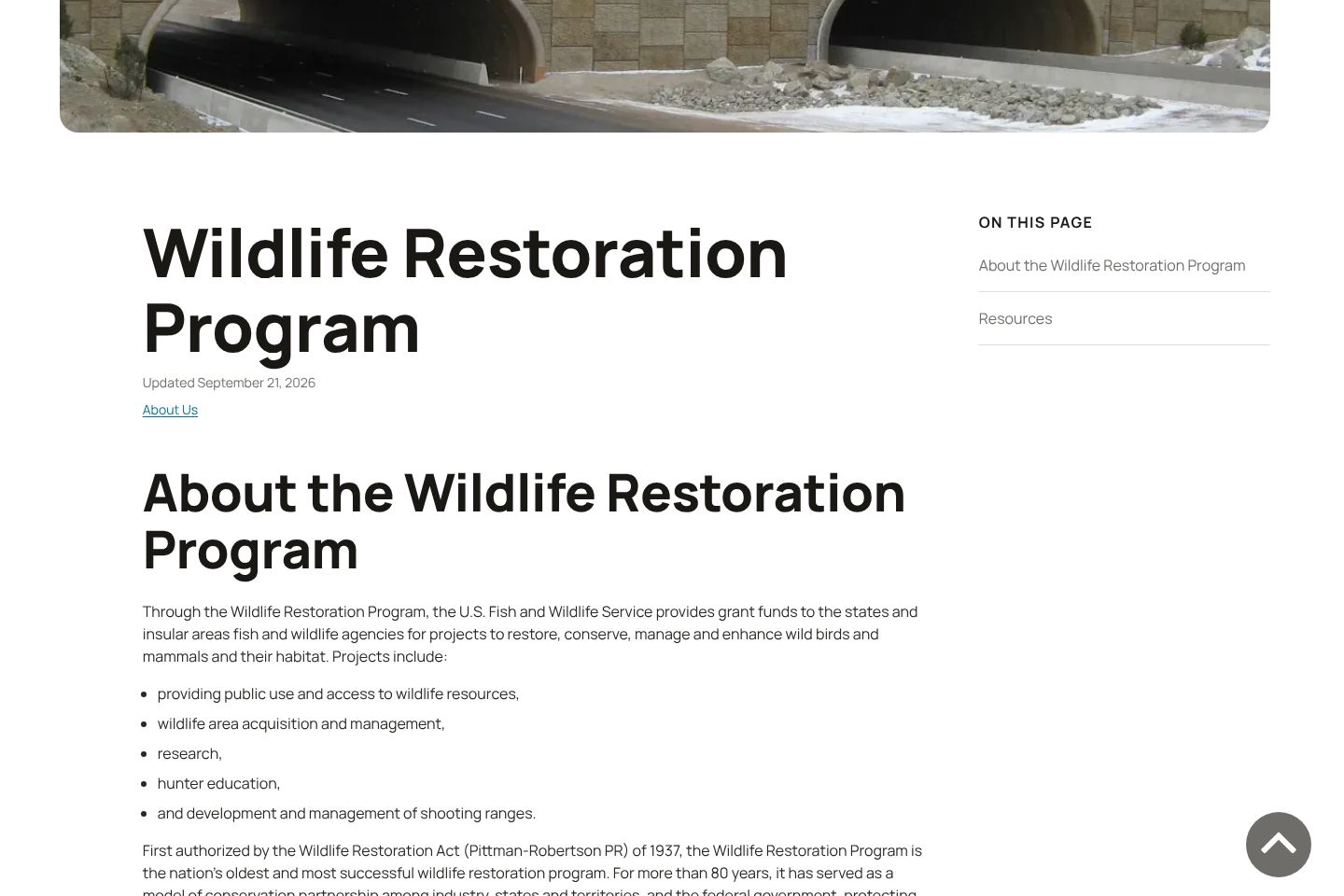
The Pittman-Robertson Wildlife Restoration Act of 1937 created the durable funding pipe behind modern state deer management: manufacturers pay federal excise taxes on firearms, ammunition, and later archery equipment; the U.S. Fish and Wildlife Service apportions those dollars to state fish and wildlife agencies for wildlife restoration, habitat, research, hunter education, and shooting-range work (USFWS Wildlife Restoration; NSSF Wildlife Restoration Program).
Key Takeaways
- PR is a user-pay excise tax on hunting/shooting/archery gear, not a general income tax (USFWS; NSSF).
- States must match federal dollars (classically 3 federal : 1 nonfederal, often from license sales) (NSSF; Partner with a Payer winter habitat).
- Funds buy and manage habitat, surveys, research, access, hunter ed, and ranges (USFWS).
- Whitetail recovery after market hunting used closed seasons plus this funded professional management (NDA 85 years; Partner with a Payer).
- Diversion to unrelated state budget items is restricted by federal program rules (NSSF).
How the money moves
USFWS describes Wildlife Restoration as grants to states and territories for projects that restore, conserve, manage, and enhance wild birds and mammals and their habitats, plus public access, research, hunter education, and shooting ranges (USFWS). Industry summaries place the excise near 10-11% on covered arms, ammo, and archery gear and note cumulative investments in the many billions since 1937, with hundreds of millions generated in recent years (NSSF; NDA 85 years). National Deer Association cited about $1.1 billion apportioned to state agencies in a recent celebration year (NDA 85 years). States submit plans; USFWS administers; license dollars commonly supply the required match (Partner with a Payer; NSSF).
What deer hunters actually get
Partner-with-a-Payer case notes show PR dollars mapping and managing northern deer wintering cover in Vermont, acquiring cedar winter range in Michigan, and expanding wildlife management areas with deer as a priority species in Maine (Partner with a Payer winter habitat). Example apportionments cited there include millions annually to those states for Wildlife Restoration work tied to habitat and surveys (Partner with a Payer winter habitat). NSSF state vignettes credit PR-era management with growing Alabama’s deer herd from roughly 15,000 in 1937 to about 1.6 million by 2018 with far longer seasons - an illustration of funded recovery, not a claim that tax alone caused every deer (NSSF). USFWS framing is broader than deer alone - hundreds of species monitored and tens of millions of acres under habitat/access management in industry tallies - but whitetails are among the clearest beneficiaries of professional, funded state programs (USFWS; NSSF).
Why the structure matters
Because revenue scales with equipment sales and is dedicated to wildlife restoration purposes, agencies gain a steadier science and habitat budget than year-to-year general-fund politics alone would provide (USFWS; NSSF). Federal rules tying dollars to hunting/recreation enhancement and barring casual diversion are part of why sportsmen defend the system (NSSF). Match requirements keep states invested through licenses - another reason license compliance is conservation funding, not only permission to hunt (Partner with a Payer).
Link to the crash-and-comeback story
USFWS and conservation partners describe PR as the nation’s oldest major wildlife restoration partnership among industry, states, and the federal government (USFWS). It arrived after market hunting and habitat loss had emptied much of the East of deer; closed seasons and restocking needed professional staff, land, and data that PR helped pay for (NDA 85 years; Partner with a Payer harvest). Modern bag limits, DMUs, and CWD sampling programs sit on that funding foundation even when a hunter never sees the grant paperwork.
Bottom line
Pittman-Robertson turns gear purchases into state wildlife capacity - habitat, surveys, education, ranges - under USFWS apportionment and state match rules (USFWS; NSSF). Deer seasons exist in their modern form because that pipe kept flowing after the market-hunting collapse (NDA 85 years).
Related: whitetail near extinction comeback and bag limits.
The crash
Fair abundance gave way to market hunting and habitat destruction; early game laws were weak; by 1925 Missouri estimates hit about 400 deer (MU Extension G9479).
The other side of it
Several of the big dollar figures here come from industry and conservation-group summaries, and even NSSF frames Alabama’s climb from roughly 15,000 deer to about 1.6 million as an illustration, not proof the tax did it alone. Closed seasons and restocking did plenty of the early lifting. And because the money scales with equipment sales, a slow year at the gun counter means a thinner check for the states.
Keep reading
Latest deer news
Sources
- Wildlife Restoration Program | U.S. Fish & Wildlife Service
- NSSF Wildlife Restoration Program (nssf.org)
- White-tailed Deer Rely on Quality Winter Habitats – Partner with a Payer
- NDA 85 years (deerassociation.com)
- Sharing the Wild Harvest – Partner with a Payer
- Ecology and Management of White-Tailed Deer in Missouri | MU Extension
- FWS hunters as conservationists (fws.gov)
Comments