Does a fenced deer hunting preserve need a zoning permit in Kansas? In Coffey County it does, the Kansas Court of Appeals ruled on Nov. 20, 2026. The court held that Danny and Laura Hawkins’ fenced hunting operation for domesticated deer is “being used as a recreational hunting preserve” under the county zoning regulations, not farmland exempt from zoning, and that “the Landowners need a special use permit” (Iseman v. Coffey County Board of Zoning Appeals, No. 129,117, official opinion PDF).
The case is Iseman v. Coffey County Board of Zoning Appeals, No. 129,117. The court heard oral argument on Sept. 8, 2026, and filed the opinion on Nov. 20, 2026 (official opinion PDF, Kansas Judicial Branch).
Key Takeaways
- The Court of Appeals affirmed a Coffey County district court ruling that the Hawkinses need a special use permit for their roughly 100-acre domesticated deer hunting facility (official opinion PDF).
- The court agreed domesticated deer are livestock in Kansas, but found that selling hunts for them “goes beyond the agricultural purpose” of the farm exemption in state zoning law (official opinion PDF).
- The opinion says customers pay $3,500 to $7,500, depending on antler size, and can hunt “with whatever weapon they want” (official opinion PDF).
- The case is No. 129,117, and the opinion was filed Nov. 20, 2026 (official opinion PDF).
What did the Kansas Court of Appeals decide?
The three-judge panel of Judges Hill, Schroeder and Coble framed the question as “whether the use of their land qualifies as agricultural use when its primary purpose is to hunt specially bred and managed domesticated deer in a confined, fenced-in area.” Its answer was no. The opinion ends with one word: “Affirmed” (official opinion PDF).
The court called the county board’s earlier ruling for the landowners “unreasonable and contrary to the law” and found “the district court correctly held the Board acted unreasonably” (official opinion PDF).
Who brought the case, and how did it get to the appeals court?
The landowners are Danny and Laura Hawkins, who the court says “operate about a 100-acre domesticated deer hunting facility” in Coffey County. The neighbors who sued are Jim and Diana Iseman and Bill and Kara Reynolds, whose land is adjacent. The court said the neighbors “have safety concerns related to the operation of the hunting facility” (official opinion PDF).
It has been going on since 2019. According to the opinion, the county zoning administrator wrote the Hawkinses on July 25, 2019, that they were violating county zoning “by operating a privately owned deer hunting preserve.” The Hawkinses appealed to the Board of Zoning Appeals, and in October 2019 the board reversed her, finding the land “appears to be a privately owned natural wildlife habitat and reserve which is considered an agricultural use” (official opinion PDF).
The neighbors took the board to district court and won, but the Hawkinses had not been named as parties. The court said the Hawkinses then “filed an entirely new lawsuit,” and the district court reopened the case to let them in. It again found the land was being used as a hunting preserve. On appeal, the panel held the Hawkinses were “an indispensable party” and that the district court did not abuse its discretion in letting them intervene. It also held their 2019 appeal to the board was timely (official opinion PDF).
Why isn’t a fenced domesticated deer hunt treated as farming?
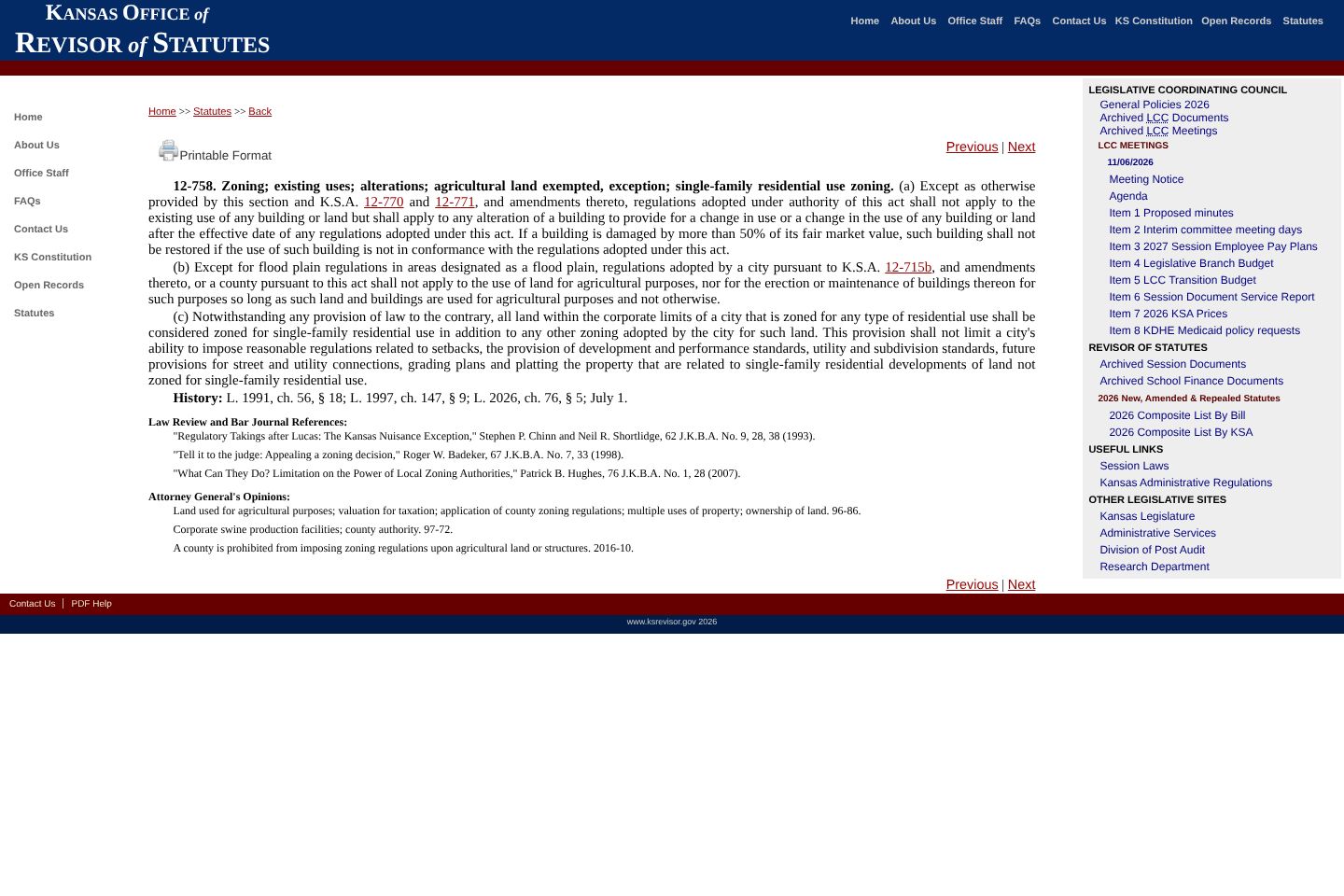
Kansas law keeps county zoning off farm ground. The state statute says county regulations “shall not apply to the use of land for agricultural purposes” so long as the land is “used for agricultural purposes and not otherwise” (K.S.A. 12-758, Kansas Revisor of Statutes). The county zoning statute has the same language (K.S.A. 19-2908).
Nobody argued the deer weren’t livestock. The court wrote that “the parties do not dispute domesticated deer are considered livestock,” and raising livestock counts as agricultural activity under Kansas law. Its question was whether deer “produced for commercial hunting” count as an agricultural pursuit (official opinion PDF).
The court leaned on a 2006 case about a racehorse training track, Board of Seward County Comm’rs v. Navarro, where horses were livestock but training them to race was not traditional agriculture. “While hunting domesticated deer is different from running a horse racetrack,” the panel wrote, “the activity tied to the domesticated deer here goes beyond the agricultural purpose for which the statutory exception was designed to protect” (official opinion PDF).
It pointed to how the business is run. Per the opinion, the operation is called OZsome Big Game Hunts and offers rides “to and from Kansas City International Airport” for out-of-state hunters, plus “photography and video for its customers.” The court also said “the Landowners’ customers pay between $3,500 and $7,500,” with the price based on antler size, “to hunt with whatever weapon they want.” Its conclusion: “The livestock are raised for recreational hunting” (official opinion PDF).
How is this different from planting food plots for wild deer?
The Hawkinses had a 1989 case on their side, Corbet v. Board of Shawnee County Comm’rs, where a wildlife hunting preserve was found to be agricultural. The panel said Corbet “is distinguishable as the landowners there cultivated land to attract wildlife to the property for hunting. Here, the Landowners are using their land to hunt domesticated deer, not wildlife” (official opinion PDF).
The opinion notes the Hawkinses “admit the deer are domesticated livestock, the deer are not wild, and they even had the wild deer removed from the fenced area.” The court’s line on that: “The deer are in the restricted area to be hunted” (official opinion PDF).
The ruling turns on that difference: bred deer behind a fence sold as hunts, not wild deer drawn in by what a landowner plants. For the wider argument over hunting behind wire, see RAD’s look at high fence hunting and our guide to high fence deer rules and record books.
Who regulates domesticated deer in Kansas?
The court said it “was uncontroverted below the Kansas Department of Wildlife and Parks does not have jurisdiction over the killing of domesticated deer.” Because they are livestock, “they are regulated by the Department of Agriculture,” and “there is no designated hunting season” for them. The court added that state law still requires “a valid Kansas hunting license” to hunt in Kansas, and “the statute does not distinguish between hunting wildlife or domesticated animals” (official opinion PDF).
Kansas law says “it shall be unlawful for any person to possess domesticated deer unless such person has obtained from the animal health commissioner a domesticated deer permit.” It defines domesticated deer as cervids “being sold or raised in a confined area” for breeding stock, carcasses or parts, exhibition or companionship (K.S.A. 47-2101, Kansas Revisor of Statutes).
Why did safety come into it?
County rules say some uses in agricultural districts need special use permits because they “might have an adverse effect upon nearby properties.” The panel added, “as we all know, bullets can have an adverse effect once discharged.” It wrote that the neighbors “are simply requesting the Landowners follow the zoning laws by obtaining a special use permit to run their recreational business” (official opinion PDF).
The court summed up the neighbors’ argument as a hunting preserve that “poses a danger to neighboring properties only a few hundred yards away.” In its own words, the advertised “whatever weapon you want” policy poses “significant dangers to neighboring landowners, as bullets know no boundary” (official opinion PDF).
The other side of it
The court itself noted that Kansas zoning rules “must be liberally construed in favor of the property owner,” and the Hawkinses argued that no Kansas law restricts how agricultural products are harvested. This ruling is about one operation in one county, and the court tied it to “the facts of this case.” It decides that this operation needs a permit. The opinion does not say whether the county will grant one (official opinion PDF).
Sources
- Iseman v. Coffey County Board of Zoning Appeals, No. 129,117 (Kansas Court of Appeals opinion, filed Nov. 20, 2026), Kansas Judicial Branch (official opinion PDF, linked from the decisions list)
- K.S.A. 12-758 | Kansas Office of Revisor of Statutes, Kansas Office of Revisor of Statutes
- K.S.A. 19-2908 | Kansas Office of Revisor of Statutes, Kansas Office of Revisor of Statutes
- K.S.A. 47-2101 | Kansas Office of Revisor of Statutes, Kansas Office of Revisor of Statutes
Comments