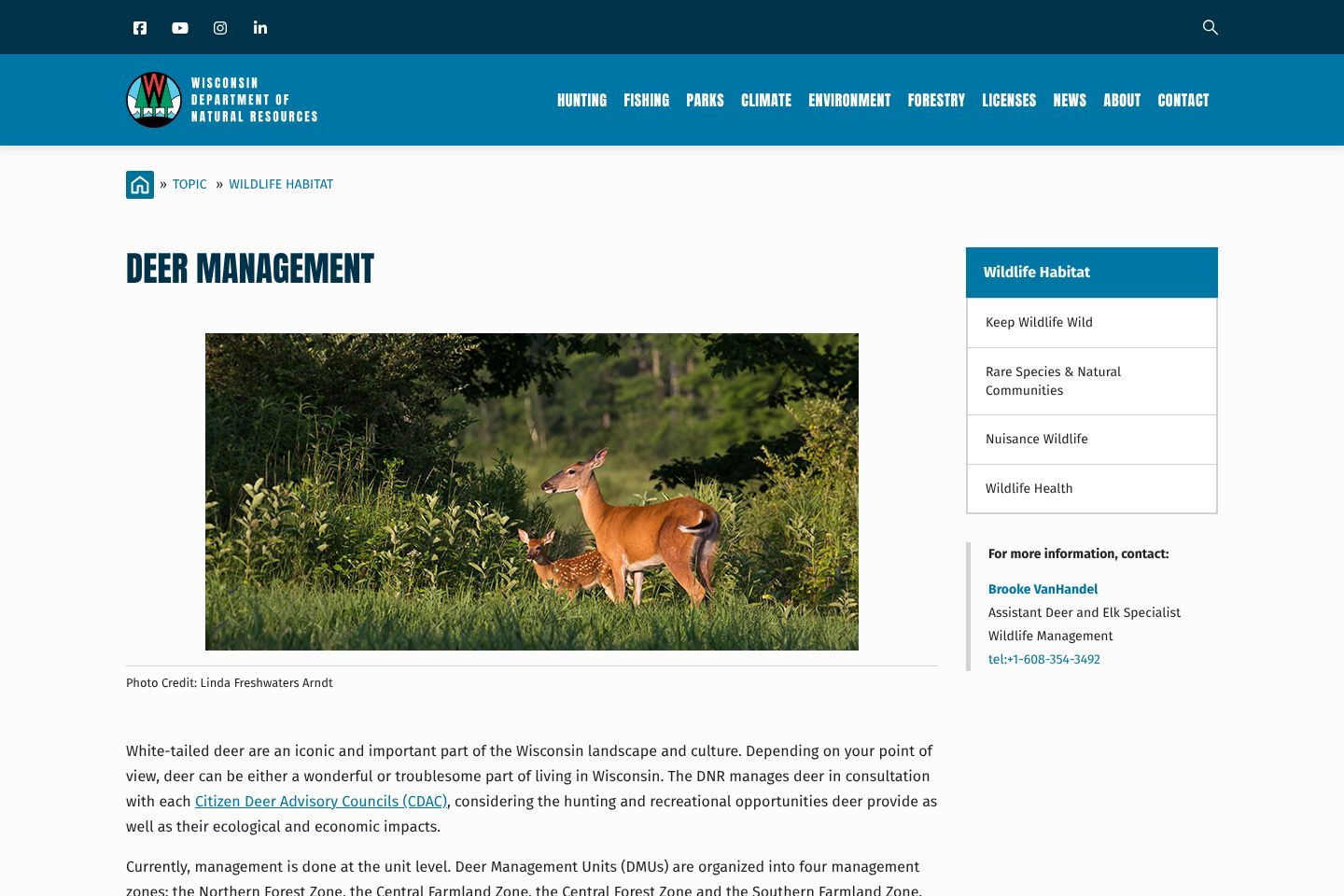
Agencies set deer harvest caps with two different tools that get blurred at the truck: a bag limit, which is how many deer one person may tag, and a quota or authorization pool, which is how much antlerless harvest a management unit is supposed to deliver. Both serve a population objective to increase, decrease or maintain the herd, balancing biology against crop damage, collisions and hunter opportunity. Wisconsin’s council system is the clearest public example of how those numbers get made (WI DNR CDAC).
Key Takeaways
- Bag limits govern individual hunters; quotas govern unit-scale antlerless take (WI DNR CDAC).
- Antlerless harvest is the main density lever (MU Extension G9491; MU Extension G9479).
- Councils and agencies use fawn:doe ratios, harvest, damage, collisions and winter severity (WI DNR CDAC).
- Paper quotas only work if hunters fill tags (MU Extension G9491).
- Neighboring units can carry different rules for habitat and impact reasons (WI DNR deer management).
What’s the difference between a bag limit and a quota?
A statewide or season bag limit answers “how many may I keep?” A unit’s antlerless quota answers a different question: how many does should this landscape give up this year to move toward the objective (WI DNR CDAC)?
The unit itself is a management tool. In Wisconsin, Deer Management Units sit inside four habitat zones: Northern Forest, Central Farmland, Central Forest and Southern Farmland. Farmland units often mirror counties, forest units may be habitat-based, and metropolitan subunits carve urban deer problems out of larger units. Recent map reviews reconsidered the northern units and metro boundaries, so the lines on the map aren’t permanent either (WI DNR deer management).
Who sets the quota, and how often does it change?
Wisconsin splits long goals from yearly tools. Citizen Deer Advisory Councils (CDACs) for each unit review herd indicators and impacts, then recommend three-year population objectives along with annual antlerless quotas, permit levels and some season options. The Natural Resources Board adopts the final package (WI DNR CDAC; WI DNR deer management).
Every three years, councils revisit whether a unit should increase, decrease or hold the herd. They weigh fawn:doe ratios, antler development, herd health, farm and forest impacts, vehicle collisions and hunter experience. Each spring, after public comment, they meet on quotas and season framework and send recommendations up for approval. Department staff supply the data and run the meetings, but the council drafts what the board receives (WI DNR CDAC).
Councils can also weigh options like holiday antlerless firearm windows or extended archery and crossbow dates where they’re authorized (WI DNR deer management; WI DNR CDAC). If you want more or less doe pressure in your unit, those meetings are where it gets decided.
Why do agencies lean so hard on antlerless tags?
Because does drive the math. MU Extension says hunting mortality of does is the single most important factor in whether a deer population grows or shrinks, since one buck can breed many does. Buck-heavy bags without antlerless tools make weak density controls (MU Extension G9479).
Adult sex-ratio goals around one buck to two or three does are usually reached by taking more does than bucks, then monitoring so the ratio doesn’t drift (MU Extension G9491). Private QDM cooperatives still work inside the legal caps. A property goal can’t exceed the regulations (MU Extension G9480; MU Extension G9491).
People count too. Even when the woods still hold plenty of food, collisions and crop damage people won’t tolerate push agencies toward higher antlerless quotas. MU Extension calls that cultural carrying capacity (MU Extension G9479).
What data moves next year’s numbers?
Council packets commonly include prior harvest, recruitment indices, winter severity, and damage or collision complaints, and annual quotas adjust for last year’s harvest and winter (WI DNR CDAC). A hemorrhagic-disease year, a hard winter or a surge in crop complaints can flip next season’s authorizations even when the trail-camera bucks still look plentiful.
It cuts the other way, too. Under-filled antlerless quotas leave the gardens, crashes and forest browse problems unsolved (MU Extension G9479; WI DNR CDAC). Fill rates are what turn a quota into actual population change.
How should you read your state’s deer regulations?
- Find your management unit or county and its population objective (WI DNR deer management).
- Separate the antlered bag rules from antlerless authorization counts, deadlines and leftover-tag rules (WI DNR CDAC).
- Look for metro or farmland special seasons that exist to raise antlerless harvest where firearms are limited (WI DNR deer management).
- In a “decrease” unit, filling antlerless tags is management participation, not second-class hunting (MU Extension G9491).
- Check again every year, because quotas are built to move after winters and harvest reports (WI DNR CDAC).
Are quotas accurate?
Not perfectly. A quota is a negotiated product of biology, public input and board approval, and it gets adjusted because last year’s harvest, winter and disease change the starting point (WI DNR CDAC). When hunters pass on doe tags in a decrease unit, the political fight over car crashes and crop loss usually comes back harder the next cycle (MU Extension G9479).
The other side of it
Wisconsin’s council system is one model, not the national standard, and Wyoming gets to its numbers through biologist surveys and commission approval instead. Wyoming Game and Fish says its staff count deer from mid-November, survey license holders on harvest, and send recommendations to the Commission “at their April meeting for review and approval” (Wyoming Game and Fish). Quotas are negotiated products rather than perfect forecasts, so a hunter who sees fewer deer after a hemorrhagic-disease year or a hard winter has a fair case for easing off until the next cycle catches up. That case belongs in the spring meeting, though, where it can still change the number.
Keep reading
Latest deer news
Sources
- Deer management | | Wisconsin DNR
- Citizen Deer Advisory Councils | | Wisconsin DNR
- Managing for White-tailed Deer in Missouri: Setting and Accomplishing Management Goals | MU Extension
- Ecology and Management of White-Tailed Deer in Missouri | MU Extension
- Implementing Quality Deer Management on Your Property | MU Extension
- Ask Game and Fish: How do you set annual hunting seasons? | Wyoming Game and Fish Department
Comments