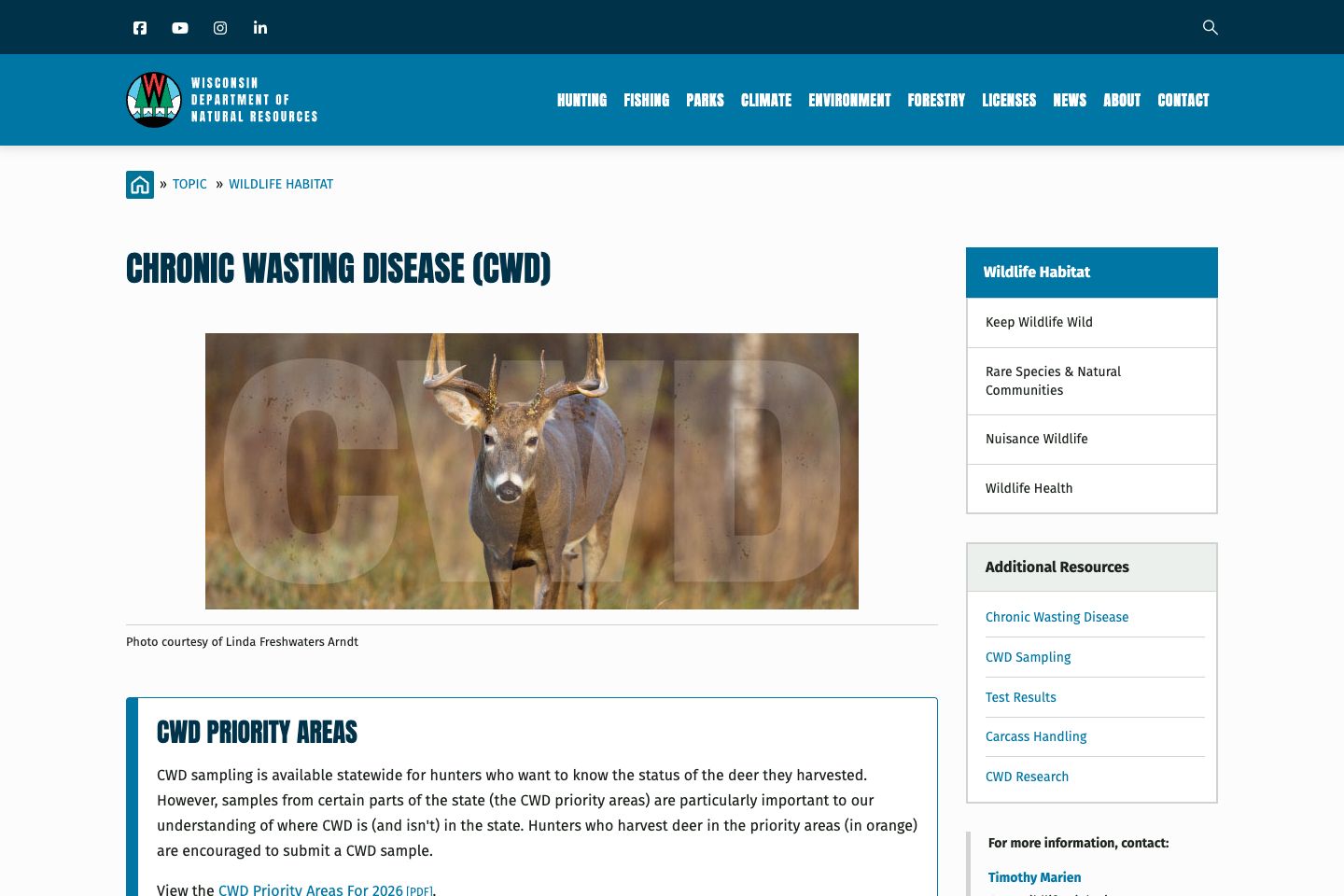
Official U.S. CWD surveillance leans on immunohistochemistry and ELISA of lymphoid and/or brainstem tissue collected after death (JVDI; CWD-INFO.ORG). A Journal of Veterinary Diagnostic Investigation laboratory comparison used hunter-harvested deer retropharyngeal lymph nodes and found RT-QuIC matched IHC and ELISA calls on all 50 nodes tested - 35 positive and 15 negative (JVDI). CWD-INFO states that definitive diagnosis examines brain for spongiform change and/or prion accumulation in brain and lymphoid tissues via IHC, and that clinical signs alone are never enough (CWD-INFO.ORG). Wisconsin invites statewide sampling with extra emphasis on priority areas that teach agencies where disease is and is not (Wisconsin DNR). Hunters who treat the strip kit as a food-safety certificate are reading the wrong label - CWD-INFO and agency pages frame testing as herd surveillance (CWD-INFO.ORG; Wisconsin DNR).
Key Takeaways
- Standard tissues: lymphoid (often retropharyngeal nodes) and/or brainstem (JVDI; CWD-INFO.ORG).
- IHC and ELISA are official postmortem workhorses (JVDI).
- RT-QuIC matched IHC/ELISA 100 percent on 50 hunter RLNs in one JVDI study (JVDI).
- Live biopsies exist but are less practical and less accurate for free-ranging herds (CWD-INFO.ORG).
- Tests are surveillance tools, not food-safety certificates (CWD-INFO.ORG).
Which lumps matter
Retropharyngeal lymph nodes sit in the throat area and are the common hunter-harvest lymphoid target in surveillance pipelines (JVDI). Brainstem and obex samples remain classic for IHC programs that examine spongiform lesions and prion accumulation (CWD-INFO.ORG; JVDI). Agency kits and kiosk instructions show the exact cuts - follow them rather than improvising from a social-media diagram (Wisconsin DNR). Most deer in the JVDI RLN set were QQ/GG/AA/QQ at PRNP codons 95/96/116/226, a genotype detail that matters to labs more than to field dressers but shows how carefully those hunter nodes were characterized (JVDI).
How labs read the sample
ELISA screens and IHC visualizes abnormal prion in tissue; both need correctly collected postmortem lymphoid or brainstem pieces (JVDI; CWD-INFO.ORG). RT-QuIC amplifies misfolded prions and agreed completely with IHC/ELISA on the 50 hunter RLNs in the JVDI study (JVDI). CWD-INFO emphasizes that the disease belongs to the TSE family and that spongiform brain change plus prion detection define the diagnosis, not a hunter’s eyeball estimate of body condition (CWD-INFO.ORG). That is why your tag still points you to a kiosk or drop freezer after the shot (Wisconsin DNR).
Field-dressing habits that protect the sample and you
Wear latex or rubber gloves when field dressing; bone out the meat; do not saw through bone; avoid cutting through brain or spinal column; minimize handling of brain and spinal tissues; wash hands and instruments thoroughly afterward (CWD-INFO.ORG; Wisconsin DNR). CWD-INFO recommends soaking cleaned instruments and cutting boards for five minutes in a 40 percent household bleach solution to help inactivate prions, stressing that organic matter must be gone first (CWD-INFO.ORG). Avoid consuming brain, spinal cord, eyes, spleen, tonsils, and lymph nodes; normal field dressing plus boning and cutting away fatty tissue removes most of those parts (CWD-INFO.ORG). Do not smash the nodes you need for the sample tube (JVDI).
Live tests vs hunter kits
CWD-INFO notes biopsies of tonsil, lymph node, or rectal mucosa are possible on live deer but are not practical at scale for free-ranging herds and are currently less accurate than postmortem testing (CWD-INFO.ORG). That practicality gap is why hunter-harvested RLN and brainstem programs remain the surveillance backbone (JVDI; Wisconsin DNR). Priority-area samples in Wisconsin are especially important for mapping where CWD is and is not, even though sampling stays available statewide (Wisconsin DNR).
Reading the result
Do not eat CWD-positive animals or any animal that appears clinically sick; treat negatives as surveillance data, not a safety stamp (CWD-INFO.ORG). Dispose of carcass waste correctly either way - preferably via landfill, transfer station, or approved dumpster so waste sits behind engineered barriers (Wisconsin DNR). Wisconsin frames movement of dead or alive CWD-positive cervids as a key spread pathway because of infectious prions (Wisconsin DNR). Your correctly collected node is how agencies keep that map honest (Wisconsin DNR; JVDI).
Bottom line
Pull the retropharyngeal nodes or brainstem your agency asks for, glove up, and remember the strip test watches the herd - it is not a food-safety certificate (JVDI; CWD-INFO.ORG; Wisconsin DNR).
The other side of it
A hunter in a CWD zone will say a negative result is the best information he’s going to get before he feeds his family, and calling it surveillance data doesn’t change what he does with it. The RT-QuIC agreement is also one study of 50 nodes, which is encouraging but small. Still, the guy who saws the skull open in the driveway to save the agency a trip has managed to miss every point at once.
Keep reading
Latest deer news
Sources
- Detection by real-time quaking-induced conversion (RT-QuIC), ELISA, and IHC of chronic wasting disease prion in lymph nodes from Pennsylvania white-tailed deer with specific PRN...
- Chronic Wasting Disease FAQ – CWD-INFO.ORG
- Chronic wasting disease (CWD) | | Wisconsin DNR
- Recommendations for Hunters – CWD-INFO.ORG
- Carcass movement, processing and disposal | | Wisconsin DNR
Comments