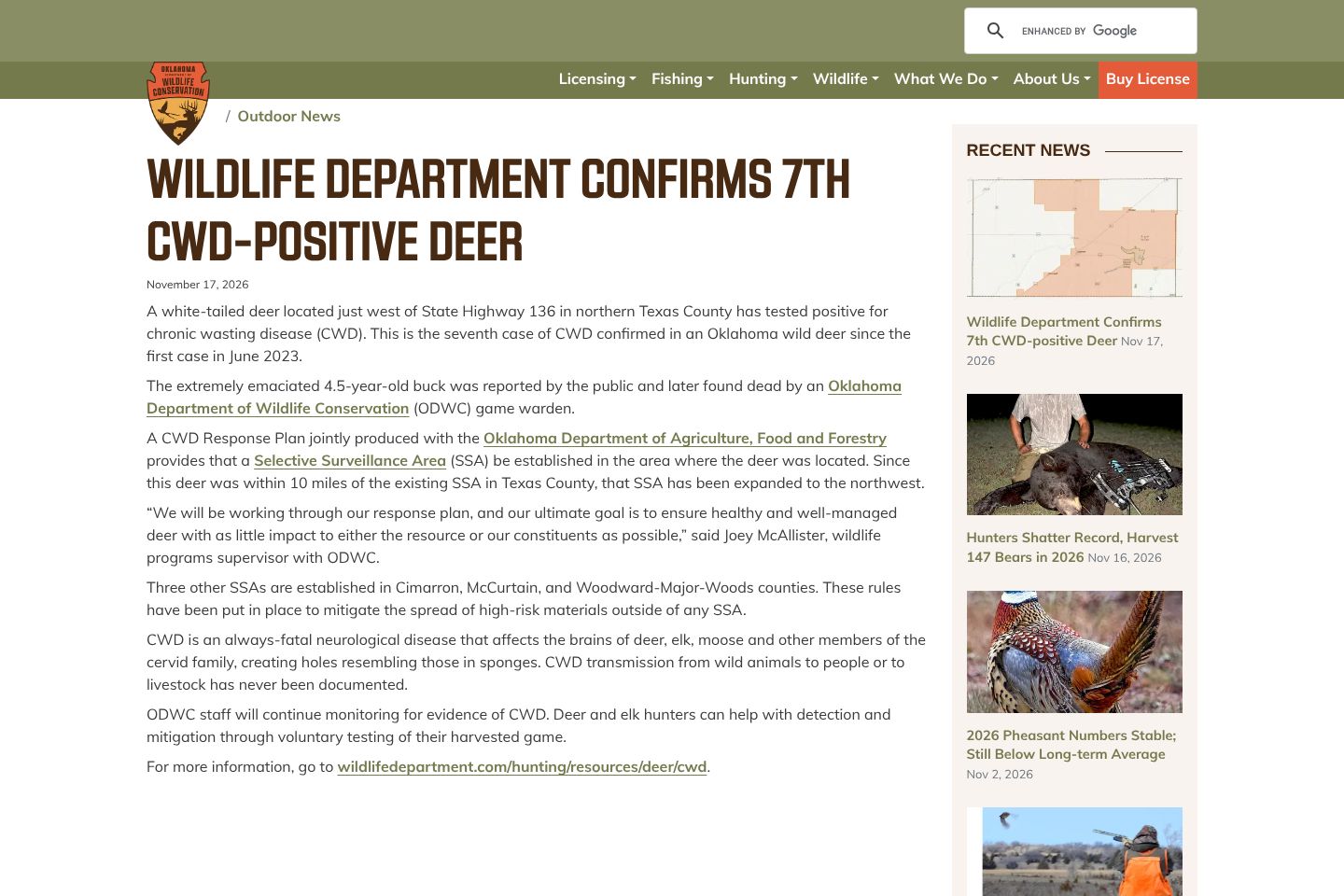
Oklahoma’s seventh CWD-positive wild deer was found just west of State Highway 136 in northern Texas County, in the Panhandle. The Oklahoma Department of Wildlife Conservation (ODWC) announced it on Nov. 17, 2026, and called it “the seventh case of CWD confirmed in an Oklahoma wild deer since the first case in June 2023” (ODWC Nov. 17 release). The deer was a 4.5-year-old whitetail buck, “extremely emaciated,” reported by the public and later found dead by an ODWC game warden.
Key Takeaways
- The buck was within 10 miles of the existing Texas County Selective Surveillance Area (SSA), so ODWC expanded that SSA to the northwest (ODWC Nov. 17 release).
- A deer or elk killed inside any SSA has to be processed before it leaves the SSA. Only antlers, clean skulls or skull plates, quarters or meat with no spinal column, cleaned teeth, finished taxidermy and hides may leave (ODWC SSA page).
- Oklahoma now has four SSAs: Texas County, Cimarron County, McCurtain County and a Woodward-Major-Woods area.
- Testing is voluntary. ODWC runs head drop-off freezers at testing sites in and around the SSAs.
- ODWC says CWD transmission from wild animals to people or livestock has never been documented.
Where in Texas County was the CWD deer found?
ODWC places the buck “just west of State Highway 136 in northern Texas County.” The release doesn’t give a nearer town or a property type. It does say the deer “was within 10 miles of the existing SSA in Texas County,” and that the SSA “has been expanded to the northwest” (ODWC Nov. 17 release).
This is Texas County’s second case this fall. ODWC’s timeline lists a Sept. 28, 2026 positive, “a white-tailed deer located about two miles south of Optima in Texas County,” after which “the existing SSA in Texas County was expanded” (ODWC CWD page). Texas County is also where Oklahoma’s first wild case turned up, confirmed June 6, 2023.
What changes for hunters in the expanded Texas County SSA?
The carcass rule is the big one. ODWC says: “Hunters who harvest deer or elk within the boundaries of an SSA must process those animals before leaving the SSA.” The only parts that may leave are:
- antlers off the skull plate, or antlers on a clean skull plate or clean skull
- quarters with no spinal material, or meat with the spinal column removed
- cleaned teeth
- finished taxidermy
- hides or tanned products
That list comes from ODWC’s SSA page (ODWC SSA page). The rule applies in all four SSAs, not just Texas County.
Check the boundary before you hunt. On Nov. 17, the written Texas County boundary on the SSA page was long and road-by-road, and the page’s header still talked about “Two CWD-positive cases” from earlier detections. We couldn’t confirm the page had been redrawn for the northwest expansion. Go by ODWC’s current Texas County SSA map and PDF, and call the regional office if your ground is near the line.
Where can you get a deer tested for CWD in the Oklahoma Panhandle?
Testing is voluntary. ODWC says it is “providing freezers at voluntary testing sites for hunters to drop off deer and elk heads for testing,” with sampling tags in the freezer (ODWC SSA page). For Texas County, the page lists:
- Guymon Police Department, 906 NW 5th St, Guymon
- Goodwell Fire Department, 104 S Main St, Goodwell
- Hooker EMS Building, 112 S Broadway, Hooker
- Texhoma Fire Department, 107 Main St., Texhoma
- Pak-a-Snak, 301 Peery St, Hardesty
Cimarron County’s site is Moore’s Food Pride in Boise City. Woodward-area hunters can use the ODWC Northwest Region Office in Woodward or the Mooreland Fire Department, and McCurtain County’s site is the Eagletown Fire Department. ODWC posts results by sample ID on the same page. “Deer and elk hunters can help with detection and mitigation through voluntary testing of their harvested game,” the release says.
How many CWD cases has Oklahoma had?
Seven in wild deer, per ODWC, starting with the Texas County deer confirmed June 6, 2023. ODWC says that first case came after testing tissue “from more than 10,000 wild deer and elk throughout Oklahoma” (ODWC CWD page). Its timeline since then lists a Woodward County deer about 15 miles east of Woodward in 2023, a deer near Felt in Cimarron County in 2024, a Panhandle deer in 2025, a deer harvested about 3.5 miles west of Felt on Feb. 6, 2026, the Optima deer on Sept. 28, 2026, and now this buck.
Captive herds are a separate track. ODWC’s timeline lists a captive elk herd in Oklahoma County in 1998 and one farmed elk in Lincoln County in 2019. The McCurtain County SSA dates to a 2025 case in a deer “harvested… less than four miles east of the Oklahoma-Arkansas border,” which ODWC treated as close enough to set up an SSA on its side of the line.
The state is also weighing rules on releasing captive deer bred for CWD resistance. We covered that proposal in Can Captive CWD-Resistant Deer Be Released in Oklahoma?.
Can you bring a deer from another state into Oklahoma?
Not whole. ODWC says “No person shall import, transport, or possess any cervid carcass or part of a cervid carcass from outside the boundaries of Oklahoma,” with exceptions for antlers on a clean skull plate, quarters or meat with no spinal column, cleaned teeth, finished taxidermy, hides, and deer headed to a taxidermist in good standing with the Secretary of State (ODWC CWD page). ODWC lists CWD in wild deer or elk in Texas, New Mexico, Colorado, Kansas, Missouri and Arkansas. That matters for Panhandle hunters crossing into Texas or Kansas and back. Our Oklahoma deer hunting hub has the rest of the state’s rules.
How should you dispose of a deer carcass in Oklahoma?
ODWC recommends burial on the property where the deer was killed, deep enough that scavengers can’t dig it up, or bagging remains with household trash bound for a lined landfill. If you can’t bury it, the remains may be left where the deer was killed. ODWC says don’t dump carcasses in ponds, lakes or waterways, and don’t burn them; “Only closed commercial incinerators are capable of generating enough heat to destroy the prions” (ODWC CWD page). If you process at a different property, send the remains to a landfill instead of dumping them there.
Is it safe to eat venison from the Texas County area?
ODWC says “CWD transmission from wild animals to people or to livestock has never been documented” (ODWC Nov. 17 release). Its CWD page adds that the CDC recommends, as a precaution, that people not eat any part of an animal diagnosed with or showing signs of CWD. A sick-looking deer is worth reporting, which is how this buck was found.
The other side of it
Seven wild cases in three and a half years is a small count, and every one was found through testing or a public report. Most hunters in Oklahoma don’t hunt in an SSA. But ODWC’s testing is voluntary, so the count only reflects the deer that get sampled. This buck was found dead, not checked in. If you hunt the Panhandle, dropping a head at a freezer is the only way the next case shows up on a hunter’s sample instead of a warden’s.
Sources
- Wildlife Department Confirms 7th CWD-positive Deer, Oklahoma Department of Wildlife Conservation
- Selective Surveillance Area (SSA), Oklahoma Department of Wildlife Conservation
- Chronic Wasting Disease (CWD), Oklahoma Department of Wildlife Conservation
Comments