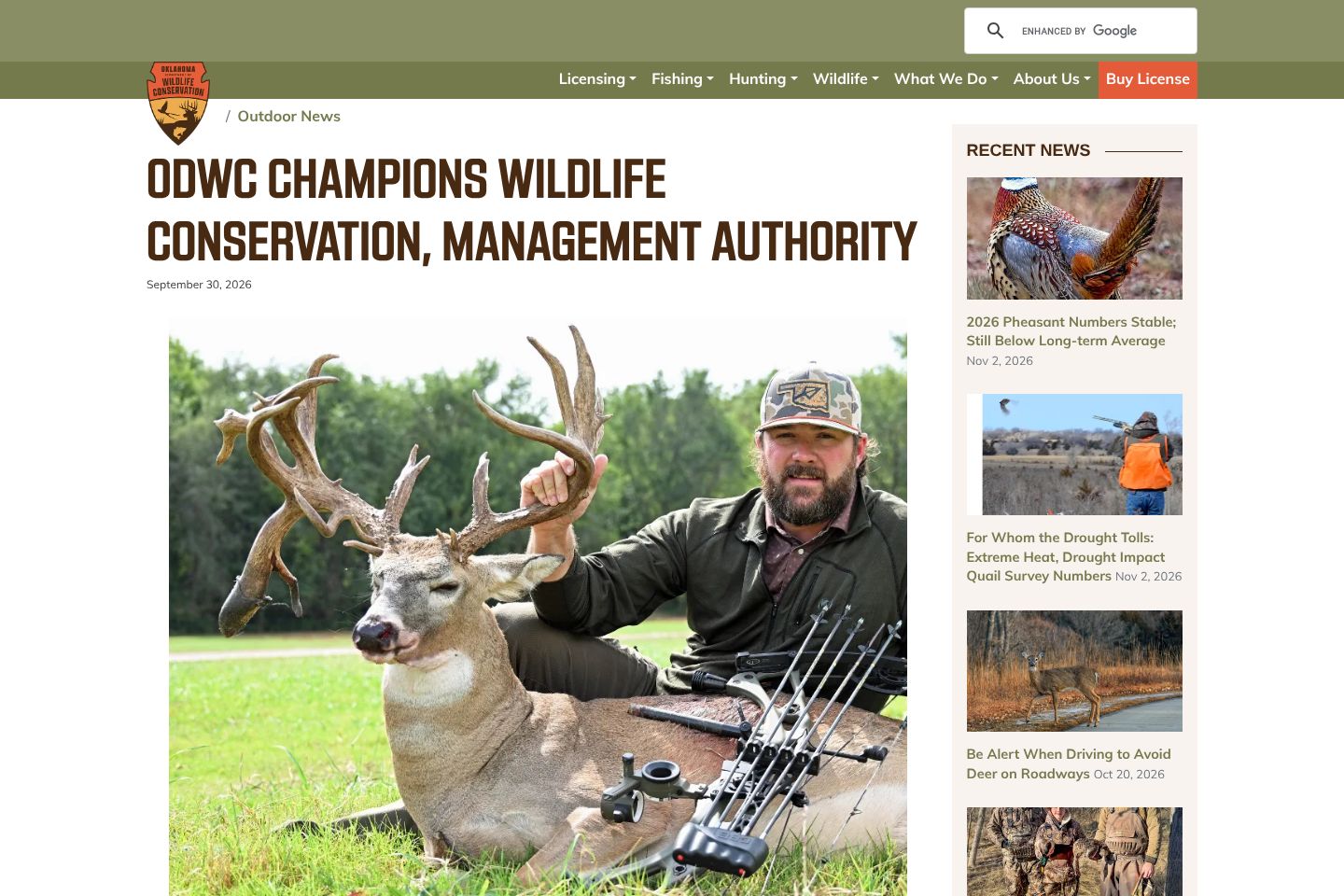
Captive CWD-resistant deer can be released in Oklahoma only under a narrow pilot program, and only onto qualifying private land between Feb. 1 and April 15. The 2024 CWD Genetic Improvement Act created what the Oklahoma Department of Wildlife Conservation (ODWC) calls “a pilot framework for releasing captive-raised deer with specific genetic markers into native populations” (ODWC). ODWC has proposed permanent rules that set a high bar for any release, and the Oklahoma Wildlife Conservation Commission is set to take up the rule package on Dec. 7, 2026.
Key Takeaways
- Only deer born and raised in Oklahoma, with the SS allele at codon 96 and a genomic score past a set cutoff, qualify for release (Oklahoma Attorney General).
- ODWC’s proposed rule limits releases to at least 1,000 contiguous privately owned acres, with written permission from every landowner within 3 miles (ODWC proposed Chapter 25 rules).
- The permit costs $500, and the permit holder must test every deer that dies or is harvested on the property for at least five years at their own expense.
- ODWC says “Releasing captive-raised deer is not a viable strategy to manage CWD” (ODWC).
- Public comment closed Nov. 6. If the Commission approves the rules, they go to the Legislature in February 2027 and then to the governor.
What does Oklahoma’s CWD Genetic Improvement Act allow?
The Legislature passed the act in 2024 as House Bill 3462 and told the Oklahoma Department of Agriculture, Food and Forestry (ODAFF) to set up a pilot program. Oklahoma Attorney General Gentner Drummond laid out the law’s limits in a March 5, 2026 opinion. Participation is limited “to native white-tailed deer, born and raised in Oklahoma with genetic resistance breeding, including the SS allele at codon 96, and that surpass the genomic estimated breeding value cutoff” set by ODAFF. Beginning in 2026, “bred female and male deer may be released” between Feb. 1 and April 15 (Oklahoma Attorney General).
The opinion concluded that only farmed cervid producers licensed by and registered with ODAFF can release these deer, that the deer must be tagged and meet the genetic and age benchmarks, and that releases may go only onto private land where the landowner has paid any permit fee. At the time, the opinion noted that ODWC “has not promulgated rules setting forth the criteria for landowners who wish to have Pilot Program deer released on their property.”
What would ODWC’s rules require before a release?
ODWC filled that gap with emergency rules and now wants to make them permanent (ODWC). Under the proposed rule, a landowner can apply for a private land release permit only if two things line up. Harvest has to fall below 50 percent of the 10-year average in ODWC’s Annual Big Game Report. The second condition, as written, pairs CWD prevalence above 50 percent in the area with a Commission resolution declaring “that a normal deer population does not exist” in the county where the deer would go (ODWC proposed Chapter 25 rules).
The application has to include:
- GPS coordinates of the exact release site and the number and sex of the deer.
- A list of every property owner within a 3-mile radius, with written permission from all of them.
- Written permission from the neighboring state’s wildlife agency if the site is within 3 miles of a state line.
- A “not detected” live-animal CWD test for each deer.
- The $500 permit fee.
The deer must come from Oklahoma farmed cervid licensees with certified herds in the USDA CWD Herd Certification Program. Does of any age and bucks under 24 months can be released only from Feb. 1 to April 15. Each deer gets an orange bangle tag in each ear, and ODWC can require a GPS collar paid for by the permit holder.
How long does a release permit last?
The proposed rule says a permit is valid for one year or until ODWC declares the wild deer population “normal” for that county, whichever is longer. A permit holder must send the full application details to ODWC at least 10 days before any later release and wait for ODWC to confirm the submission is complete. ODWC can suspend a permit for noncompliance or bad information and can recommend permanent revocation, with a right to an administrative hearing (ODWC proposed Chapter 25 rules).
The testing burden is the long tail. The permit holder must collect CWD and genetic samples from “all deer that die or are harvested on their property annually for a minimum of 5 years following the release of any deer,” at the holder’s expense, and hand the results to ODWC. The Commission also has to review the science on predictive genetics at least every other year starting July 1, 2028.
Are 96SS deer immune to CWD?
No. ODWC says “Selectively bred deer (including those with 96SS genetics) remain susceptible to CWD” and that “no peer-reviewed studies support releasing captive deer into wild populations” (ODWC).
USDA’s guidance for deer farms makes a similar point about codon 96. It says “breeding for specific codon 96 genetics (GS or SS) alone is insufficient to significantly reduce herd susceptibility.” USDA describes the -0.056 genomic score as “the starting point for herd improvement, not the end goal,” and warns that “Even good scoring deer may not be able to withstand infection in highly contaminated environments or in herds with a high CWD prevalence” (USDA APHIS). That last line matters, because the proposed Oklahoma rule ties releases to areas where prevalence is already above 50 percent.
One wording issue in the proposal: the definition section requires a score “at or below - 0.0560,” while the release criteria call for a certificate “meeting or exceeding the GEBV -0.056.” In USDA’s scale, lower (more negative) scores mean less susceptibility. The proposal doesn’t say which line controls.
What does ODWC want hunters to do about CWD instead?
ODWC says “liberal deer harvest, voluntary testing and limiting human movement of deer could be effective strategies.” The agency points to the stakes: hunters took 133,791 deer in the 2025-26 season, the second-best harvest in state history, and more than 200,000 hunters take part in Oklahoma’s deer season each year (ODWC).
The National Deer Association sent ODWC a comment letter backing clear regulations. NDA’s position “is that captive deer should not be released into the wild until sufficient research has been conducted to understand the potential impacts” (National Deer Association).
When does the Commission vote?
ODWC took public comment on its 2027 rule proposals, including the release rules, until 4:30 p.m. Nov. 6, with an in-person hearing Nov. 5 in Oklahoma City. ODWC says “Discussion and possible action on the rule change proposals are planned for the regular Commission meeting scheduled for Dec. 7, 2026” (ODWC). If approved, the rules go to the Oklahoma Legislature in February 2027 for endorsement and then to the governor (ODWC).
The same rule package also adds a two-day waiting period for nonresidents who buy a deer license after the season opens.
The other side of it
The Legislature wrote the pilot program into law, and the Attorney General’s opinion takes “no position on the wisdom of the Pilot Program,” leaving that call to lawmakers. Breeders and supporters see predictive genetics as a tool against a disease that hunting pressure alone hasn’t stopped, and USDA does use genomic scores to lower CWD susceptibility inside deer farms. What’s missing, by ODWC’s account, is evidence from free-ranging herds, and the Commission’s Dec. 7 action could still change the details above.
Sources
- ODWC Champions Wildlife Conservation, Management Authority, Oklahoma Department of Wildlife Conservation
- ODWC proposed 2027 rule changes, Title 800 Chapter 25 (Subchapter 42, CWD Genetic Improvement Program Rules), Oklahoma Department of Wildlife Conservation
- Attorney General Opinion 2026-3, Oklahoma Office of the Attorney General
- Genomically Estimated Breeding Value Predictive Genetics and Chronic Wasting Disease, USDA APHIS
- Fish, Wildlife Rule Change Proposals Open for Public Comment, Oklahoma Department of Wildlife Conservation
- NDA Encourages Public Input on Proposed Oklahoma Captive Deer Release Regulations, National Deer Association
Comments