Ask what is tree stand hunting and the short answer is hunting from a small platform, usually with a seat, that is strapped to or leaned against a tree so you sit above the ground and watch for deer. The national hunter education course from Kalkomey, which produces state-approved hunter ed courses, defines the broader category: “Elevated stands place the hunter above ground level. They can be tree stands placed in or against trees, or freestanding structures” (Hunter-ed.com national course).
Key Takeaways
- A tree stand lifts you off the ground so you can see farther and stay out of a deer’s line of sight and nose.
- The main types are hang-on (fixed-position), ladder, and climbing stands. Tower stands are the free-standing cousin.
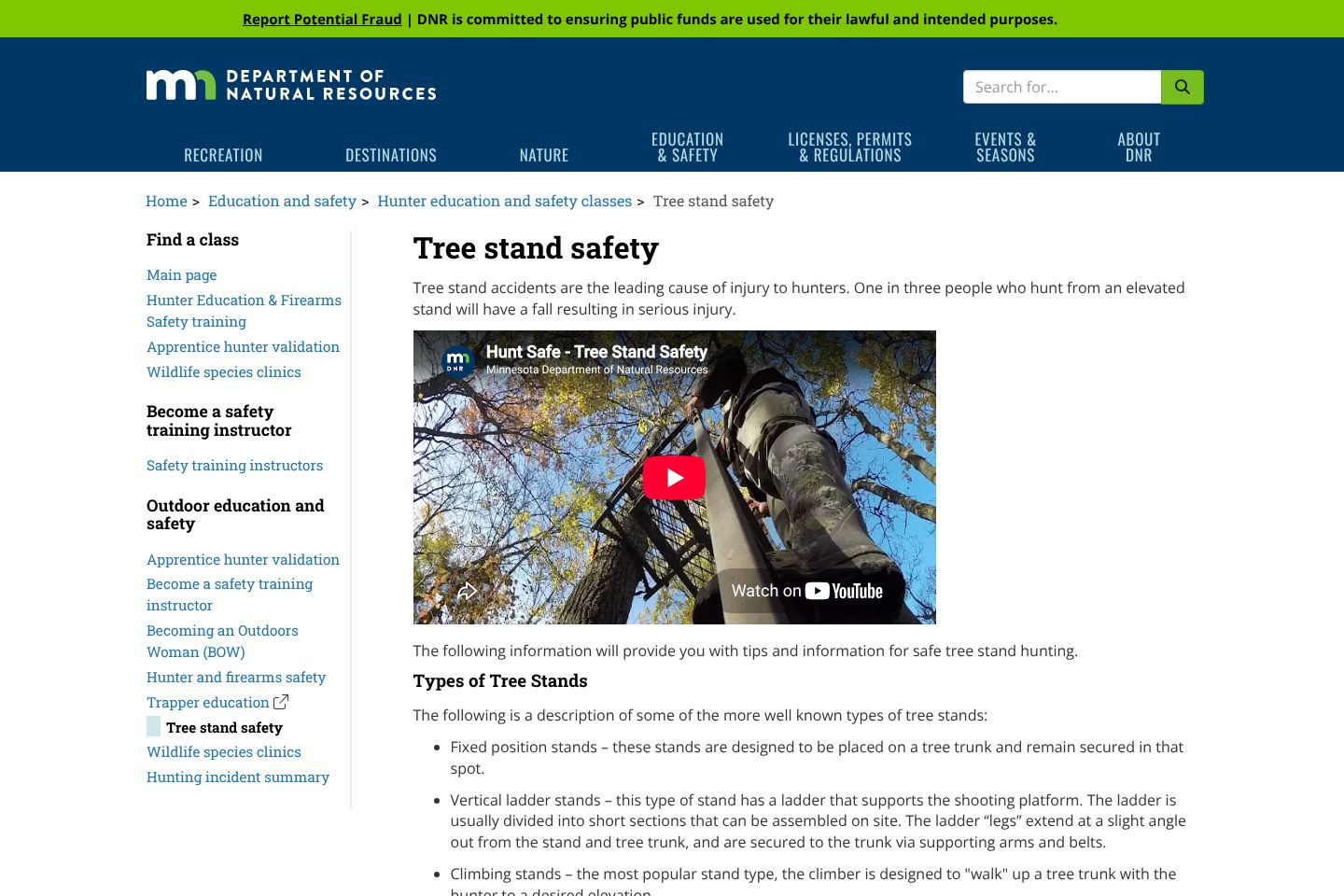
- Minnesota DNR says tree stand accidents are the leading cause of injury to hunters.
- Every state agency we checked says to wear a full-body harness, or fall-arrest system, from the time you leave the ground.
- Tree stand isn’t an abbreviation. It just means a stand in a tree.
What is tree stand hunting used for?
Height. Missouri’s Department of Conservation lists the benefits: “Tree stands offer better visibility to see deer at longer distances, increased scent control due to an elevated position, reduced noise when entering and exiting, and reduced visibility by deer if the stand is properly placed” (Missouri Department of Conservation).
The national hunter ed course adds one that matters for safety: elevated stands “Provide a good backstop for arrows or bullets due to shooting at a downward angle.” It also says they “Make a hunter’s scent harder to detect and movement less noticeable” (Hunter-ed.com, pros and cons).
There are downsides. The same course lists “Increase risk of injury resulting from falling,” “Provide no protection from cold or wind” and “Give little room for movement.” Missouri adds that “Tree stands can be cold to hunt from when temperatures drop and winds pick up.” If that’s a deal-breaker, a ground blind is the usual alternative.
What are the types of tree stands?
Agencies sort them a little differently. Missouri keeps it to two: “Tree stands come in two types: hang-on (including ladder stands) and climbers.” The national hunter ed course uses three: “Portable tree stands come in three basic types: hang-ons, climbing stands, and ladder stands” (Hunter-ed.com, types). Minnesota breaks them out too.
Hang-on, or fixed-position, stands. Minnesota DNR says these “are designed to be placed on a tree trunk and remain secured in that spot” (Minnesota DNR). The hunter ed course says “These simple stands provide about four square feet of space” and that they “require separate climbing aids, such as segmented ladders or climbing sticks” (Hunter-ed.com, hang-on stands). Missouri likes them for flexibility, since you can set several early, but warns “You should remove hang-on stands yearly and inspect all straps, cables, welds, and nuts and bolts.”
Ladder stands. A platform on top of its own ladder, leaned against the tree. The hunter ed course says “Ladder stands provide a platform 10 to 20 feet above the ground” and “The built-in ladder lets you use these stands with a wider range of trees.” Putting one up is a team job: “Three to five people are needed to erect or take down a ladder stand safely” (Hunter-ed.com, ladder stands).
Climbing stands. Two pieces that you inch up the trunk. Minnesota calls the climber “the most popular stand type.” Missouri says “Climbing stands are popular, especially among hunters who use public land where theft can sometimes be a problem,” and that they “require straight trees with few lower limbs.” The hunter ed course says to “Avoid using this type of stand on trees with shaggy bark or with branches between the ground and the desired elevation” and adds: “Never use these stands on trees covered with ice or snow” (Hunter-ed.com, climbing stands). We cover technique in climbing stand hunting.
Tower stands and permanent stands. The hunter ed course says tower stands, tripods and quadpods “are similar to a ladder tree stand but are freestanding and do not require a tree,” and “can be placed anywhere that has a firm base” (Hunter-ed.com, tower stands). Permanent, built-in-the-tree stands get a warning from Minnesota: “Never trust the safety of a permanent tree stand that was built previously by someone else.” The hunter ed course goes further: “Homemade stands should not be used.”
Some hunters skip the platform entirely and hang in a saddle. That’s its own system. See what saddle hunting is.
Are tree stands dangerous?
They can be. Minnesota DNR says “Tree stand accidents are the leading cause of injury to hunters” and that “One in three people who hunt from an elevated stand will have a fall resulting in serious injury.” Missouri says “Many accidents occur each year from the improper use of tree stands and from hunters not wearing a full-body safety harness and fall-arrest system.”
The fix is a harness, worn the whole time. Texas Parks and Wildlife describes the system as “a full body harness worn by the hunter, a tether, and a tree belt” (TPWD). Wisconsin DNR says to “Use a lifeline when climbing up and down, this keeps you connected from the time you leave the ground to the time you get back down,” and to keep the tether short because “The tether is designed to keep you in the seat, not to catch you after you fall” (Wisconsin DNR).
Owning a harness isn’t the same as wearing one. Wisconsin cites a 2003 survey that “showed that two-thirds of hunters who hunted from tree stands owned a harness but less than one-third of them reported actually using the harness.”
The other rules repeat across agencies:
- Keep three points of contact on the steps or ladder. Minnesota describes it as “two arms and one leg” or “one arm and two legs.”
- Never climb with your gun or bow. Minnesota says “Always use a haul line to pull up your gear and unloaded firearm or bow to your tree stand.”
- Carry a way to call for help. Hanging in a harness is dangerous on its own. TPWD warns it “can result in a life threatening condition known as Suspension Trauma.”
For what to look for in a harness, see our guide to full-body harness standards.
How high should a tree stand be?
There’s no single number. Minnesota DNR’s guidance is low: “The recommended height for an elevated tree stand is less than ten feet above the ground.” The national hunter ed course puts ladder stand platforms at 10 to 20 feet, and Ohio’s bowhunter course says “A tree stand is usually placed 8 to 16 feet above the ground” (Ohio Bowhunter Safety Course). Your stand’s manual sets its own limits, and some states regulate stands on public land, so check local rules before you hang one.
FAQ
What is a tree stand in hunting? A platform and seat attached to or leaned against a tree so a hunter can sit above the ground.
What does tree stand stand for? Nothing. It isn’t an acronym. It’s a stand that goes in a tree.
What is the most popular type of tree stand? Minnesota DNR calls the climbing stand the most popular type.
Do I need a harness in a tree stand? Every agency here says yes, from leaving the ground to getting back down.
The other side of it
Plenty of hunters argue tree stands are overrated, and they have a point. Ground blinds and natural cover kill a lot of deer, nobody falls out of a ground blind, and Minnesota’s one-in-three fall figure is a hard number to argue with. Height helps with sight lines and scent, but it isn’t magic. And the hunter who owns a harness but leaves it in the truck because he’s only going up fifteen feet has already done the risk math, just wrong.
Keep reading
Latest deer news
Sources
- Introduction to Elevated Stands (National Hunter Safety Course study guide), Hunter-ed.com (Kalkomey Enterprises, state-delegated hunter education provider)
- Pros and Cons of Elevated Stands (National Hunter Safety Course study guide), Hunter-ed.com (Kalkomey)
- Types of Portable Tree Stands (National Hunter Safety Course study guide), Hunter-ed.com (Kalkomey)
- Portable Tree Stands: Hang-On Stands (National Hunter Safety Course study guide), Hunter-ed.com (Kalkomey)
- Portable Tree Stands: Ladder Stands (National Hunter Safety Course study guide), Hunter-ed.com (Kalkomey)
- Portable Tree Stands: Climbing Stands (National Hunter Safety Course study guide), Hunter-ed.com (Kalkomey)
- Tripods, Quadpods, or Tower Stands (National Hunter Safety Course study guide), Hunter-ed.com (Kalkomey)
- Types of Portable Tree Stands (Ohio Bowhunter Safety Course study guide), Bowhunter-ed.com (Kalkomey), Ohio course
- Stand Locations, Missouri Department of Conservation
- Tree stand safety, Minnesota Department of Natural Resources
- Elevated Stands, Texas Parks and Wildlife Department
- Tree Stand Safety, Wisconsin Department of Natural Resources
Comments