What should you do when operating a crossbow? Keep your fingers below the rail and out of the string’s path, check that the safety is on after cocking, make sure the limbs are clear, and never dry-fire it. Those rules come straight from state wildlife agencies. Vermont Fish & Wildlife says “Make sure your fingers are well away (below rail) from the path of the string and cables” and “Never dry-fire a crossbow” (Vermont Fish & Wildlife). Here are the main rules, with sources.
Key Takeaways
- Fingers, hands and thumbs stay below the rail, out of the string path.
- Check the safety right after cocking. Wisconsin DNR calls this “critical.”
- Never dry-fire. That means firing without a bolt on the rail.
- Clear the limb tips before every shot, especially in a ground blind.
- Cock on the ground, but don’t load until you’re secured in the stand.
1. Read your owner’s manual first
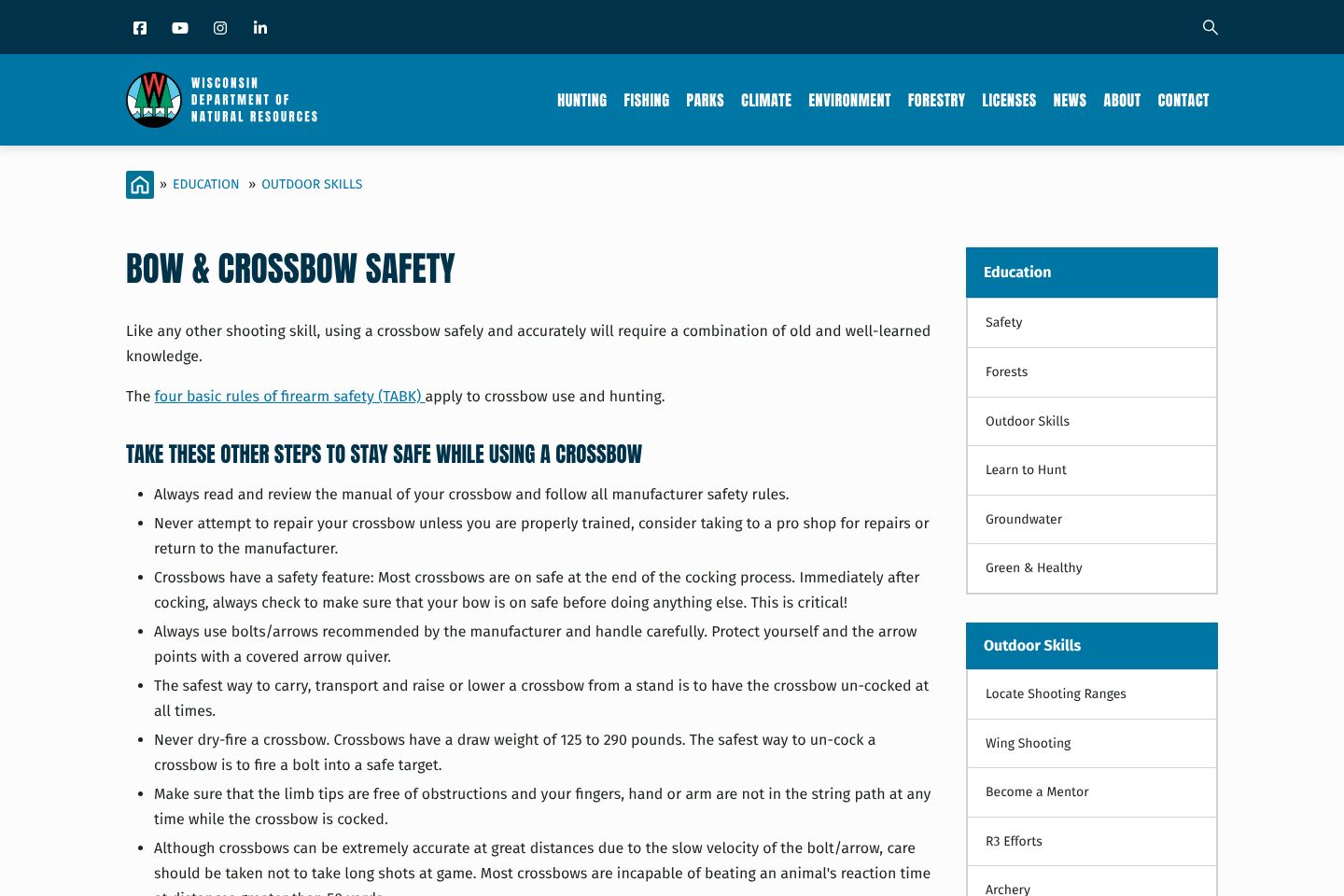
Wisconsin DNR says “Always read and review the manual of your crossbow and follow all manufacturer safety rules” (Wisconsin DNR). Every crossbow is a little different, so the manual for your model is the first safety document to read.
2. Keep your fingers below the rail
Vermont and Wisconsin both list this rule, and so does Barnett. A crossbow string moves across the top of the rail. Wisconsin DNR says to make sure “your fingers, hand or arm are not in the string path at any time while the crossbow is cocked.” Barnett’s manual is blunter: “Never place fingers or thumbs on, in or near the arrow/flight track, the string and/or the cables.” It warns that doing so “may result in serious injury, including finger and/or thumb amputation” (Barnett owner’s manual).
3. Check the safety after cocking
Wisconsin DNR says “Most crossbows are on safe at the end of the cocking process. Immediately after cocking, always check to make sure that your bow is on safe before doing anything else. This is critical!”
4. Never dry-fire
Vermont and Wisconsin both say “Never dry-fire a crossbow.” Dry-firing means releasing the string without a bolt on the rail. Barnett’s manual says that after a dry fire, the crossbow “must be inspected by a qualified Barnett service representative prior to further use” (Barnett owner’s manual).
5. Make sure the limbs are clear
Vermont says “Make sure the limbs are free of obstructions before firing; be particularly careful if you are hunting from a ground blind.” A crossbow’s limbs stick out to the sides, so a blind wall or tree trunk can be in the way even when the bolt’s path is clear.
6. Use the right bolts
Wisconsin DNR says “Always use bolts/arrows recommended by the manufacturer and handle carefully. Protect yourself and the arrow points with a covered arrow quiver.” For choosing heads, see our guide to broadheads for a crossbow.
7. Don’t walk with it loaded
Wisconsin says “The safest way to carry, transport and raise or lower a crossbow from a stand is to have the crossbow un-cocked at all times.”
8. Use a haul line at the stand
Vermont gives a simple tree stand routine: “Always cock the crossbow without a bolt on the ground before climbing into the stand. Once seated and secured, pull up your unloaded crossbow with a haul line. Do not place a bolt on the crossbow until you are safely secured in your stand.” Wear a full-body harness too; see our guide to harness and lineman rope setup.
9. Be sure of your target
Know what’s in front of and beyond your target before you shoot. Wisconsin DNR notes that “The four basic rules of firearm safety (TABK) apply to crossbow use and hunting.”
10. Uncock the right way
Wisconsin says “The safest way to un-cock a crossbow is to fire a bolt into a safe target.” Vermont says “Never use a cocking device to uncock unless you have a model that is specifically designed to do so. Most are not.”
The sources differ on one point. Vermont says to uncock by shooting an unloading point or a field tip “into soft ground; or shoot a field tip into a target.” Barnett’s manual says it “does not recommend discharging a crossbow into the ground as the arrow may hit a solid object (i.e., rock, root, etc.).” A target is the option every source accepts.
Know your range
Wisconsin DNR says “Most crossbows are incapable of beating an animal’s reaction time at distances greater than 50 yards.” Vermont puts effective range at “generally less than 40 yards” (Vermont Fish & Wildlife). For shooting basics, see how to use a crossbow.
FAQ
What is the most important crossbow safety rule? Both state agencies we checked, and Barnett’s manual, put keeping fingers below the rail and out of the string’s path near the top of their lists.
Why is dry-firing a crossbow dangerous? Both state agencies list it as a rule, and Barnett requires inspection by a service rep before using a crossbow that was dry-fired.
Should I take a bowhunter education course? Some states require it. New York’s official 2026-27 regulations guide says hunters “wishing to bow or crossbow hunt for big game” must show proof of an approved bowhunter education course or an older New York bowhunting license (NY regulations guide). Check your state’s rules.
How strong is a crossbow? Wisconsin DNR says crossbows “have a draw weight of 125 to 290 pounds,” which is why these rules matter (Wisconsin DNR).
The other side of it
Some hunters say crossbows are so easy to shoot that safety training is overkill. The opposite is true: a crossbow is easy to aim, and almost every rule above is about the string, the limbs and the stand, not the aiming. The hunter who wraps his thumb over the rail just this once is the one hunter-ed instructors tell stories about.
Keep reading
Latest deer news
Sources
- Crossbow Safety, Vermont Fish & Wildlife Department
- Bow & Crossbow Safety, Wisconsin DNR
- General License Information (2026-27 New York Hunting & Trapping Regulations Guide), eRegulations, published in partnership with NYSDEC
- Barnett Crossbow Owner's Manual, Barnett Outdoors (PDF hosted on images.carid.com)
Comments