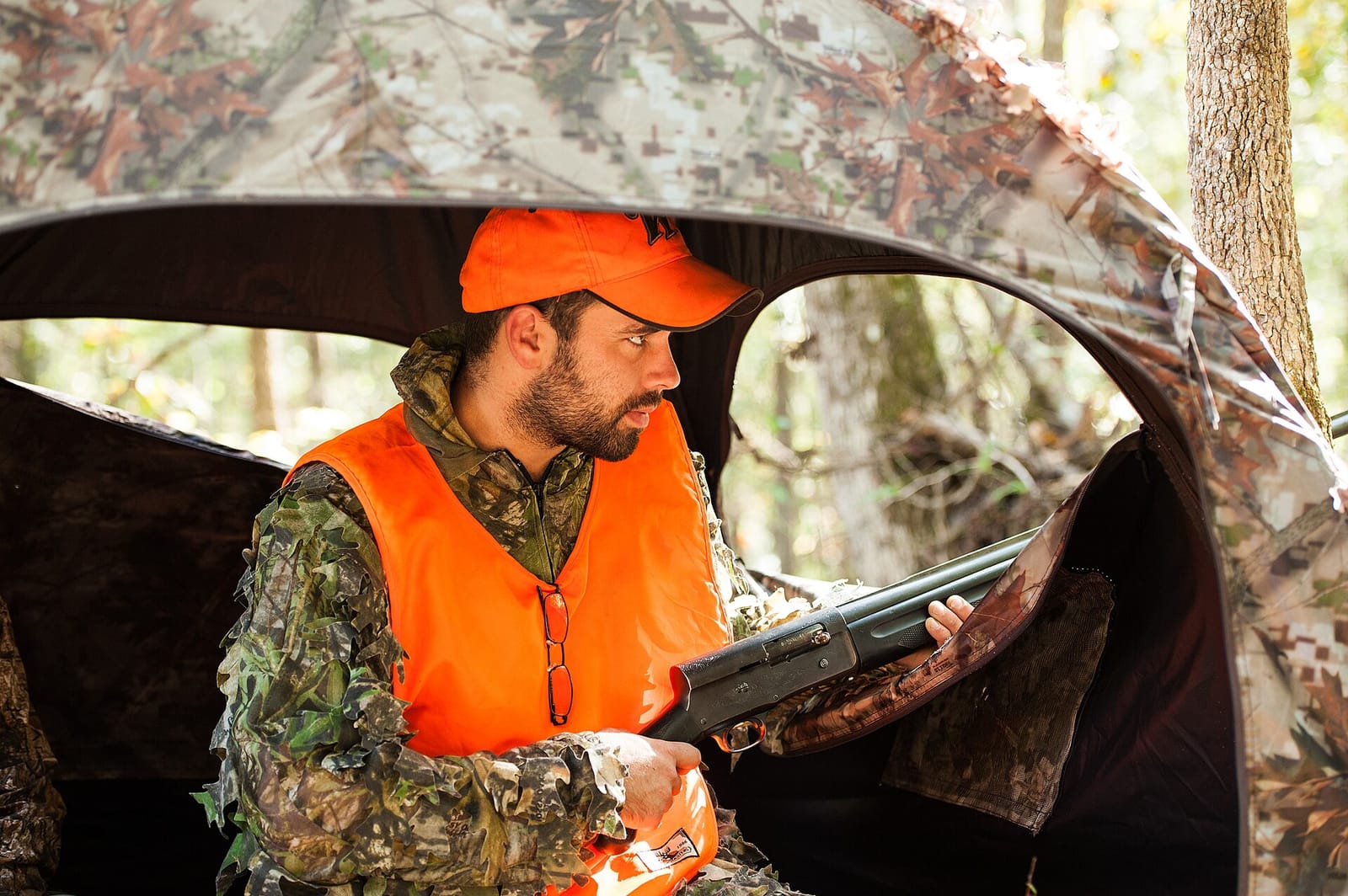
Ground blind deer hunting works, and yes, a fresh blind can spook deer for a while. Nobody has published a controlled study on how long whitetails take to accept a pop-up blind, so what you’ll read everywhere, including here, is hunter experience. The honest version: a blind that’s been sitting for weeks and brushed in gets ignored, a blind you threw up this morning in the open gets stared at, and a blind that leaks your scent downwind doesn’t matter either way.
Key Takeaways
- We could not find a published study measuring how long deer take to get used to a hunting blind. The advice below is hunter experience, labeled as such.
- Bowhunter contributor Wade Grassedonio’s rule: “Set up your ground blind several weeks early. More time is better than less” (Bowhunter, 2023).
- Outline and motion give you away, not color (NDA, citing UGA Deer Lab).
- Some states require orange on the blind during gun season, and public land has its own overnight rules. See ground blind rules.
Will a ground blind scare deer away?
At first, probably. A deer’s whole survival plan is noticing what changed in its home range. Drop a pop-up blind on a trail it walks every evening and it is going to notice.
We found no study that tracked deer around hunting blinds, so anyone quoting a precise number of days is quoting a hunch. What we do have is the reasoning hunters use, and it holds together: deer live around tractors, round bales, feeders and fence posts, and they quit caring about objects that never do anything. National Deer Association CEO Nick Pinizzotto makes the same point about ground setups generally, that deer tend to ignore things they see every day (NDA, 2025).
The research that does exist is on deer eyesight, and it explains why a bare blind in a bean field fails. The NDA’s rundown of UGA Deer Lab work puts whitetail daytime acuity at about 20/60 with a 300-degree field of view, lousy at detail but built for catching motion and silhouettes. A hard-edged box with a dark hole in the side is a silhouette and a contrast problem, and deer don’t need sharp eyes to catch either one.
How long should a ground blind sit before you hunt it?
The most common published advice is weeks, not days. Grassedonio’s first rule is to put the blind up “several weeks early” because animals need time to get used to something new in their range (Bowhunter). Realtree’s blind guide says the same thing with less precision: put it up “as far in advance of the hunt as possible so deer have time to get used to it” (Realtree).
Can you hunt a blind the day you set it? Hunters do it all the time and kill deer, usually by tucking it into cover so thick the blind isn’t the new thing, the brush pile is. That’s the trade: time or concealment. If you can’t give it time, you owe it concealment.
How do you brush in a ground blind?
Think like a deer that sees edges, not colors. Aram von Benedikt’s setup guide for American Hunter says the goal is “to eliminate all lines, especially silhouettes, and flat-looking parts of the blind,” and to keep going “until all surfaces and lines are obscured, even (especially) the roof” (American Hunter, 2020). Cedar and juniper hold their needles. Oak leaves curl and drop in a week.
Two cautions from the same sources. Grassedonio warns that branches rubbing the fabric in wind will wear holes in it (Bowhunter). And once you’ve brushed it in, climb inside and “pretend to shoot through the window,” then trim every twig in the lane (American Hunter). The brush you added is now the thing most likely to deflect your arrow.
Does a ground blind hide your scent from deer?
No. A blind stops a deer’s eyes, not its nose. Play the wind like you’re sitting on a stump. Grassedonio sets his blind so the prevailing wind carries scent away from where he expects deer (Bowhunter). Pinizzotto’s line is “Always set up with the wind in your face, and if it shifts, take advantage of being mobile and shift with it” (NDA).
Scent-control products buy margin, not immunity. NDA’s Matt Ross, in a 2026 piece on scent-plan failures, writes that “no individual action is bullet-proof at blocking your scent” and lists ignoring wind and thermals as the last and biggest crack (NDA, 2026). We go deeper on that in Deer hunting scent control.
Why does a blind on the ground get winded more than a treestand?
Thermals. In the morning, as the sun heats the ground, air at ground level rises. In the evening, “air cools and settles back toward the ground, pulling your scent along with it,” and scent pools in the lowest ground like frost (NDA). A blind in a creek bottom on a cold evening is sitting in its own scent puddle. The rule of thumb from that piece: hunt high in the mornings, low in the evenings. Carry a puffer bottle or tie a feather to your bow, because the weather app does not know what the air is doing 40 yards from your window.
One more sense to respect: hearing. UGA work puts deer hearing between 0.25 and 30 kHz with best sensitivity around 4 to 8 kHz, and a Texas A&M-Kingsville study found deer nearly twice as likely to flee from human voices as from other predator sounds (NDA, 2023). Nylon walls do not make whispering safe. We get into deer hearing more in Do deer whistles work?
How do you shoot a bow out of a ground blind?
The window that frames the deer for your eyes may not clear your arrow.
How high should the shooting window be?
Grassedonio’s tip 26 is the one to tape to your bow case: “your arrow’s line of flight is three or four inches below your line of sight,” so keep the window bottom well below the arrow path, and at full draw check for “points of contact top, bottom, front and on all sides” (Bowhunter). Jeff Johnston’s American Hunter piece describes the opposite failure: windows set so high he had to hover above the chair, and when he knelt, “my arrow usually won’t clear the window” (American Hunter, 2016). Same article, same lesson from the roof: his top cam touched the ceiling at full draw.
The fix is boring. Set your chair, draw on an empty blind in daylight, and move the chair or the window until nothing touches. Then do it again from the stool, beside it and in front of it, because the deer will not stand where you planned.
Which windows do you open, and what do you wear inside?
Open one shooting window and keep the others shut, and never sit between two open windows where a deer sees your outline backlit (American Hunter). Von Benedikt keeps mesh across even the shooting windows because an open hole reads as a “black hole” that makes deer nervous (American Hunter). Shooting through mesh with mechanical broadheads is its own argument; Johnston advises against it.
Clothing inside the blind is a real split among experienced hunters. Grassedonio wears black (Bowhunter). Realtree’s writer says, “I’ve never been a fan of the complete blackout tactic” and matches camo to the blind’s interior wall (Realtree). The vision research favors whoever keeps contrast lowest against the wall behind them, whatever color that is. Which side are you on, and has a deer ever proved you wrong?
What is the real disadvantage of a ground blind?
You’re at eye level with every deer, inside a box that shows you only what its windows face. Pinizzotto, who prefers natural ground cover, says even a good pop-up leaves him feeling “isolated from my surroundings and handicapped by limited shot opportunities” (NDA). You hear less, see less, and your scent starts at nose height. The upside is the same list turned around: weather, kids, cameras, a bad knee, and a spot with no tree worth climbing. Whether ground blind deer hunting beats a treestand on your ground is a separate argument.
Related reading on RAD:
- Deer hunting scent control
- How far can deer smell?
- Ground blind rules: blaze orange and public land overnight
The other side of it
The case against all this fuss: plenty of deer get killed from blinds set up that morning, by hunters who never brushed in a thing, because the deer was on a doe or on a food source and simply didn’t care. Rutting bucks and hungry December deer forgive a lot, and the “let it sit three weeks” rule is folklore with a nice ring to it, not a finding. Then again, the guys who swear a blind needs zero prep are usually hunting a feeder on a lease where the deer have been trained to ignore pickups, which is a slightly different test than a public-land ridge.
Keep reading
Latest deer news
Sources
- Bowhunter, 2023 (bowhunter.com)
- NDA's rundown of UGA Deer Lab work (deerassociation.com)
- NDA, 2025 (deerassociation.com)
- 8 Tips for Bowhunting Deer from a Ground Blind - Realtree Camo
- How to Set Up a Ground Blind for Bowhunting | An Official Journal Of The NRA
- NDA, 2026 (deerassociation.com)
- NDA (deerassociation.com)
- NDA, 2023 (deerassociation.com)
- Know-How: The Blind Shot | An Official Journal Of The NRA
Comments