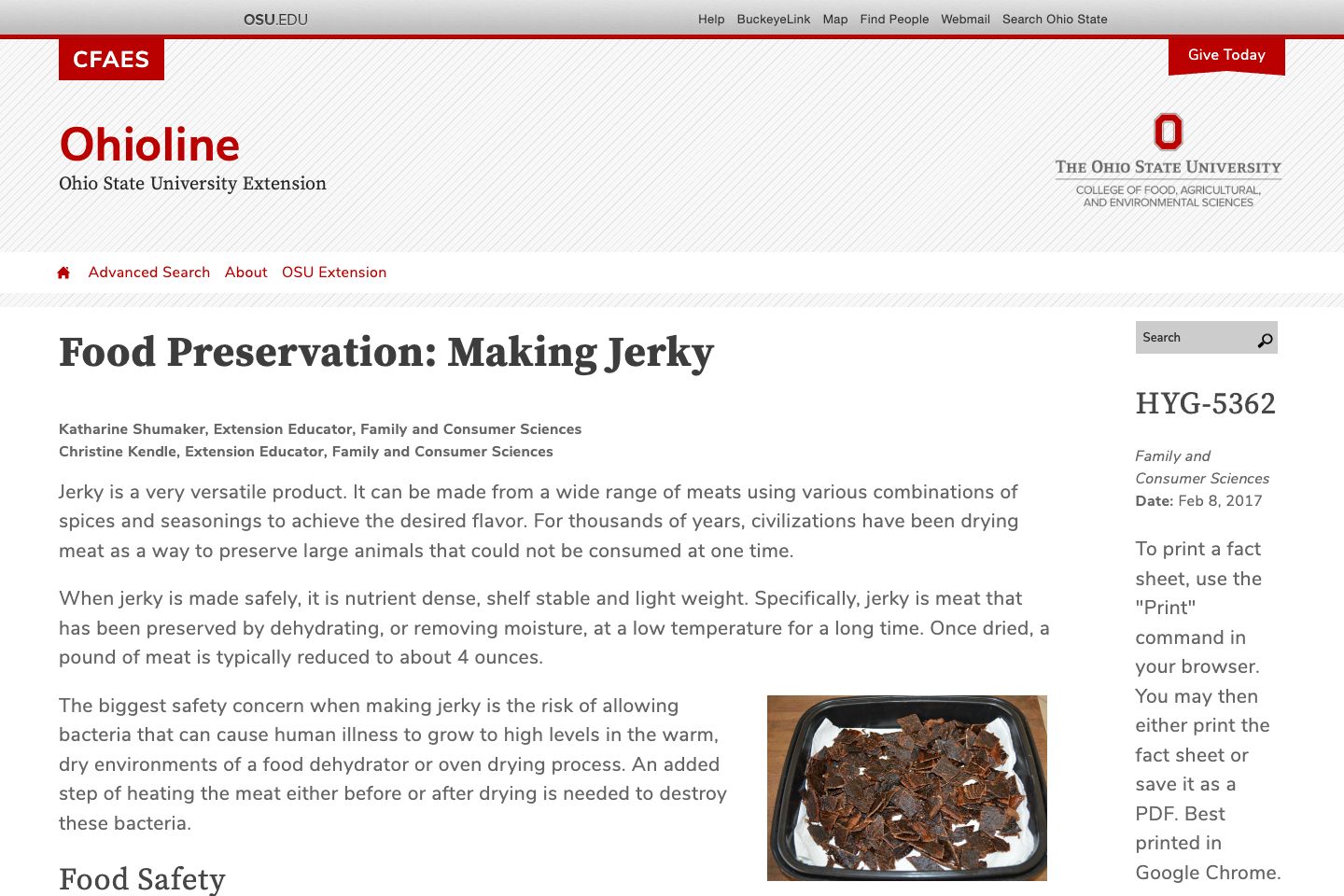
Venison jerky is safe when the meat gets heated to 160°F at some point in the process, before drying or after it, because a dehydrator alone doesn’t run hot enough to kill what raw meat can carry. Slice it lean, marinate it in the fridge, dry it at a steady temperature you’ve actually checked, and store it like it has a shelf life, because it does. And if you’re thinking about selling a few bags to cover the cost of the dehydrator, check your state law first. In many states you can’t.
Key Takeaways
- USDA recommends heating meat to 160°F (poultry 165°F) before dehydrating, as relayed by University of Kentucky Extension and Ohio State Extension.
- Ohio State says dehydrator and oven temperatures are too low on their own to destroy the harmful microorganisms common in raw meat (Ohioline).
- For venison, Penn State says to freeze the meat at 0°F or below, in portions no more than six inches thick, for at least 30 days to kill trichinella (Penn State).
- Home-dried jerky keeps about two weeks at room temperature, per the National Center for Home Food Preservation and Ohio State.
- Wisconsin lists the meat of a wild deer as illegal to commercialize at any time (Wisconsin DNR).
Why does venison jerky need a 160°F step?
Because drying isn’t cooking. University of Kentucky Extension says USDA currently recommends heating meat to 160°F before dehydrating, and that precooking to the right temperature minimizes the risk from bacteria like Salmonella and E. coli O157:H7 (Kentucky). Ohio State Extension, citing the USDA Meat and Poultry Hotline, explains why: the temperatures a dehydrator or oven runs at for drying are too low to destroy the harmful microorganisms common in raw meat (Ohioline).
Deer add two problems a grocery-store eye of round doesn’t have.
The shot and the field dressing. Ohio State notes game meat “may also be contaminated with fecal bacteria,” with wound location and field-dressing practices driving the risk (Ohioline). The National Center for Home Food Preservation goes further: if gut contents touched the meat, don’t make jerky out of it; use it only in thoroughly cooked dishes (NCHFP). Your gut-shot deer is a chili deer.
Trichinella. Penn State and Ohio State both say to freeze venison meant for jerky at 0°F or below, in portions six inches thick or less, for at least 30 days (Penn State, Ohioline). That handles the parasite, not bacteria. NCHFP is clear that freezing doesn’t get rid of bacteria (NCHFP), which is why the 160°F step still applies.
Should you heat it before drying or after?
Either works. Pick one and do it on purpose.
- Before: NCHFP’s method is to bring the strips and marinade to a boil and boil for 5 minutes, then drain and dry (NCHFP). Ohio State also lists simmering, steaming or baking at 325°F, and notes precooking shortens drying time and can change color and texture (Ohioline).
- After: Put the dried strips in a 275°F oven for about 10 minutes for strips 1/4 inch thick or less; thicker strips take longer (NCHFP, Penn State).
Check a few of the thickest strips with a thermometer. Penn State’s field-to-table guide lists the jerky number as 160°F before drying (Penn State).
Dehydrator or oven: which is better for venison jerky?
Both work, but the extension pages don’t agree on the exact dehydrator setting.
| Source | Dehydrator | Oven |
|---|---|---|
| University of Kentucky | Hold 130 to 140°F after the 160°F heating | Warm oven acceptable |
| Penn State | Constant 140°F | No higher than 170°F |
| NCHFP | 140°F, 10 to 24 hours | Not covered |
| Ohio State | Must reach at least 145°F | Constant 145 to 170°F |
Kentucky says a dehydrator gives you more temperature control than an oven. Ohio State’s tip is the one to steal: test the empty dehydrator with a stem thermometer, because the dial may be lying to you. How sure are you that yours runs where the knob says?
NCHFP’s doneness test: a cooled test piece cracks when you bend it, but doesn’t break (NCHFP).
Do you need curing salt for deer jerky?
None of the four extension jerky pages we read requires a cure. Their safety step is heat. Ohio State mentions a dry spice and curing mix only for ground-meat jerky (Ohioline). Some commercial jerky kits include a cure, like the one in the Virginia DWR recipe below, and that’s a flavor and texture choice you can make. It doesn’t replace the 160°F step.
How long does homemade venison jerky last?
| Source | Room temperature | Refrigerator / freezer |
|---|---|---|
| NCHFP | About 2 weeks, sealed container | Extends shelf life |
| Ohio State | Up to 2 weeks | 3 to 6 months refrigerated |
| Penn State | 1 to 3 weeks, cool and dark, airtight | Freeze for longer storage |
| University of Kentucky | Eat home-dried jerky within 1 to 2 months | Not covered |
When the sources disagree, go with the shortest number for anything left on the counter. Penn State’s reason for the airtight container: jerky pulls moisture out of the air.
Is venison good for jerky, and is it healthy?
It’s about as lean as jerky meat gets, and lean is what you want. Penn State’s preservation guide says to trim as much fat as possible from jerky slices to prevent off flavors (Penn State). USDA’s FoodData Central lists raw deer at 120 calories, 23.0 grams of protein and 2.42 grams of fat per 100 grams of raw meat (“Game meat, deer, raw,” FDC 173855). USDA’s other deer entries, raw and cooked, are in our venison nutrition table.
Then drying concentrates everything. Kentucky Extension says a pound of meat weighs about 4 ounces once it’s jerky (Kentucky). That’s roughly four pounds of venison per pound of jerky, which is the real answer to why a pound of it costs what it does, and why the salt in your marinade matters more than you’d think.
Can you sell deer jerky?
Rules verified on the agency pages 2026-11-04. Sale laws are set state by state; check your own state’s wildlife agency before you sell, trade or barter any wild game.
In a lot of states, no. Two examples:
- Wisconsin lists “the meat or bones (other than the head bones) of a wild deer” among items illegal to commercialize at any time. Farm-raised deer with proper proof of source are a separate category and can be sold, and gifting deer meat is handled under a different statute (Wisconsin DNR).
- New York’s 2026 Hunting and Trapping Digest, for the 2026-27 seasons, says: “It is unlawful to sell deer or bear meat.” Hides, skulls, antlers and mounts from legally taken and reported deer can be sold (NY digest).
Jerky is still deer meat, so the drying doesn’t change the answer. The jerky on a store shelf is a different animal in more ways than one: Kentucky Extension notes commercial jerky is made in federally inspected plants monitored by USDA’s Food Safety and Inspection Service (Kentucky).
Which venison jerky recipes come from trusted sources?
We read each one. The method notes are ours; the full recipes are at the links.
| Recipe | Published by | Method notes |
|---|---|---|
| Jerky (venison listed as an option) | National Center for Home Food Preservation, University of Georgia | Soy and Worcestershire marinade in the fridge, with both the boil-first and oven-after heating options built in |
| Cracked Pepper ‘N Garlic Venison Jerky (partner content, Hi Mountain Seasonings) | Virginia DWR | Hindquarter roast with a kit cure, refrigerated 24 hours, dried at 200°F in an oven or smoker to 165°F internal |
| Matt’s Deer Jerky (Officer Matt Rush, Iowa Game Wardens’ Cookbook) | Iowa DNR | 24-hour soy and Worcestershire marinade, then the dehydrator. The page doesn’t include a 160°F step, so add one using the methods above |
Related reading on RAD:
The other side of it
Hunters made venison jerky for generations without a probe thermometer, and the Iowa game warden recipe above goes straight to the dehydrator like most family recipes do. The 160°F step is a risk-reduction rule, and the four extension pages behind this guide can’t even agree on the dehydrator setting. But the uncle who says “we never heated ours and nobody ever got sick” also can’t tell you what the dehydrator dial actually read, and has never once asked the cousins.
Keep reading
Latest deer news
Sources
- FCS3-594: Jerky Safety
- Food Preservation: Making Jerky | Ohioline
- Drying Jerky
- Jerky - National Center for Home Food Preservation
- Guidance on Possession, Sale, Purchase, Trade, and Use of Wild Animals | PUB-LE-685A-2021 | Wisconsin DNR
- Proper Care and Handling of Venison from Field to Table
- Let's Preserve: Meat and Poultry
- Game meat, deer, raw (FDC 173855) | USDA FoodData Central
- Big Game Hunting - New York Hunting | eRegulations
- Cracked Pepper ’N Garlic Venison Jerky | Virginia DWR
- Four Creative Ways to Use Venison | Department of Natural Resources
Comments