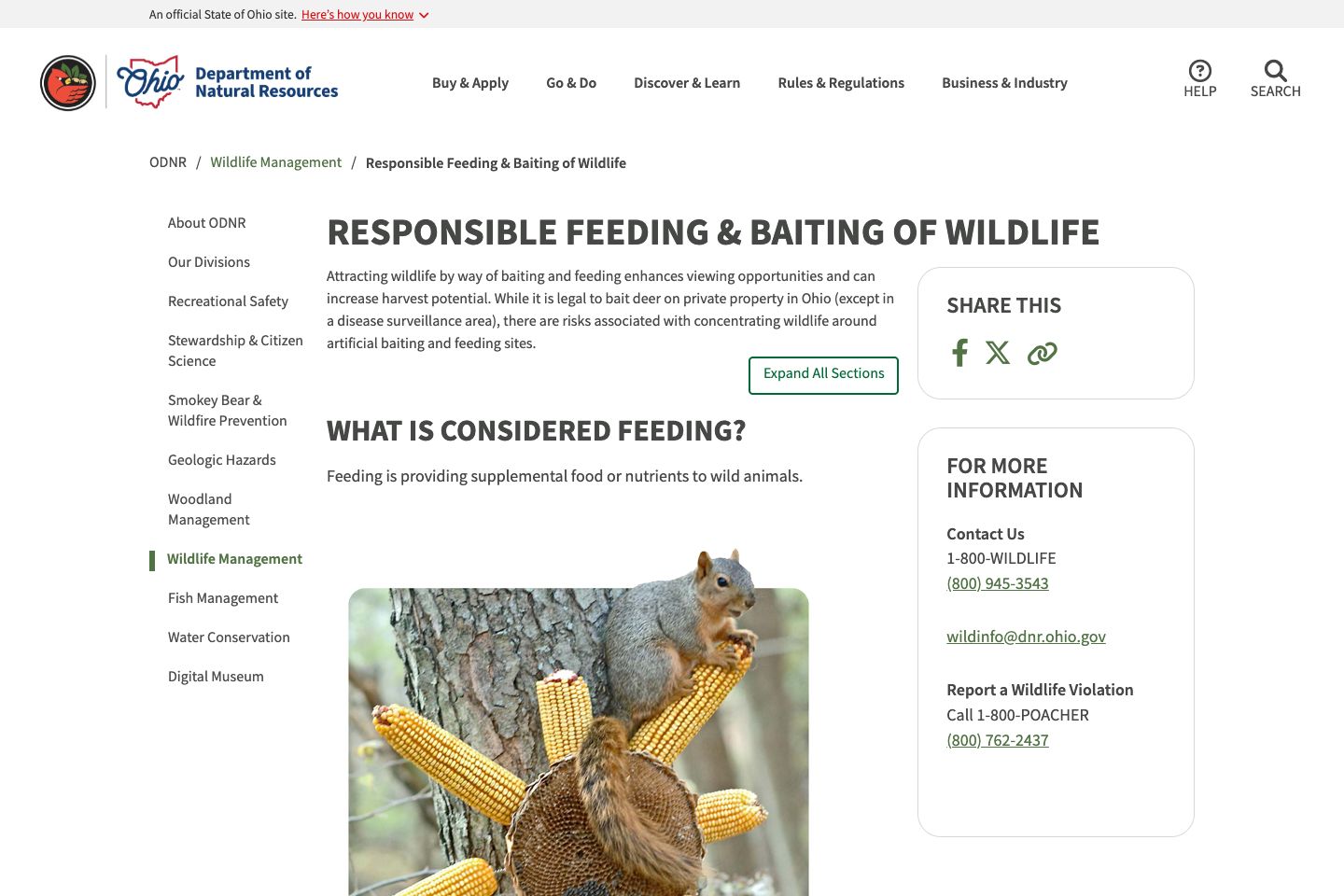
Deer baiting is putting out food to draw deer to where you hunt, and Wisconsin’s DNR defines bait as any material, “including food, scented materials, salts, minerals and grains,” placed to attract wild animals for hunting (Wisconsin DNR). Whether you can do it legally depends on your state, your county and whether the land is public. So step one isn’t choosing a bait, it’s reading your state’s rules, and our deer baiting laws by state page compares nine of them.
Key Takeaways
- Check your state’s law first. Minnesota bans hunting deer with bait statewide, Michigan allows it only in the Upper Peninsula, and many states ban it on public land (MN DNR; MDNR).
- Where it’s legal, agencies cap the amount (2 gallons in Michigan’s UP and in Wisconsin’s open counties) and limit where you put it (MDNR; Wisconsin DNR).
- Corn is the classic bait, but several agencies warn that a sudden diet of corn can kill deer through rumen acidosis (Wisconsin DNR; PGC).
- A spot can stay legally baited after the pile is gone. Minnesota requires bait removed 10 days before hunting, Missouri treats a site as baited for 10 days after removal, and Pennsylvania’s rule reaches back 30 days (MN DNR; MDC; PGC digest).
What counts as bait for deer?
More than you might think. Michigan’s definition covers grains, fruits, vegetables, hay and “minerals (including salt and salt blocks)” (MDNR). Texas counts “salt, grain, minerals, or other feed” but not scent attractants (TPWD). Pennsylvania goes further: it’s unlawful to hunt where bait or its residue has been used within the past 30 days, “regardless the type or quantity” (PGC digest). Minnesota and Missouri don’t count plain salt or mineral products as bait, but only if there’s no food in them, so read the label (MN DNR; MDC). Food plots and standing crops generally aren’t bait in the states we checked.
Other states write it just as broadly. AGFC defines baiting as placing salt, grain or other feed that could lure wildlife where hunters are trying to take them (AGFC). Maine’s list covers salt, grain, fruit, nuts or other bait (MDIFW). Mississippi draws its line between bait and supplemental feed: “it is illegal to hunt or trap any wild animal or wild bird with the aid of bait” (MDWFP).
How do you bait deer legally?
Follow the rules for where you hunt. In the two states with detailed rules we read:
- Michigan, Upper Peninsula only: Sept. 15 through Jan. 1. No more than 2 gallons per hunting site, spread over at least a 10-by-10-foot area and scattered directly on the ground. Spin-cast feeders are allowed if they stay under the volume limit (MDNR).
- Wisconsin, counties without a CWD ban: 2 gallons per 40 acres. Sites must be at least 100 yards apart and 50 yards from public trails, roads and campsites. No feeders that refill automatically, mechanically or by gravity, no animal products, and nothing in packaging. Bait may go out from midnight before the archery opener through the close of deer season (Wisconsin DNR).
Ohio, where baiting is legal on private land outside its disease zone, publishes best practices rather than a volume cap (Ohio DNR):
- Put out only what deer will eat within 48 hours.
- Move the bait site when you can, to reduce disease risk.
- Bait only when you’re actively hunting.
- Throw out sprouted, moldy or wet feed, and avoid grain in warm, moist conditions.
- Keep bait away from roads and property lines.
Which other states ban hunting deer over bait?
These states say no, flat out.
| State | What the rule says | Source |
|---|---|---|
| Alaska | Prohibits taking big game “with the use of bait for ungulates,” which includes deer | 5 AAC 92.085, ADF&G |
| California | Unlawful to “take game birds and mammals within 400 yards of any baited area” or to “knowingly feed big game mammals” | CDFW digest |
| Colorado | Unlawful to hunt big game over bait, whether or not you placed it | 2 CCR 406-2 §209 |
| Idaho | Bait “may be used to hunt only black bear” | IDAPA 13.01.08 |
| Illinois | “You cannot legally feed deer at any time and/or take deer by the use or aid of bait or baiting of any kind” | IDNR 2026 regulations |
| Iowa | Bait is a prohibited device, along with dogs and other domestic animals | Iowa Admin. Code 571-106.11 |
| Missouri | “Use of bait” while hunting “is illegal”; bait means grain or other feed placed or scattered to attract deer or turkeys | MDC |
| Montana | “Unlawful for anyone to hunt or attempt to hunt any game animal or game bird by the aid of or with the use of any bait, salt lick, trap, snare, or set gun” | FWP 2026 regulations |
| Nevada | No baiting big game mammals for the purpose of hunting, and no knowingly hunting big game someone else baited | NAC 503.149 |
| New Mexico | “It is unlawful for any person to take or attempt to take any big game species or turkey by use of baiting,” or from an area that hasn’t been “completely free of bait (including in feeders) for at least 10 days” | 19.31.10 NMAC |
| New York | Hunting with “the aid of a pre-established bait pile” is illegal, and “intentional feeding or baiting of deer or bear is prohibited at all times of year” | DEC guide |
| Rhode Island | “Feeding, baiting, and hunting deer over bait is prohibited,” and that includes salt, minerals, apples and grain | 250-RICR-60-00-9 |
| Utah | Baiting of big game for hunting purposes prohibited throughout Utah since a 2021 law | Utah DWR |
| Vermont | “It is illegal to bait or feed deer in Vermont” | Vermont Fish and Wildlife |
| Virginia | “Hunting over bait is illegal in Virginia,” and feeding deer is illegal statewide from September 1 to the first Saturday in January | Virginia DWR; 4VAC15-40-285 |
| Washington | “Baiting deer, elk, and moose in Washington is banned statewide, as baiting draws animals together where they can spread disease” | WDFW |
| Wyoming | No placing bait for big game or knowingly taking big game by use of bait, except as authorized by Commission regulation or statute | WGFD regulations |
Where else can you bait, and what’s the catch?
In these states the answer hangs on who owns the land, a disease zone, a distance or the calendar.
| State | Short answer | The catch | Source |
|---|---|---|---|
| Alabama | Yes, on private or leased land | Bait privilege license required, even for license-exempt hunters; banned on public lands, WMAs included | ADCNR |
| Arizona | Not with food | Water, salt, or salt with trace minerals made for the livestock industry are the exceptions | AZGFD |
| Arkansas | Depends on the CWD zone | Feeding wildlife is unlawful inside the CWD Management Zone, with listed exceptions | AGFC CWD |
| Connecticut | Only in part of the state | Banned in Deer Management Zones 1 to 10, and on state land in Zones 11 and 12 | CT DEEP |
| Kansas | Yes, on private land | “Strongly discouraged for biological reasons” | KDWP |
| Maine | No, June 1 to December 15 | Bait, or a stand or blind overlooking it, “is prohibited from June 1 to December 15” | MDIFW |
| Maryland | Yes, except on state land | Not on “state-owned or state-controlled properties” | Maryland DNR |
| Mississippi | Not as bait | Supplemental feeding is allowed on private land outside a CWD Management Zone | MDWFP |
| Nebraska | You can’t hunt near it | Illegal “to hunt any big game animals or turkeys within 200 yards of a baited area”; hunter and animal must both be outside it | Nebraska Game and Parks |
| New Jersey | Yes | Legal “except where prohibited by the landowner”; corn, mineral supplements and apple-scented grain blends are its examples of bait | NJ digest |
| Oklahoma | Not on ODWC lands | Unlawful to place or hunt over bait on lands owned or managed by the Department, including Corps lands | ODWC |
| South Carolina | Yes, on private land | Act 2 of 2013 “removed the prohibition on baiting for deer on private lands in Game Zones 1 and 2,” so it “is no longer prohibited on private land anywhere in South Carolina” | SCDNR |
| South Dakota | Not during hunting seasons | No bait station “from Aug. 1 - Feb. 1, inclusive and from March 15 - May 31, inclusive” for any big game animal, turkey included | SD GFP |
| Texas | Yes, on private land | Baiting game animals is a legal means and method “except for wild turkey in the East Zone and migratory game birds” | TPWD |
| West Virginia | Yes, with exceptions | “Baiting is prohibited in the CWD Containment Area; and it is illegal to bait or feed any wildlife at any time on public lands” | WVDNR |
Is corn safe to bait deer with?
It’s legal where baiting is legal, but wildlife agencies warn about it. Wisconsin’s DNR says the switch from “high-fiber woody browse to a low-fiber/high carbohydrate diet,” such as corn, can cause acidosis or enterotoxemia, and death “may occur within 24-72 hours of excessive grain ingestion,” even in deer in good condition (Wisconsin DNR). Pennsylvania’s Game Commission names corn, wheat and barley as the most common causes of rumen acidosis and says there’s no treatment for wild ruminants (PGC).
The risk is highest in late winter. Indiana’s DNR says a deer’s stomach microbes “take several weeks to adjust to new foods,” and that deer go through the adjustment again when the feeding stops (Indiana DNR). Virginia’s agency adds that corn can carry aflatoxin, a mold toxin, and that corn sold as “Deer Corn” often has levels above what’s acceptable for livestock or people (Virginia DWR). Montana State University Extension warns that a deer “can starve to death with a full stomach” on unfamiliar feed (MSU Extension).
Keeping amounts small, the way the 2-gallon caps and Ohio’s 48-hour guidance do, limits how much grain any one deer can eat at once.
Can you use mineral blocks or scents instead of bait?
Sometimes, but they aren’t automatically exempt. In Minnesota, liquid scents, sprays, salt and minerals aren’t bait “if they do not contain food products.” The DNR warns that many liquid, powder and block products contain grains, fruit or sugars such as glucose, dextrose and fructose, and “if a salt or mineral product has anything other than salt or mineral in it, it is illegal to use for hunting” (MN DNR). Missouri also allows plain mineral and salt blocks but bans blocks with grain or food additives, and bans blocks entirely on conservation areas (MDC). In Wisconsin, scents that attract deer only by odor are legal statewide, as long as deer can’t eat them (Wisconsin DNR). Vermont Fish and Wildlife says artificial scents and lures are legal if they aren’t designed to be eaten or licked, but natural urine-based lures are illegal because of CWD risk (VTFW). Michigan counts salt blocks as bait, so in the Lower Peninsula a mineral lick is off-limits for hunting (MDNR).
How long does a baited area stay baited?
Longer than the pile does. Minnesota requires all bait to be removed 10 days before hunting, Missouri treats a site as baited for 10 days after removal, and Pennsylvania’s rule reaches back 30 days (MN DNR; MDC; PGC digest). If you lease land or hunt a new spot, Pennsylvania’s advice applies anywhere: inspect the area and ask the landowner (PGC digest).
What should you look for in a deer feeder with a timer?
Spec-based section. Compiled from manufacturer product pages read in November 2026. Not a hands-on review.
Check the law before you check the specs. Wisconsin bans bait from any feeder “designed to deposit or replenish feed automatically, mechanically or by gravity” (Wisconsin DNR). Michigan’s Upper Peninsula allows spin-cast feeders only if they don’t throw more than the 2-gallon limit (MDNR). Where timed feeders are legal, the specs that matter are how many feed times you can set, how long each lasts and how the feeder is powered:
- Moultrie 250LB Deer Feeder Pro III: up to 10 feed times per day, 1 to 60 seconds each. Settings can be adjusted by Bluetooth through the Moultrie app, with no subscription. It holds up to 250 pounds, spreads feed 360° with High, Medium and Low distance settings, and runs on a 6V tab-top rechargeable battery (sold separately). It’s compatible with Moultrie’s 6V solar panel (Moultrie).
- American Hunter XDE-Pro with hopper (AH-225XDE): feeds 1 to 16 times per day, with a feed rate adjustable from 1 to 60 seconds. It has two preconfigured “Q-Set” settings for quick setup and a digital timer with a large LCD display. The maker recommends its DE-30045 battery, which is not included (Boss Buck, American Hunter XDE-Pro).
Short, timed bursts are the closest a feeder gets to Ohio’s advice to put out only what deer will eat in 48 hours (Ohio DNR).
Is baiting deer worth it?
That’s a debate, not a regulation. See baiting deer: is it really hunting?. For salt and minerals, see deer mineral lick.
The other side of it
Legal and harmless aren’t the same thing, and the agencies writing these caps are the same ones warning that corn can kill a deer within days and that moving bait sites helps cut disease risk. A hunter who skips the pile isn’t being precious, he’s just reading the rest of the regulation page. The 2-gallon limit only helps if somebody actually measures. Funny how just a little corn always gets carried in by the bucket and never by the gallon.
Keep reading
Latest deer news
Sources
- Deer Hunting Regulations | Deer | Wisconsin DNR
- Hunting and Trapping Regulations Booklet 2026-2027
- Baiting and Feeding
- Corn toxicity in ruminants | | Wisconsin DNR
- Rumen Acidosis | Game Commission | Commonwealth of Pennsylvania
- Hunting Definitions — Texas Parks & Wildlife Department
- PGC digest (pa.gov)
- Deer: Regulations | Missouri Department of Conservation
- Ohio DNR (ohiodnr.gov)
- Indiana DNR (in.gov)
- Should I Feed the Deer? | Virginia DWR
- Deer- Winter Feeding - MSU Extenison Animal and Range Science | Montana State University
- Moultrie | 250LB DEER FEEDER PRO III
- XDE-PRO With Hopper | Boss Buck (American Hunter)
- Arkansas deer-specific hunting regulations (AGFC)
- Deer hunting laws and rules (Maine IFW)
- General hunting rules and regulations (MDWFP)
- 5 AAC 92.085 (ADF&G)
- CDFW hunting digest
- 2 CCR 406-2 §209 (Colorado)
- IDAPA 13.01.08 (Idaho)
- Illinois Digest of Hunting and Trapping Regulations 2026 (IDNR)
- Iowa Admin. Code 571-106.11
- Montana FWP 2026 deer, elk and antelope regulations
- NAC 503.149 (Nevada)
- 19.31.10 NMAC (New Mexico)
- NYSDEC big game hunting guide
- 250-RICR-60-00-9 (Rhode Island)
- Baiting big game (Utah DWR)
- White-tailed deer FAQs (Vermont Fish and Wildlife)
- 4VAC15-40-285 (Virginia)
- CWD rules (WDFW)
- WGFD regulations
- License FAQs (ADCNR)
- 2026-27 Arizona Hunting Regulations (AZGFD)
- CWD-related wildlife hunting regulations (AGFC)
- 2026 Connecticut Hunting and Trapping Guide | Deer Hunting
- Kansas Hunting Regulations (KDWP)
- Deer other regulations (Maryland DNR)
- Big game guide (Nebraska Game and Parks)
- NJ hunting and trapping digest 2026-2027
- Department-managed area rules (ODWC)
- Deer baiting law (SCDNR)
- Big game regulations (SD GFP)
- Hunting Means and Methods (TPWD)
- White-tail deer FAQs (WVDNR)
Comments