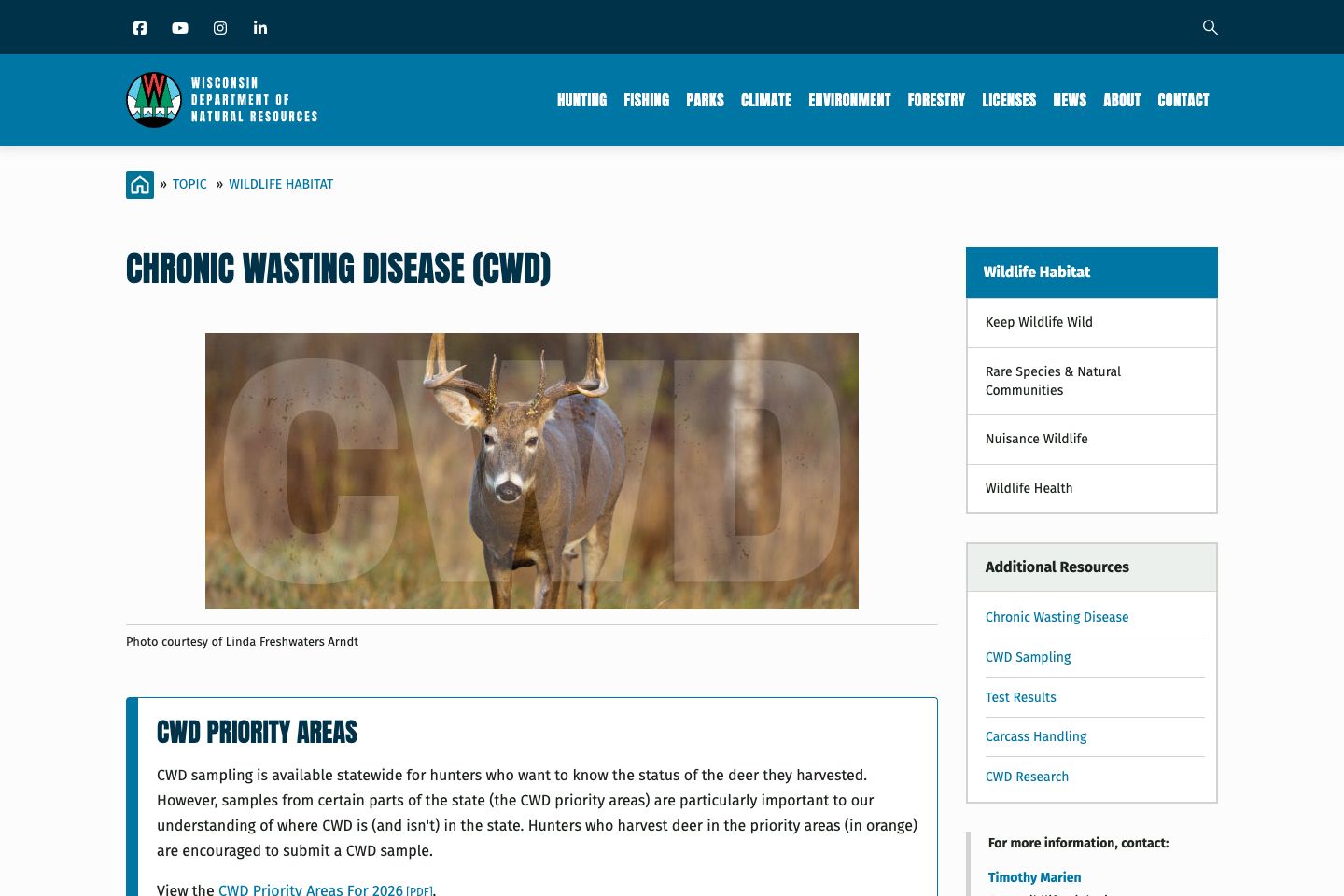
CWD zones are surveillance maps turned into rules hunters must read before opening day. Wisconsin DNR highlights CWD priority areas where hunter samples matter most for knowing where disease is and is not, while still offering statewide sampling opportunity for hunters who want status on their own deer (Wisconsin DNR). The agency began monitoring the wild white-tailed deer population for CWD in 1999 and found first positives in 2002 (Wisconsin DNR). CWD-INFO summarizes AFWA 2018 best management practices that push carcass and live-cervid movement limits, anti-congregation rules, surveillance, and targeted removal - the toolkit behind core versus buffer designations hunters see on regs pages (CWD-INFO.ORG). Zones change as positives accumulate; they are not permanent folklore lines drawn once and forgotten (Wisconsin DNR; CWD-INFO.ORG).
Key Takeaways
- WI monitored wild deer since 1999; first positives 2002 (Wisconsin DNR).
- WI priority sampling areas sit inside a statewide CWD program (Wisconsin DNR).
- AFWA BMPs drive movement, congregation, and surveillance tools states zone around (CWD-INFO.ORG).
- Carcass movement of positives is a key spread pathway (Wisconsin DNR).
- Hunter tests are surveillance tools, not food-safety certificates (CWD-INFO.ORG).
Surveillance draws the first line
Wisconsin began monitoring the wild white-tailed deer population for CWD in 1999 and found first positives in 2002 (Wisconsin DNR). Sampling is available statewide, but samples from priority areas are particularly important for understanding where CWD is and is not (Wisconsin DNR). Interactive mapping of positives by southern farmland, central farmland and forest, and northern forest zones then feeds regulation discussions hunters see as colored polygons (Wisconsin DNR). Priority-area hunter samples are therefore management data, not just personal curiosity strips (Wisconsin DNR).
AFWA tools become zone rules
AFWA’s 2018 BMPs recommend regulating live cervid and carcass movements, prohibiting artificial congregation, targeted removal, hunting, surveillance and monitoring, and education (CWD-INFO.ORG). Core areas with established positives often see the strictest carcass transport and baiting limits; buffers extend surveillance and movement controls outward (CWD-INFO.ORG; Wisconsin DNR). CWD-INFO notes some states prohibit transporting intact hunter-harvested cervid carcasses or high-risk parts out of CWD-affected areas, and some ban natural urine-based lures over contamination concerns (CWD-INFO.ORG). Feeding bans that Wisconsin urges even outside formal bans follow the same anti-congregation logic (Wisconsin DNR).
Carcass geography is zoning geography
Wisconsin states that movement of dead or alive CWD-positive deer, moose, elk, or reindeer/caribou is a key pathway for spread because of the infectious nature of the CWD prion (Wisconsin DNR). Landfill-first disposal keeps waste behind engineered barriers between uninfected deer, potentially infected material, and the environment (Wisconsin DNR). Zone boundaries therefore often hitch to where you may transport whole carcasses versus quarters or boned meat (Wisconsin DNR; CWD-INFO.ORG). Transfer stations and dumpsters that accept deer waste become part of the zone compliance story, not afterthoughts (Wisconsin DNR).
What hunters should do with a zone map
Check current priority areas and carcass rules before the season - maps update with new positives (Wisconsin DNR). Sample when asked, especially in orange priority polygons, remembering the test is for disease monitoring, not a food-safety stamp (Wisconsin DNR; CWD-INFO.ORG). Wear gloves, bone out meat, avoid brain and spinal column, and do not eat positive or clinically sick animals (CWD-INFO.ORG; Wisconsin DNR). Dispose of carcass waste via landfill, approved dumpster, or allowed municipal pickup (Wisconsin DNR).
Why buffers exist
CWD-INFO notes heavily infected wild populations are unlikely to thrive and that CWD alters harvest regulations and drains management budgets wherever it establishes (CWD-INFO.ORG). Buffer rings buy detection time before a core expands (CWD-INFO.ORG; Wisconsin DNR). Strain and genotype research may later explain uneven spread across landscapes, but zone lines still follow surveillance positives and BMP tools today (Scientific Reports; CWD-INFO.ORG). As of May 2026 CWD-INFO reported wild cervid detections in 35 U.S. states - zoning pressure only grows with that map (CWD-INFO.ORG).
Bottom line
CWD zones are living surveillance products - hunt the current priority map, follow carcass and congregation rules, and sample where agencies ask (Wisconsin DNR; CWD-INFO.ORG).
The other side of it
A zone map shows where agencies found positives, which partly means where hunters turned in heads, so a quiet county might just be an unsampled one. The article admits strain and genotype research may later explain uneven spread that today’s lines can’t. Buffers buy time, but nobody here shows how much. Funny how the folks who call the zones arbitrary are usually the same ones who never dropped off a sample.
Keep reading
Latest deer news
Sources
- Chronic wasting disease (CWD) | | Wisconsin DNR
- Chronic Wasting Disease FAQ – CWD-INFO.ORG
- Carcass movement, processing and disposal | | Wisconsin DNR
- Recommendations for Hunters – CWD-INFO.ORG
- Help Maintain A Healthy Herd: Avoid Baiting And Feeding Deer | Wisconsin DNR
- White-tailed deer S96 prion protein does not support stable in vitro propagation of most common CWD strains | Scientific Reports
Comments