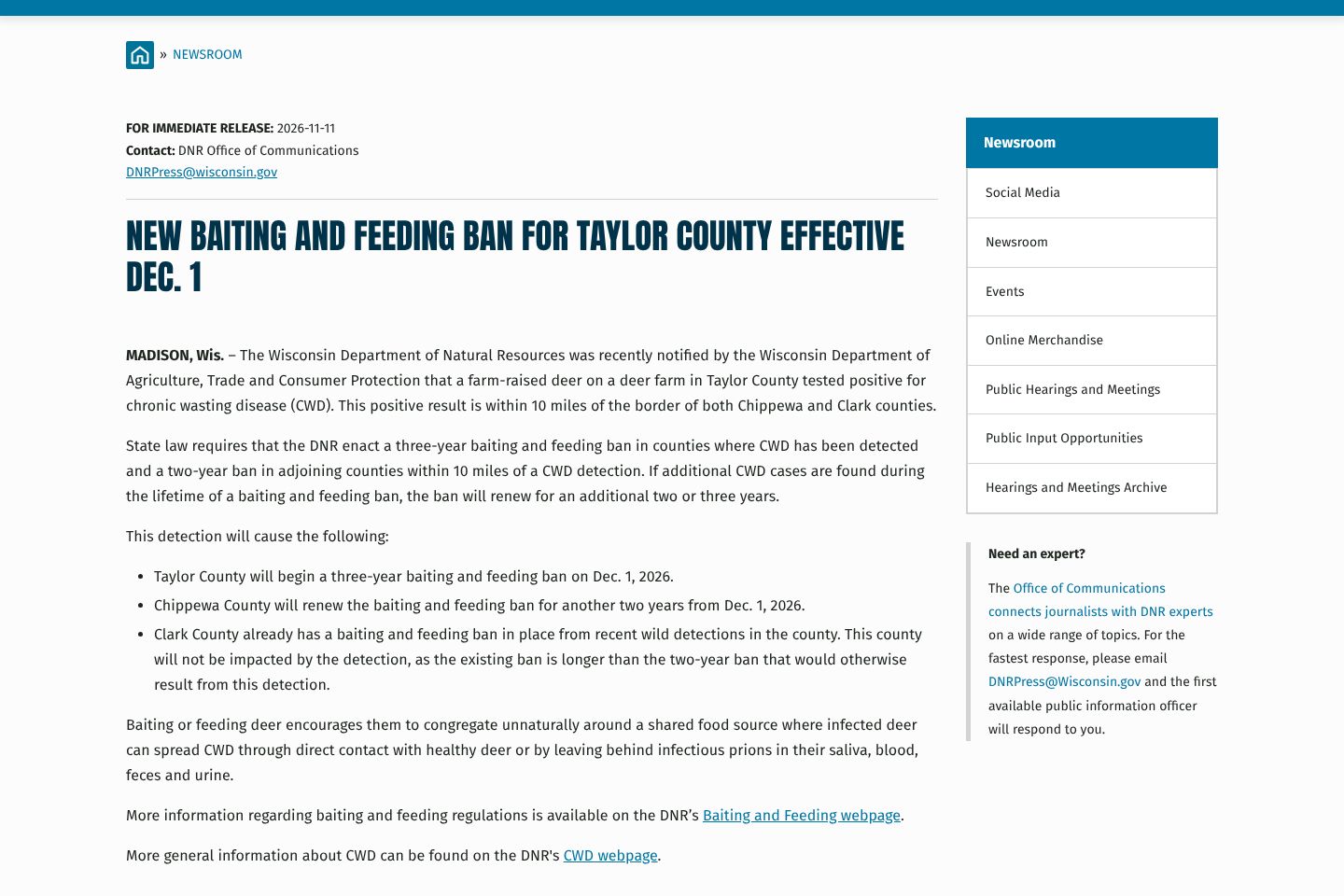
Deer baiting will be banned in Taylor County, Wisconsin starting Dec. 1, 2026. The Wisconsin Department of Natural Resources (DNR) announced on Nov. 11 that a three-year baiting and feeding ban takes effect that day, after the Wisconsin Department of Agriculture, Trade and Consumer Protection (DATCP) told the DNR that “a farm-raised deer on a deer farm in Taylor County tested positive for chronic wasting disease (CWD)” (Wisconsin DNR Nov. 11 release). Until then, Taylor is still one of the Wisconsin counties where baiting is allowed, so the change lands after the nine-day gun season, not during it.
Key Takeaways
- Taylor County’s three-year baiting and feeding ban begins Dec. 1, 2026 (Wisconsin DNR Nov. 11 release).
- Chippewa County’s ban renews for another two years from Dec. 1, 2026. Clark County’s existing ban doesn’t change (Wisconsin DNR Nov. 11 release).
- The positive was in a farm-raised deer, and it sits within 10 miles of both the Chippewa and Clark county lines (Wisconsin DNR Nov. 11 release).
- Wisconsin’s 2026 nine-day gun season runs Nov. 21 through Nov. 29 (Wisconsin DNR gun season release), before the Taylor ban starts.
- Local ordinances can still ban baiting where state law allows it (Wisconsin DNR baiting page).
Why is Taylor County getting a baiting ban?
Because Wisconsin law makes it automatic. The DNR says “State law requires that the DNR enact a three-year baiting and feeding ban in counties where CWD has been detected and a two-year ban in adjoining counties within 10 miles of a CWD detection” (Wisconsin DNR Nov. 11 release).
So the county where the positive turned up gets three years, and neighboring counties within 10 miles get two. Because the law requires it, the ban follows from the confirmed detection itself.
The trigger here was a captive deer, not a wild one. The DNR release says it was DATCP that notified the department of the Taylor County positive. The release doesn’t name the farm or say where in the county it is.
Which counties are affected by the Taylor County CWD detection?
Three, according to the DNR:
| County | What happens | When |
|---|---|---|
| Taylor | New three-year baiting and feeding ban | Starts Dec. 1, 2026 |
| Chippewa | Existing ban renewed for two more years | From Dec. 1, 2026 |
| Clark | No change; its current ban from wild detections runs longer | Already in place |
The DNR says Clark County “already has a baiting and feeding ban in place from recent wild detections in the county” and won’t be affected, “as the existing ban is longer than the two-year ban that would otherwise result from this detection” (Wisconsin DNR Nov. 11 release).
Can you bait deer in Taylor County during the 2026 gun season?
Under state rules, yes, through Nov. 30. The DNR’s baiting page, with a county map dated Nov. 9, 2026, lists Taylor among the 13 Wisconsin counties where deer baiting and feeding are allowed: “Ashland, Bayfield, Burnett, Door, Douglas, Brown, Iron, Kewaunee, Price, Rusk, Sawyer, Taylor and Washburn Counties.” The other 59 counties are closed (Wisconsin DNR baiting page). The new ban doesn’t start until Dec. 1, and the nine-day gun season “opens on Saturday, Nov. 21, and runs through Sunday, Nov. 29” (Wisconsin DNR gun season release).
Two catches. First, the DNR says “Hunters should follow local ordinances that may prohibit baiting and feeding deer until they are notified of a change locally,” so check with the county and town before you put corn out. Second, baiting in an open county still comes with state limits on how much bait you can put out, how sites are spaced and what the bait can contain. Read the current rules on the Wisconsin DNR baiting page and its linked regulations before you hunt over a pile.
If you hunt Taylor County into December, plan on your bait sites being illegal from Dec. 1 on.
How many Wisconsin counties still allow baiting?
As of the DNR’s Nov. 9 map, 13. Washburn County only just got back on that list: the DNR says it “had its baiting and feeding ban removed on Nov. 9, 2026.” Once Taylor’s ban starts Dec. 1, our own count from that Nov. 9 list drops to 12 open counties, unless another detection changes it first. That 12 is RAD’s math (13 minus Taylor), not a number the DNR has published. The DNR warns that “new detections may cause new bans to go into place yet this year” and that its baiting page “will always have the most up-to-date information on current baiting and feeding bans” (Wisconsin DNR baiting page).
Bans also restart. The DNR says “If additional CWD cases are found during the lifetime of a baiting and feeding ban, the ban will renew for an additional two or three years” (Wisconsin DNR Nov. 11 release). That’s what just happened in Chippewa.
Why does Wisconsin ban baiting where CWD shows up?
The DNR’s reasoning is about crowding at a shared pile. “Baiting or feeding deer encourages them to congregate unnaturally around a shared food source where infected deer can spread CWD through direct contact with healthy deer or by leaving behind infectious prions in their saliva, blood, feces and urine” (Wisconsin DNR Nov. 11 release).
CWD is a fatal prion disease of the nervous system that only hits the deer family, including deer, elk and moose. The DNR started watching for it in wild Wisconsin whitetails in 1999 and found the first positives in 2002 (Wisconsin DNR CWD page).
Should Taylor County hunters test their deer for CWD?
It’s free, so there’s little reason not to. The DNR says “Testing through the DNR is free for deer harvested within the state,” and hunters anywhere in Wisconsin can submit a sample. The options the DNR lists are self-service kiosks where you drop the head “with 5 inches of neck attached,” cooperating meat processors and taxidermists, pulling the retropharyngeal lymph nodes yourself and dropping them at a kiosk, or an appointment with DNR staff through the Wildlife Switchboard (Wisconsin DNR gun season release).
Every Wisconsin deer still has to be registered electronically “by 5 p.m. the day after the deer is recovered,” with or without a CWD sample.
The other side of it
This ban comes from a single positive on a deer farm, not from a wild Taylor County deer, and the DNR release doesn’t say whether CWD has turned up in wild deer there. The law doesn’t weigh that difference; any confirmed captive or wild case starts the clock. Hunters who bait in Taylor County lose the option on Dec. 1 regardless of what testing of wild deer shows this season.
Sources
- New Baiting And Feeding Ban For Taylor County Effective Dec. 1, Wisconsin Department of Natural Resources
- Baiting and feeding regulations, Wisconsin Department of Natural Resources
- Wisconsin's 2026 Nine-Day Gun Deer Season Opens Nov. 21, Wisconsin Department of Natural Resources
- Chronic wasting disease (CWD), Wisconsin Department of Natural Resources
Comments