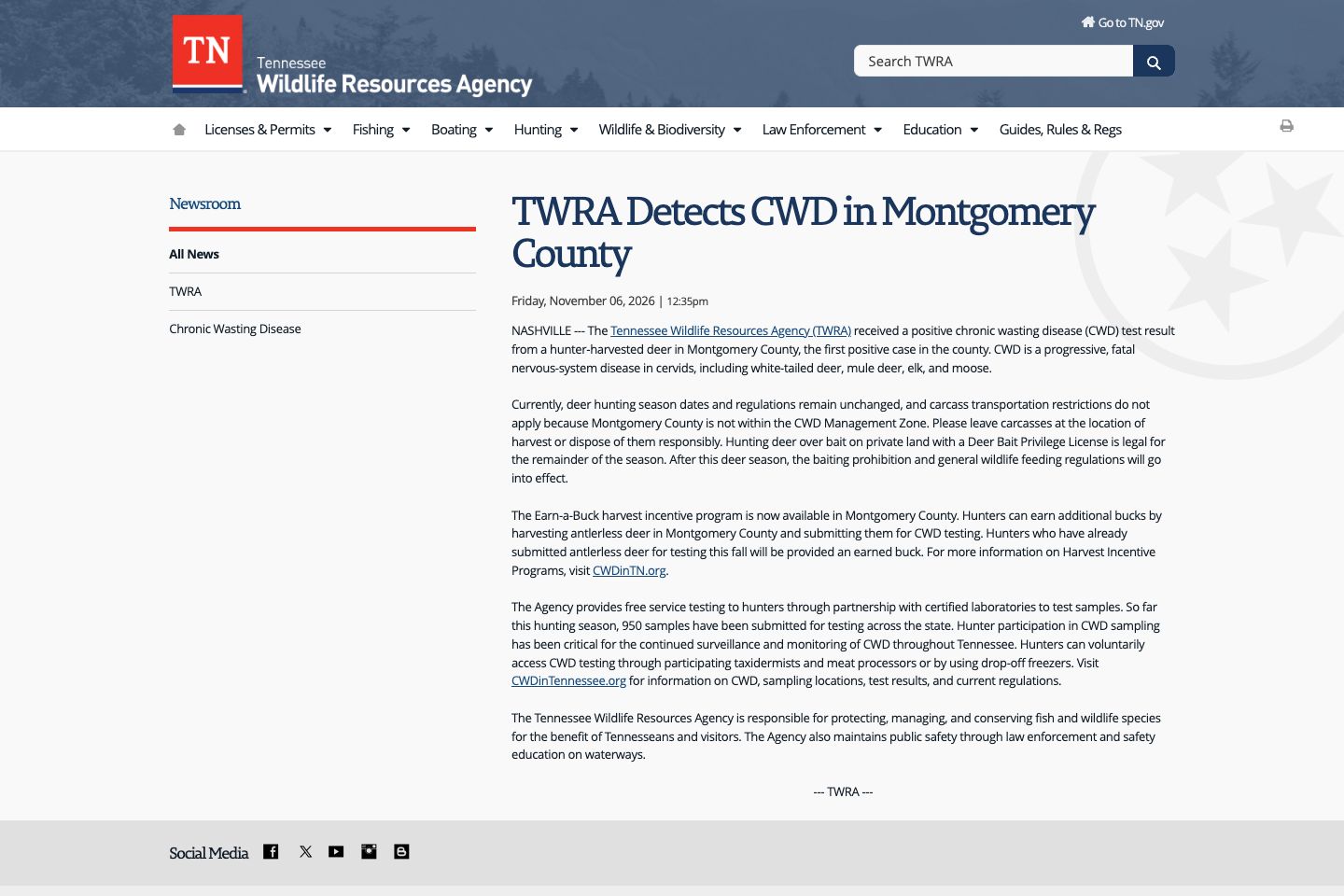
Yes. On November 6, 2026, the Tennessee Wildlife Resources Agency (TWRA) announced a positive chronic wasting disease (CWD) test from a hunter-harvested deer in Montgomery County, the first positive case in that county.
This page covers that county-first detection and the hunter rules TWRA posted with it. It is not a rewrite of RAD’s general CWD explainer or the statewide Tennessee season hub. TWRA did not publish the index deer’s sex, age, exact harvest location inside the county, or laboratory method on its press release, so those details are not stated here.
Key Takeaways
- November 6, 2026: TWRA reported the first CWD-positive hunter-harvested deer in Montgomery County (TWRA press).
- Deer hunting season dates and regulations remain unchanged for now (TWRA press).
- Carcass transportation restrictions do not currently apply because Montgomery County is outside Tennessee’s CWD Management Zone (TWRA press; TWRA CWD regulations).
- Earn-a-Buck is now available in Montgomery County: each antlerless deer harvested there and submitted for CWD testing earns an additional antlered deer (TWRA press; TWRA incentive programs).
- Private-land baiting with a Deer Bait Privilege License remains legal in Montgomery County for the remainder of this deer season; TWRA says baiting prohibition and general wildlife feeding rules take effect after the season (TWRA press).
- TWRA’s CWD-in-Tennessee page lists Montgomery among the state’s CWD-positive counties (TWRA CWD in Tennessee).
What did TWRA announce for Montgomery County?
TWRA’s November 6, 2026 newsroom release states the agency received a positive CWD test result from a hunter-harvested deer in Montgomery County and that it is the first positive case in the county. TWRA describes CWD as a progressive, fatal nervous-system disease in cervids, including white-tailed deer, mule deer, elk, and moose (TWRA press).
The same release says season dates and regulations remain unchanged, asks hunters to leave carcasses at the harvest location or dispose of them responsibly, and points hunters to CWDinTennessee.org / CWDinTN.org for sampling locations, test results, and current regulations (TWRA press).
TWRA also reported that 950 samples had been submitted for testing statewide so far this hunting season, and that free testing is available through certified laboratory partners via participating taxidermists and meat processors or drop-off freezers (TWRA press).
Is Montgomery County inside Tennessee’s CWD Management Zone?
No, according to TWRA’s detection press and the agency’s CWD regulations page. Because Montgomery County is not within the CWD Management Zone, TWRA says carcass transportation restrictions do not apply to this detection (TWRA press).
TWRA’s regulations page lists the CWD Management Zone counties for carcass transport as Benton, Carroll, Chester, Crockett, Decatur, Dyer, Fayette, Gibson, Hardeman, Hardin, Haywood, Henderson, Henry, Madison, McNairy, Lake, Lauderdale, Obion, Shelby, Tipton, and Weakley. Montgomery is not on that zone list (TWRA CWD regulations).
Inside the Management Zone, TWRA restricts moving whole or undressed carcasses out of the zone. Approved parts that may move more freely include deboned meat; antlers and cleaned skull plates/skulls with no meat or tissue attached; cleaned teeth; finished taxidermy and antler products; and hides and tanned products. Unapproved high-risk parts include whole and field-dressed carcasses, organs, guts, and uncleaned heads/skulls (TWRA CWD regulations).
TWRA also states that only approved parts may be transported into Tennessee from another state (TWRA CWD regulations). Montgomery hunters should still follow statewide check-in and disposal expectations TWRA posts, and recheck the live regs page if the Commission later expands the Management Zone.
How does Earn-a-Buck work now that Montgomery is CWD-positive?
TWRA’s press says the Earn-a-Buck harvest incentive program is now available in Montgomery County. Hunters earn additional bucks by harvesting antlerless deer in Montgomery County and submitting them for CWD testing. Hunters who already submitted antlerless deer for testing in the county this fall will be provided an earned buck (TWRA press).
TWRA’s Management and Incentive Programs page states Earn-a-Buck applies only in CWD-positive counties and automatically activates if a county becomes CWD-positive during the hunting season. That page lists Montgomery among CWD-positive counties for the program and explains:
- Tennessee’s statewide antlered deer bag limit is two.
- In CWD-positive counties, hunters may earn an unlimited number of additional antlered deer beyond that statewide limit.
- Each antlerless deer harvested in a CWD-positive county and submitted for CWD testing earns one additional antlered deer.
- Earned antlered deer must be harvested in CWD-positive counties.
- The earned antlered deer is available immediately upon check-in and submission for CWD testing.
- The program details on that page are labeled valid for the 2026-2027 hunting season (TWRA incentive programs).
Related incentives on the same page (statewide Fight CWD processing vouchers for CWD-positive results, and Replacement Buck after official notice of a CWD-positive antlered deer) are separate from Earn-a-Buck. Replacement bucks must also be harvested in a CWD-positive county (TWRA incentive programs).
Can you still bait deer in Montgomery County?
For the rest of this deer season, yes on private land if you hold a Deer Bait Privilege License. TWRA’s Montgomery detection press states hunting deer over bait on private land with a Deer Bait Privilege License is legal for the remainder of the season, and that after this deer season the baiting prohibition and general wildlife feeding regulations will go into effect (TWRA press).
That grace period matters because TWRA’s broader CWD regulations generally prohibit deer baiting and wildlife feeding in the CWD Management Zone and in CWD-positive counties. The regulations page includes a Montgomery-specific note that baiting and general wildlife feeding remain allowed through the remainder of the deer season after the county detection, with changes afterward (TWRA CWD regulations).
Background on the privilege license from TWRA’s July 15, 2026 announcement: it is required for anyone hunting white-tailed deer over bait, with no exemption for lifetime licenses or age; it is valid only on private owned or leased property; and under the law baiting is not allowed on Wildlife Management Areas, in the CWD Management Zone, or in CWD-positive counties once those bans apply. Resident cost was listed at $50 and nonresident at $100 when that announcement posted (TWRA bait license press).
TWRA’s regulations page also summarizes bait rules that apply where baiting is allowed: corn, wheat, grains, natural food substances, or products marketed for feeding deer are allowed; processed foods such as sugar, honey, syrups, or peanut butter are not; bait must be scattered, not piled; no more than five gallons or 25 pounds at a site in 24 hours; spacing and acreage limits apply; open trough feeders are banned; and baiting is prohibited on all public lands (TWRA CWD regulations).
After Montgomery’s post-season baiting and feeding ban takes effect, TWRA’s general CWD feeding restrictions will matter there: no placement of grain, salt products, minerals, or other consumable products for wildlife unless narrow exceptions apply (for example feed within 100 feet of a residence, feed that reasonably excludes deer, authorized wild-hog management, or normal agriculture/forestry/food-plot practices), and hunting over feed is not allowed under those exceptions (TWRA CWD regulations).
What counties in Tennessee have CWD, and where does Montgomery fit?
TWRA’s CWD-in-Tennessee page states CWD has been found in wild white-tailed deer in twenty-four counties and lists Montgomery among them: Carroll, Chester, Crockett, Decatur, Dickson, Dyer, Fayette, Gibson, Hardeman, Hardin, Haywood, Henderson, Henry, Humphreys, Lauderdale, Lewis, Madison, McNairy, Montgomery, Shelby, Tipton, Wayne, Weakley, and Williamson (TWRA CWD in Tennessee).
That page also recounts Tennessee’s first detections in Hardeman and Fayette Counties in December 2018 and summarizes that more than 100,000 deer have been sampled since then. Prevalence estimates TWRA posts for the 2025–26 project period are county averages and are not repeated here as Montgomery-specific rates; the November 6 press is the county-first detection notice (TWRA CWD in Tennessee; TWRA press).
Other recent first-county detections TWRA has posted (for context only, not additional Montgomery facts) include Humphreys County (January 12, 2026), Dickson and Williamson Counties (December 23, 2025), Wayne County (December 18, 2025), and Decatur County (December 2, 2025) (TWRA CWD newsroom filter).
Has any human gotten CWD from deer, and should you eat the venison?
There is no evidence on the CDC page that CWD has infected people. The CDC About Chronic Wasting Disease page (updated January 21, 2026) states CWD has not been shown to infect people, that scientists continue to study whether contact with or eating meat from infected animals could affect people, and that CDC recommends people not knowingly eat meat from CWD-positive animals.
TWRA’s CWD regulations page likewise states there is no scientific evidence that CWD can be naturally transmitted to humans, and refers hunters to CDC precautions: avoid sick animals; wear rubber or latex gloves when field dressing; minimize handling of brain, spinal cord, eyes, spleen, tonsils, and lymph nodes; wash tools and sanitize (TWRA describes soaking cleaned tools in a 50 percent household bleach / 50 percent water solution for 20 minutes); and in CWD-affected counties have animals tested and do not consume animals that test positive (TWRA CWD regulations; CDC About CWD).
What should Montgomery County deer hunters do next?
- Keep hunting under posted season dates and bag limits; TWRA says those dates and regulations are unchanged for now (TWRA press).
- Submit deer for free CWD testing through participating taxidermists, processors, or drop-off freezers, and use Earn-a-Buck if you harvest antlerless deer in Montgomery County (TWRA press; TWRA incentive programs).
- Leave carcasses at the harvest site or dispose of them responsibly; Management Zone carcass-export rules do not currently apply to Montgomery, but approved-parts rules still govern interstate movement into Tennessee (TWRA press; TWRA CWD regulations).
- If you bait on private land, hold a Deer Bait Privilege License and follow bait-type and site rules for the remainder of this season; plan for baiting and general wildlife feeding bans after the season (TWRA press; TWRA CWD regulations).
- Recheck CWDinTennessee.org, the CWD-in-Tennessee page, and the CWD regulations page before each hunt, county lists and zone boundaries can change during the season.
Sources
- TWRA press release, Nov 6, 2026, TWRA Detects CWD in Montgomery County: https://www.tn.gov/twra/news/2026/11/6/twra-detects-cwd-in-montgomery-county.html
- TWRA CWD in Tennessee (county list / program history; verified 2026-11-06): https://www.tn.gov/twra/hunting/cwd/cwd-in-tennessee.html
- TWRA CWD Management and Incentive Programs (Earn-a-Buck; verified 2026-11-06): https://www.tn.gov/twra/hunting/cwd/cwd-management-and-incentive-programs.html
- TWRA Regulations & Hunting with CWD (Management Zone list, approved parts, baiting/feeding; verified 2026-11-06): https://www.tn.gov/twra/hunting/cwd/regulations-and-hunting-with-cwd.html
- TWRA press, July 15, 2026, New Deer Bait Privilege License Available July 22: https://www.tn.gov/twra/news/2026/7/15/new-deer-bait-privilege-license-available-july-22.html
- CDC About Chronic Wasting Disease (Jan 21, 2026): https://www.cdc.gov/chronic-wasting/about/index.html
- TWRA CWD newsroom filter (timeline context only): https://www.tn.gov/twra/news.chronic-wasting-disease.html
The other side of it
The baiting grace period and the lack of carcass restrictions both depend on where Montgomery sits today, and neither is locked in. Baiting and feeding bans kick in after this season, and if the Commission expands the Management Zone, transport limits could follow. One positive deer also says little yet about how common CWD is in the county, since TWRA didn’t publish where in the county it was taken or any county-specific rate.
Sources
- TWRA Detects CWD in Montgomery County
- Regulations & Hunting with CWD | TWRA | Tennessee Wildlife Resources Agency
- CWD Management and Incentive Programs | TWRA
- CWD In Tennessee - Information regarding Chronic Wasting Disease from the TWRA
- Chronic Wasting Disease | Tennessee State Wildlife Resources Agency
- CWDinTN.org (cwdintn.org)
- TWRA bait license press (tn.gov)
- TWRA CWD newsroom filter (tn.gov)
- CDC About Chronic Wasting Disease page (cdc.gov)
Comments