Yes, in two wild deer now. CWD was detected in a second wild deer in Livingston County, an adult buck from the Town of Sparta, the New York State Department of Environmental Conservation (DEC) announced on Nov. 25, 2026. DEC says the second case “confirms the disease is present in the local deer population” (DEC Nov. 25 release).
The first case was announced Nov. 6, 2026, also from the Town of Sparta. DEC called it “the first occurrence of CWD in a wild deer in New York State since 2005” (DEC Nov. 6 release). That positive came from an adult doe sampled in DEC’s annual wild deer surveillance. Cornell’s New York State Veterinary Diagnostic Laboratory tested and retested the tissue, and confirmatory testing was underway at USDA’s National Veterinary Services Laboratories in Ames, Iowa, when DEC made the announcement.
Key Takeaways
- A second wild deer, an adult buck from the Town of Sparta, tested positive for CWD, and DEC made no changes to the containment area (DEC Nov. 25 release).
- Testing is now free for deer taken in the Towns of Ossian and Dansville in Livingston County, the Town of Wayland in Steuben County, and any town bordering the containment area (DEC Nov. 25 release).
- Every deer harvested in Conesus, Groveland, North Dansville, Sparta, Springwater or West Sparta must be sampled for CWD (DEC CWD page).
- You can’t move a whole deer out of those six towns. Taking one to a processor or taxidermist outside the area takes a DEC transport permit (DEC Nov. 6 release).
- The check station moves on Nov. 30 from 3360 Gypsy Lane, Mount Morris, to the Town of Sparta Highway Department, 8374 Sparta Center Road, Dansville (DEC Nov. 23 release).
- Keep the venison, but don’t eat it until your test result comes back (DEC CWD page).
Is there CWD in New York?
There is again. New York’s only earlier case was in Oneida County in 2005, in captive and wild deer. DEC calls New York “the only state to have eliminated CWD” (DEC CWD page). In 2024, CWD turned up in a captive red deer herd in southern Herkimer County. DEC says it has tested more than 70,000 wild deer since 2002 without finding another wild case until this one (DEC Nov. 6 release).
CWD is a fatal prion disease of deer, elk and moose. DEC says the prions spread through saliva, urine and feces and can stay infectious in soil for years (DEC CWD page).
Which towns are in the Livingston County CWD containment area?
The initial containment area is six towns: Conesus, Groveland, North Dansville, Sparta, Springwater and West Sparta. DEC says it “may expand or add containment areas based on the locations of any new positive detections” (DEC Nov. 6 release). Go by DEC’s town list, not by a radius around Sparta.
DEC and Agriculture and Markets are working from the state’s Interagency CWD Response Plan since the Livingston detection (DEC CWD page).
Where was the second CWD-positive deer found?
Inside the containment area. DEC says the adult male “was harvested within the containment area in the town of Sparta, but south of the initial detection.” It turned up in the mandatory testing that started after the first case. DEC says there are “no modifications to the CWD Containment Area at this time.” A town-by-town dashboard of deer tested and positives is due on DEC’s CWD page by early December, with a full outbreak update after seasons close in early January (DEC Nov. 25 release).
Is CWD testing free outside the Livingston containment area?
In some towns next door, yes. DEC says it “is now offering free testing for deer harvested in the Towns of Ossian and Dansville in Livingston County and the Town of Wayland in Steuben County as well as any deer harvested in any town bordering the CWD Containment Area.” It’s optional there. Testing stays mandatory only inside the six containment towns (DEC Nov. 25 release).
The release gives no separate drop-off process for those towns. It points hunters to the check station and the head bins at both station sites, with instructions on DEC’s website. Results take up to two weeks, and DEC contacts the hunter directly on a positive. Elsewhere in New York, Cornell testing still costs a fee (DEC Nov. 25 release).
What must hunters do inside the Livingston containment area?
Get every deer tested. DEC’s page says “All successful hunters must submit tissue samples for all deer harvested within the containment area.” You can do that at a DEC check station, through a cooperating meat processor or taxidermist, or at a head collection bin. DEC also asks hunters and processors to put paper carcass tags or change-of-possession tags on containment-area deer so the harvest location is clear (DEC CWD page).
DEC’s emergency rules for the containment area also:
- Ban moving CWD-susceptible carcasses or parts out of the area, except to cooperating processors or taxidermists with a DEC transportation permit.
- Ban possessing deer killed by vehicles inside the area.
- Ban collecting, possessing, moving, using or selling urine, feces, glands or velvet from CWD-susceptible animals inside the area.
- Ban rehabilitating deer from or within the area.
- Allow carcass disposal double-bagged in the municipal trash or brought double-bagged to a DEC dumpster (DEC CWD page).
Where is the Livingston County CWD check station?
At 3360 Gypsy Lane, Mount Morris, through Sunday, Nov. 29. On Monday, Nov. 30, the new station opens at the Town of Sparta Highway Department, 8374 Sparta Center Road, Dansville, and Gypsy Lane closes. Head collection bins stay at both sites. Sparta is open daily from 8 a.m. to 8 p.m. through Dec. 13, 2026, with more hours to be posted on DEC’s website, and it has a self-service area where hunters “may use the self-service processing area to debone their deer and take the meat home” with their own gear (DEC Nov. 23 release). DEC’s Nov. 25 release adds that the self-service processing station is open from 8 a.m. to 4:30 p.m. daily (DEC Nov. 25 release).
The sampling rule didn’t change: containment-area hunters “must bring their deer to the check station so that DEC can collect a sample for CWD testing” (DEC Nov. 23 release). News10NBC reported before the move was announced that the station “will be closed on Thanksgiving Day, Dec. 23-25, and New Years Day” (WHEC). DEC’s new release doesn’t list closures for Sparta, so check DEC’s CWD page before a holiday hunt.
To take a deer to a cooperating processor or taxidermist, or out of the containment area, you need a transport permit from the check station first (WHEC).
Spectrum News published the eight cooperating businesses, all in Wayland and Dansville: Beckers Meat Processing, Piggy Pete’s, Wester’s Deer Processing, Earner’s Deer Processing, Robin Coombs, Ridge Runner Taxidermy, Finger Lakes Taxidermy, and Brian Pragle’s Custom Woodworking & Skull Mounts (Spectrum News). Check DEC’s page for the current list before you go.
Can you eat venison from the containment area?
Not until you get your result. DEC says hunters “can keep the venison from their deer but should not consume any until they receive test results.” If a deer tests positive, DEC will tell the hunter and ask to collect that venison for disposal (DEC Nov. 6 release). DEC says there’s no current evidence CWD infects people, but the CDC recommends no one knowingly eat a CWD-positive animal (DEC CWD page). The CDC says scientists are still studying whether eating infected meat could affect people (CDC).
DEC’s handling advice for venison from CWD areas: wear rubber gloves, and don’t eat the brain, spinal cord, eyes, spleen, tonsils, intestines or lymph nodes. Soaking tools and hard surfaces for an hour in a 50% bleach solution inactivates the prions (DEC CWD page).
How do you prepare a deer head for CWD testing?
DEC’s steps: cut the head off with some neck left on, and keep it chilled or frozen. On a buck, take off the skull plate and antlers first. Bag the head, label the bag with your name, address and phone number, and fill out the DEC tag at drop-off. DEC says it will post results for containment-area deer on its CWD page (DEC CWD page).
How is the Herkimer and Otsego testing different?
It’s voluntary. After the 2024 captive-herd case, DEC asks hunters in Columbia, German Flatts, Litchfield, Warren and Winfield in Herkimer County, and Richfield in Otsego County, to drop deer heads in DEC’s head bins for a shot at a lifetime hunting license. Outside those areas and the free-testing towns around Livingston, hunters can pay to have a deer tested through the Cornell Wildlife Health Lab (DEC CWD page).
Can you bring a New York deer into Vermont?
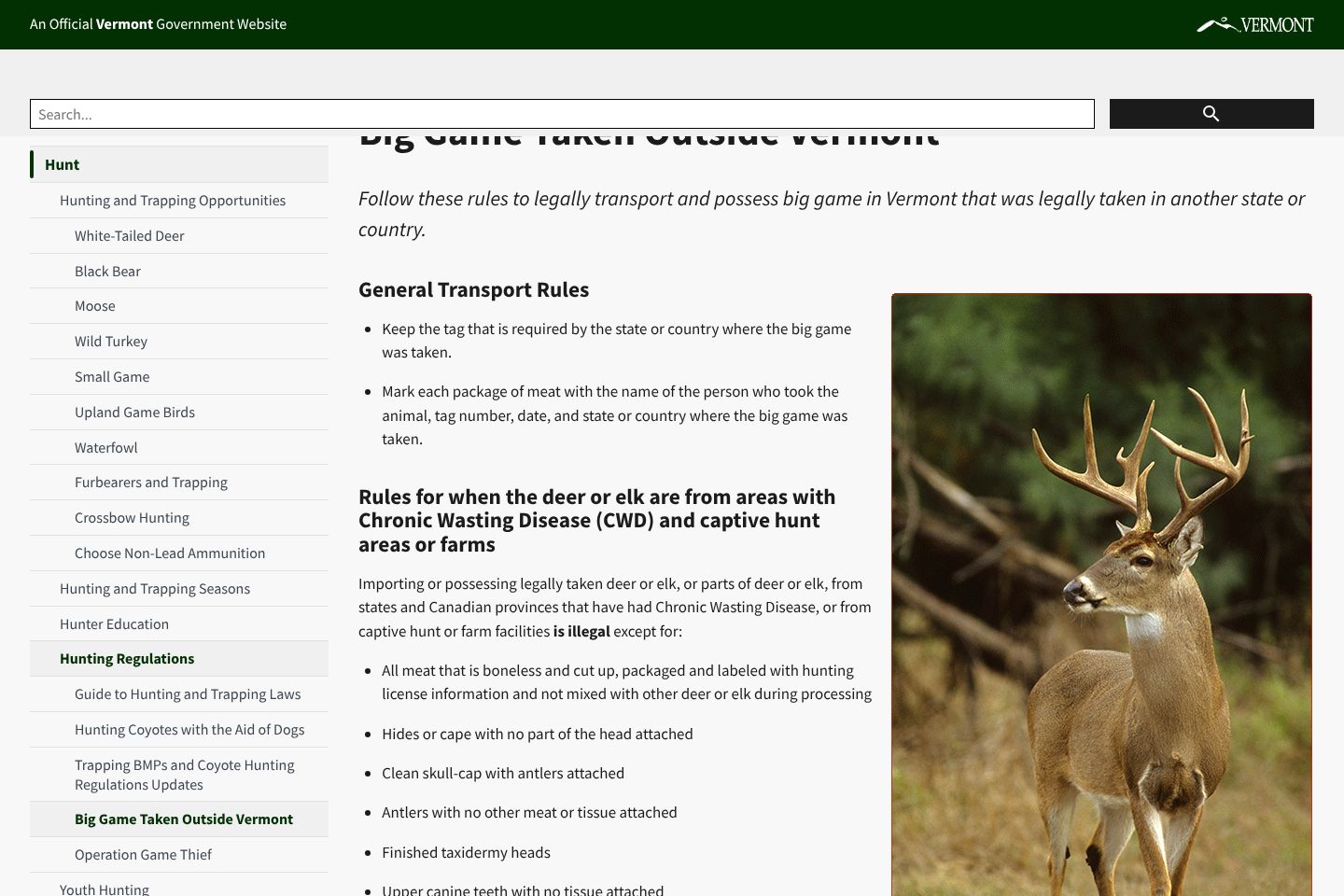
Not whole. Vermont Fish and Wildlife lists New York under its CWD import rule, so a deer, elk or moose from New York has to be processed before it crosses into Vermont (Vermont Fish and Wildlife release, Big Game Taken Outside Vermont). The parts Vermont allows:
- boneless meat, or meat cut up, packaged and labeled with hunting license information
- a hide or cape with no part of the head
- a clean skull cap with antlers, or antlers with no tissue
- a finished taxidermy head
- upper canine teeth with no tissue
Vermont lists a fine of up to $1,000 and loss of hunting and fishing licenses for one year for each animal brought in illegally. It also bans natural deer urine and body-fluid scents (Vermont Fish and Wildlife release). If you’re driving a New York deer into another state, check that state’s rules first.
New York has its own import rule going the other way. A hunter coming home from out of state can bring in only deboned meat, a cleaned skull cap, clean antlers, a cape or hide, cleaned teeth or jaw and finished taxidermy (DEC CWD page).
Why can’t you feed deer in New York?
It’s the law. DEC says “It is illegal to intentionally feed wild deer and moose in New York,” and the state’s CWD rules count minerals as an edible attractant (DEC CWD page). Inside the containment area, the urine and gland ban above applies too. Statewide, DEC tells hunters to use synthetic scents instead of natural deer urine.
The other side of it
Two positives from the same town tell you CWD is in the Sparta herd. They don’t tell you how many deer carry it or how far it has spread, and DEC says testing is how it determines “how widely the disease has spread and estimating prevalence in deer in the affected area” (DEC Nov. 25 release). The town dashboard due in early December will be the first real count.
Sources
- CDC About Chronic Wasting Disease page, cdc.gov
- Vermont Fish & Wildlife, Big Game Taken Outside Vermont, vtfishandwildlife.com
- Vermont Fish & Wildlife Aug 17, 2026 release, vtfishandwildlife.com
- DEC Announces Chronic Wasting Disease Found in Livingston County Wild Deer, New York State Department of Environmental Conservation
- Chronic Wasting Disease, New York State Department of Environmental Conservation
- DEC Announces Opening of Regular Firearms Season for Deer and Bear Hunting in the Southern Zone on November 21 (Nov. 17, 2026), New York State Department of Environmental Conservation
- DEC Announces Opening of Regular Firearms Season for Deer and Bear Hunting in the Southern Zone on November 21 (EIN Presswire copy of the DEC release), New York State Department of Environmental Conservation via EIN Presswire
- DEC adds new requirements after chronic wasting disease found in Livingston County deer, WHEC News10NBC
- New York State DEC discovers rare disease in upstate deer, Spectrum News
- DEC Announces New Deer Check Station as Part of Chronic Wasting Disease Response (EIN Presswire copy of the DEC release, Nov. 23, 2026), New York State Department of Environmental Conservation via EIN Presswire
- DEC Announces Second Wild Deer Confirmed to Have Chronic Wasting Disease (GovDelivery bulletin of the DEC release, Nov. 25, 2026), New York State Department of Environmental Conservation via GovDelivery
Comments