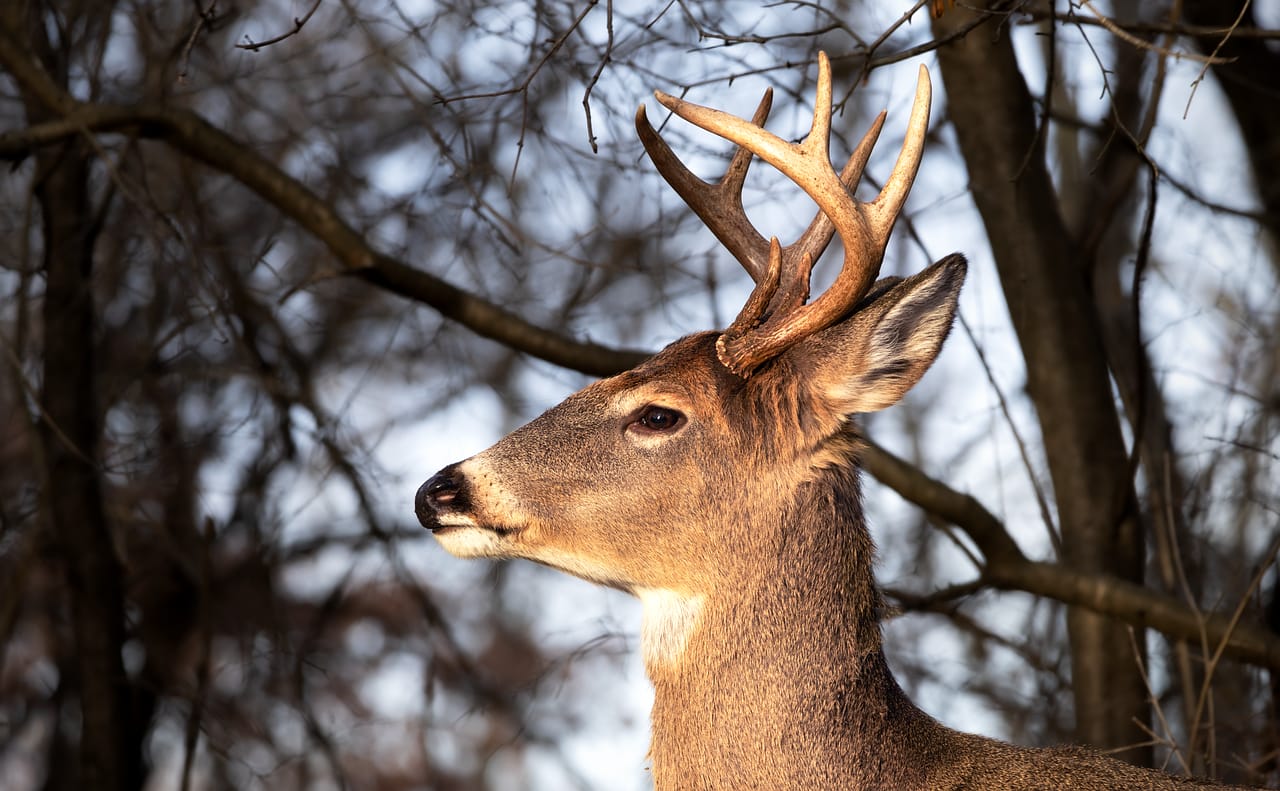
When to use a grunt call for whitetail deer depends on two things: the phase of the season and what the buck in front of you is doing. Grunt softly in October, get louder and more aggressive near the peak of the rut, grunt at bucks passing out of range, and stay quiet when a buck is already coming or looking your way. Outdoor Life contributor Michael Hanback puts it this way: “The best calling success occurs around the peak of the rut” (Outdoor Life). Here’s the timing, the main grunt types, and the mistakes to avoid.
Key Takeaways
- Early to mid-October: Hanback blows “half a dozen moderately loud grunts every 20 to 30 minutes” in travel areas.
- Near the rut peak: “loud, choppy tending grunts every 30 minutes or so.”
- Post-rut: tone it down.
- Grunt at bucks passing out of range. Don’t grunt at one that’s coming in or looking for you.
- Don’t use deep, dominant grunts on young bucks; they may run.
Why do whitetail deer grunt?
Both bucks and does grunt. Charles Alsheimer, writing in Outdoor Life, describes a 1988 University of Georgia study that recorded a captive herd and “categorized into 12 different types of calls.” The tending grunt is the one hunters care most about. Alsheimer explains that when a buck is with a doe “that is in or near estrus and other bucks are nearby,” the tending buck “will usually make a tending grunt.”
Don’t overrate sound, though. University of Missouri Extension says that “when compared to smell and visual cues, sounds play a relatively minor role in deer communication,” though bucks “occasionally bleat or grunt when chasing does during the rut” (MU Extension).
The grunts you can make with a tube
- Doe and yearling grunt. Alsheimer says these “sound like someone burping” and are “generally short or medium in length and soft to moderate in volume.” Does and young bucks use them mostly as a locator call.
- Trailing grunt. In Deer & Deer Hunting, Alsheimer describes a short grunt bucks make while traveling. A rutting buck may grunt “every one to 10 steps if he” is in the mood (Deer & Deer Hunting).
- Dominant grunt. Similar to the trailing grunt, but much deeper.
- Tending grunt. “A series of short grunts repeated in rapid fashion.” Alsheimer says you can make it by putting your tongue on the roof of your mouth and making a ticking cadence as you blow.
When to use a grunt call through the season
Early season and October. Hanback says “In areas in early to mid-October, it can’t hurt to blow half a dozen moderately loud grunts every 20 to 30 minutes” while bowhunting draws, ridges and the edges of bedding areas. He says not to blind-call near crops or acorns early in the pre-rut, since deer are coming to feed anyway and an excited doe or young buck “might come over and bust you.”
Pre-rut into the breeding phase. Alsheimer says he likes the tending grunt “when the breeding phase of the rut is due to start.” Hanback suggests adding estrous-doe bleats followed by tending grunts from about Nov. 5 to the rut peak. For more on bleats, see our guide to estrous doe calls and bleats.
Peak rut. This is the time to get loud. Hanback blows “loud, choppy tending grunts every 30 minutes or so” in 5- to 10-second sequences. Rut timing varies by region; check our deer rut guide.
Post-rut. Hanback says to “tone your calling back down” and set up near bedding areas and funnels to food. A tired buck won’t walk far to investigate loud calling.
When to use a grunt call on a buck you can see
This is where a grunt tube shines. Hanback says to “Grunt at every buck you see that is slipping by out of range.” If the buck stops and keeps going, grunt again, louder.
Alsheimer works it the same way. If a buck starts toward him, he won’t call again unless the buck stops.
When not to grunt
- When a buck is close and looking. Hanback says “Don’t grunt when a buck is within 75 yards and looking for you.”
- When a buck is walking toward you. Call again only if he loses interest.
- To stop a buck for the shot. Hanback suggests a voice grunt instead, after you’ve drawn or aimed.
- Deep grunts at young bucks. Alsheimer warns that yearlings “will often run if they hear a mature buck grunt.”
Watch the wind. Hanback once had a buck circle downwind after a grunt, so watch your downwind side even if a buck walks off.
FAQ
How often should you use a grunt call? Hanback suggests every 20 to 30 minutes in October and about every 30 minutes near the rut peak.
Can you grunt too much? Yes. Calling to a buck that is already coming, or one close and looking for you, can give you away.
Do does grunt? Yes. Alsheimer groups doe and yearling buck grunts together as softer, burp-like calls.
Should I rattle too? You can pair them. See our guide to rattling sequences by rut phase.
The other side of it
Some hunters say grunt calls are overrated, and Missouri’s extension biologists would partly agree: deer rely more on scent and sight than on sound. That’s a fair caution, and a grunt won’t fix a bad stand. But a single grunt at a buck slipping past out of range costs nothing. The hunter who grunts nonstop from the truck to the stand isn’t calling deer, he’s narrating.
Keep reading
Latest deer news
Sources
- When and How to Use a Grunt Tube to Call Deer (Charles Alsheimer, Michael Hanback, Natalie Krebs), Outdoor Life
- How to Speak the Language (Alsheimer's Greatest Insights), Deer & Deer Hunting
- Ecology and Management of White-Tailed Deer in Missouri (G9479), University of Missouri Extension and Missouri Department of Conservation
Comments