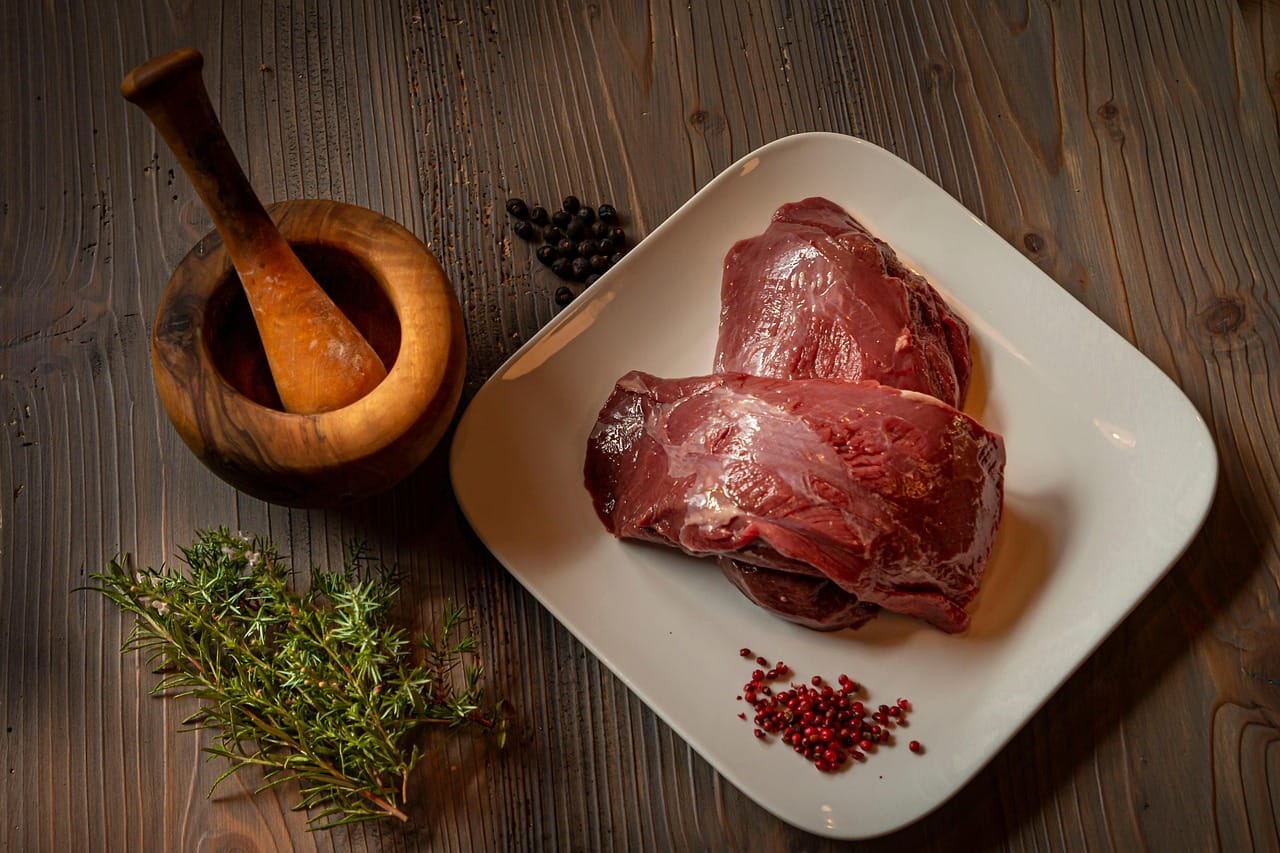
What is a venison chop? It’s a single-serving cut from the loin or rib section along the deer’s back. It can be boneless or on the bone. The Missouri Department of Conservation’s magazine calls loin chops “another choice cut” and says its writer’s family “likes chops grilled 5 to 7 minutes per side, or pan fried” (Missouri Conservationist). The Bearded Butchers describe two ways to cut the loins: “Bone-in, where the loin remains attached to part of the spine and ribs,” or “Boneless, where the meat is trimmed completely free of the bone” (Bearded Butchers). Here’s how each works.
Key Takeaways
- Venison chops come from the loin (backstrap) and rib section.
- Boneless “backstrap chops” are cut with just a knife. Bone-in chops need a saw.
- Bone-in versions include porterhouse-style steaks and rib “tomahawk” chops.
- In CWD areas, Penn State Extension advises not sawing through bone.
- Penn State says to cook venison to at least 160°F.
What is a venison chop, exactly?
The word is used loosely. On a deer, it usually means a steak-sized piece of loin or rib. The Bearded Butchers note that “most hunters are familiar with backstraps (loins) and tenderloins,” and that these “premium sections can be cut two different ways.” In their side-by-side, one side of a buck was cut bone-in “to create porterhouse and tomahawk-style venison steaks,” while the other side “was trimmed boneless to produce the classic backstrap chops and tenderloins.”
Chops vs. tenderloins
Don’t confuse chops with tenderloins. Missouri’s Conservationist says to “Treat the tenderloins as something special. They are the strips from inside the lower back.” The Bearded Butchers call tenderloins “the most tender cut on any deer” and say they sit “inside the body cavity.” Chops come from the outside of the back, the backstrap and ribs. Missouri says tenderloins “can be sliced into small, 1-inch thick medallions and cooked like tiny steaks.”
Boneless chops
Boneless chops are slices of backstrap. The Bearded Butchers say boneless is “how most home butchers and hunters prepare their deer,” because “it’s easier, faster, and doesn’t require a saw.” In their test, Seth “trimmed off the silver skin and excess fat” before cutting.
Missouri’s Conservationist recommends the same cleanup: “you must fillet them from the bone, and also trim away most of the fat and gristle to eliminate gaminess.” It adds, “Some chops will end up as several smaller pieces as you trim away all white tissue.” For cut thickness, see venison steak thickness and carryover cooking.
Bone-in chops
Bone-in chops look more like what you’d get at a butcher counter. The Bearded Butchers say “Cutting bone-in venison steaks is a bit more work,” and “typically requires a butcher’s bandsaw.” Two styles:
- Porterhouse: “cut from the saddle area of the deer and include both the backstrap (strip) and the tenderloin separated by a” T-shaped bone.
- Tomahawk chops: “Cut from the rib section, these long-bone” chops, they say, “look incredible on the grill.” They say “the bone also acts as a natural handle and helps the meat retain moisture and shape during cooking.”
In their taste test, “Bone-in steaks offered a deeper, more robust flavor profile,” while “Boneless steaks were buttery tender and simple to eat.” Their summary: “bone-in cuts require more skill and the use of a saw,” while “boneless cuts can be easily processed with just a sharp knife.” For saws, see bone saw TPI choices for home deer processing.
A CWD caution on bone-in chops
Bone-in loin chops mean cutting near or through the backbone. In areas with chronic wasting disease, Penn State Extension’s advice is: “Bone out the meat from your animal. Don’t saw through bone, and avoid cutting through the brain or spinal cord (backbone)” (Penn State Extension). Check your state wildlife agency’s CWD rules before you hunt. If your deer came from a CWD area, boneless chops are the safer choice. See CWD and human health.
How to cook venison chops
Chops are tender cuts. Missouri’s writer says “Marinating chops usually isn’t necessary if they came from a young deer,” and says chops are more tender than round steaks. Whatever the method, use a thermometer: Penn State Extension says to “Cook venison, including jerky, to a minimum internal temperature of 160°F to reduce the risk of food-borne illness” (Penn State Extension).
FAQ
Is a venison chop the same as backstrap? A boneless chop is a slice of backstrap. A bone-in chop keeps the rib or backbone attached.
What’s a venison tomahawk? A bone-in rib chop with a long bone, per the Bearded Butchers.
Do I need a saw for chops? Only for bone-in cuts.
The other side of it
Some hunters say bone-in chops are a waste of time on a deer, and that a knife, a backstrap and a hot pan is all anybody needs. On a busy weeknight, they’re right, and in CWD country the boneless route is the one the experts recommend. But a venison porterhouse on a holiday table makes a case of its own. The hunter who saws every loin into chops and then cooks them gray has found a slower way to make jerky.
Keep reading
Latest deer news
Sources
- Savoring Venison (Tony Weiss, Sept. 2, 2004), Missouri Conservationist, Missouri Department of Conservation
- Bone-In vs. Boneless Venison Cuts: Which Should You Choose? (Oct. 28, 2025), The Bearded Butchers
- Precautions for Deer Hunters in Areas with Chronic Wasting Disease, Penn State Extension
- Canning and Freezing Venison, Penn State Extension
Comments