Saddle hunting is safe when you stay connected to the tree from the ground up and back down, and it’s about as safe as any elevated hunting done by the instructions. The risk the safety documents agree on is hanging: OSHA notes research showing suspension can lead to “unconsciousness, followed by death, in less than 30 minutes,” so a saddle hunter needs a way to stand up in the ropes after a slip. The paperwork is thinner than the marketing. One ASTM test method covers saddles, the Treestand Manufacturers Association’s standards page doesn’t mention them, and the only recall tied to a saddle company was a climbing stick.
Key Takeaways
- Connected the whole time: NY DEC and TMA both say to stay connected from the moment you leave the ground (NY DEC; TMA guidelines, PDF).
- Plan for suspension: the hunter-ed saddle course says “a suspension relief device must be readily available while saddle hunting” (Hunter-Ed).
- Standards: ASTM F3544 is a static load test for saddles and bridges (ASTM). The one recall involving a saddle company was Tethrd’s One Stick GEN 2 in 2022 (CPSC).
Is saddle hunting safer than a tree stand?
Safer than a stand hunted without a harness, and about as safe as any elevated hunting done by the instructions. The pitch is that the saddle hunter is “connected to the tree 100% of the time,” as the National Deer Association’s Brian Grossman wrote after his first season (NDA). True when you run the ropes right. Not a property of the fabric.
Why does “connected from the ground” matter so much?
Because the people who write hunter-ed have been saying it about stands for years. New York’s DEC: “stay connected from the time you leave the ground to the time you get back down” (NY DEC). The TMA’s guidelines: wear a full-body harness “every time you leave the ground, including while ascending or descending” (TMA guidelines, PDF). A saddle makes that easy, since the lineman’s belt is on before your boot leaves the dirt. What it can’t fix is the hunter who skips the belt for the first two sticks because it’s fiddly in the dark. Where do you figure most people cut that corner?
What are the safety downsides of saddle hunting?
Nobody has a clean national number, and we won’t invent one. Wisconsin’s DNR says flatly that “tree stand injuries are not tracked in Wisconsin” (Wisconsin DNR). We tried to reach the Tree Stand Safety Awareness Foundation’s fall data and the site wouldn’t load, so it stays out until we can read it.
The hazard the documents agree on is hanging. TMA warns that “prolonged suspension in a harness may be fatal” and that a slack tether can leave you “suspended without the ability to recover” (TMA guidelines, PDF). OSHA’s bulletin explains why: blood pools in motionless legs, and research shows “unconsciousness, followed by death, in less than 30 minutes” (OSHA).
A saddle hunter sits in the harness on purpose with feet on a platform, which is not the same as dangling after a fall. But slip off the platform, or have one fail, and you’re hanging from the tether with nothing under you. The hunter-ed course says “a suspension relief device must be readily available while saddle hunting” and shows how to tie a foot loop from your own rope so you can stand in it (Hunter-Ed). OSHA’s advice for anyone stuck hanging is to “pump” the legs and use footholds (OSHA). Practice the loop on the ground.
Are saddles covered by TMA and ASTM standards?
Partly, and this is where the marketing runs ahead of the paperwork.
TMA is the trade group whose mark shows up on stands and harnesses. Its standards page lists the ASTM treestand standards it recognizes and says members’ products have had to comply with ASTM Subcommittee F08.18 standards since January 1, 2016. It does not mention hunting saddles (TMA). TMA also says it does not design, test, certify or approve products; a listing means it received documentation that a sample was third-party tested (TMA).
The one saddle-specific ASTM document we found is F3544, which covers “the static load capacity of hunting saddles and bridge in terms of a factor of safety relative to the manufacturer’s rated capacity,” published in 2021 and reapproved in 2026 (ASTM). Intertek lists it among the tests it runs (Intertek). So there’s a static pull test for saddles and bridges. We did not find a published drop test for saddles or any standard for tethers and lineman’s ropes as hunting products, and Latitude’s own guide tells buyers to confirm a maker “third-party test[s] all saddles, ropes, platforms, and climbing sticks” (Latitude Outdoors). Ask for the report. A company that has one will send it.
Has any saddle gear been recalled?
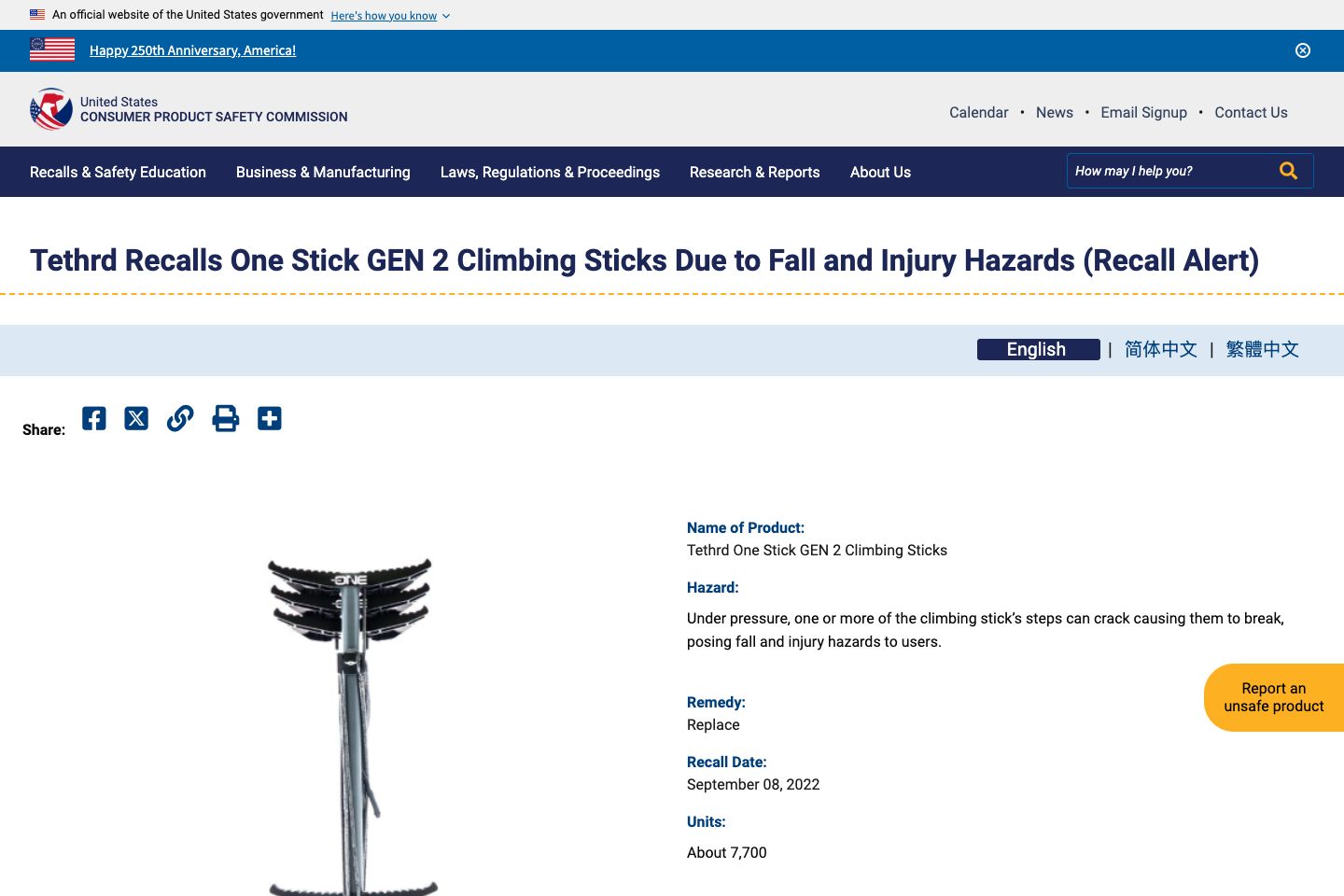
Not a saddle, tether or rope, as far as the public record shows. TMA’s recall page lists 16 recalls back to 2006, nearly all stands and harnesses (TMA). The one involving a saddle company is the September 8, 2022 CPSC recall of Tethrd’s One Stick GEN 2: about 7,700 sticks sold June through July 2022, “steps can crack causing them to break,” five reports, no injuries, free replacement (CPSC). In early November 2026, Latitude Outdoors and Hunt Arsenal issued separate manufacturer stop-use notices (not CPSC recalls as of 2026-11-05) for Carbon Synergy Climbing Sticks and 2026 Maxx Step Double/Triple Aiders; that timed notice is on Latitude and Hunt Arsenal stop-use notices. You’ve seen the forum threads about rope and glue failures. We looked for a manufacturer notice or CPSC filing behind them and found none beyond the notices already cited, so the rest stay out. If you have one, send it.
Related reading on RAD:
The other side of it
The strongest argument against calling saddles safe is that nobody tracks the falls, so “safer” rests on the design logic and not on data. That’s a fair hit, and it’s why this page sticks to what the standards and recall records actually show. The hunter who says his saddle can’t fail because a forum told him so is welcome to skip the foot loop. Gravity reads forums too.
Keep reading
Latest deer news
Sources
- Treestand Best Practices
- TSG_2015_hq
- Mitigating Suspension Trauma | Tethrd Hunter Safety Course
- F3544 Standard Test Method for Hunting Saddle Static Load Capacity
- CPSC (cpsc.gov)
- NDA (deerassociation.com)
- DNR Urges Hunters To Prioritize Tree Stand Safety This Fall | Wisconsin DNR
- SHIB Suspension Trauma.Final.10.25.11.pmd
- Standards - TMA Stands
- Homepage - TMA Stands
- Treestand and Harness Testing
- Saddle Hunting 101 - What is Saddle Hunting? – Latitude Outdoors
- Recalls - TMA Stands
Comments