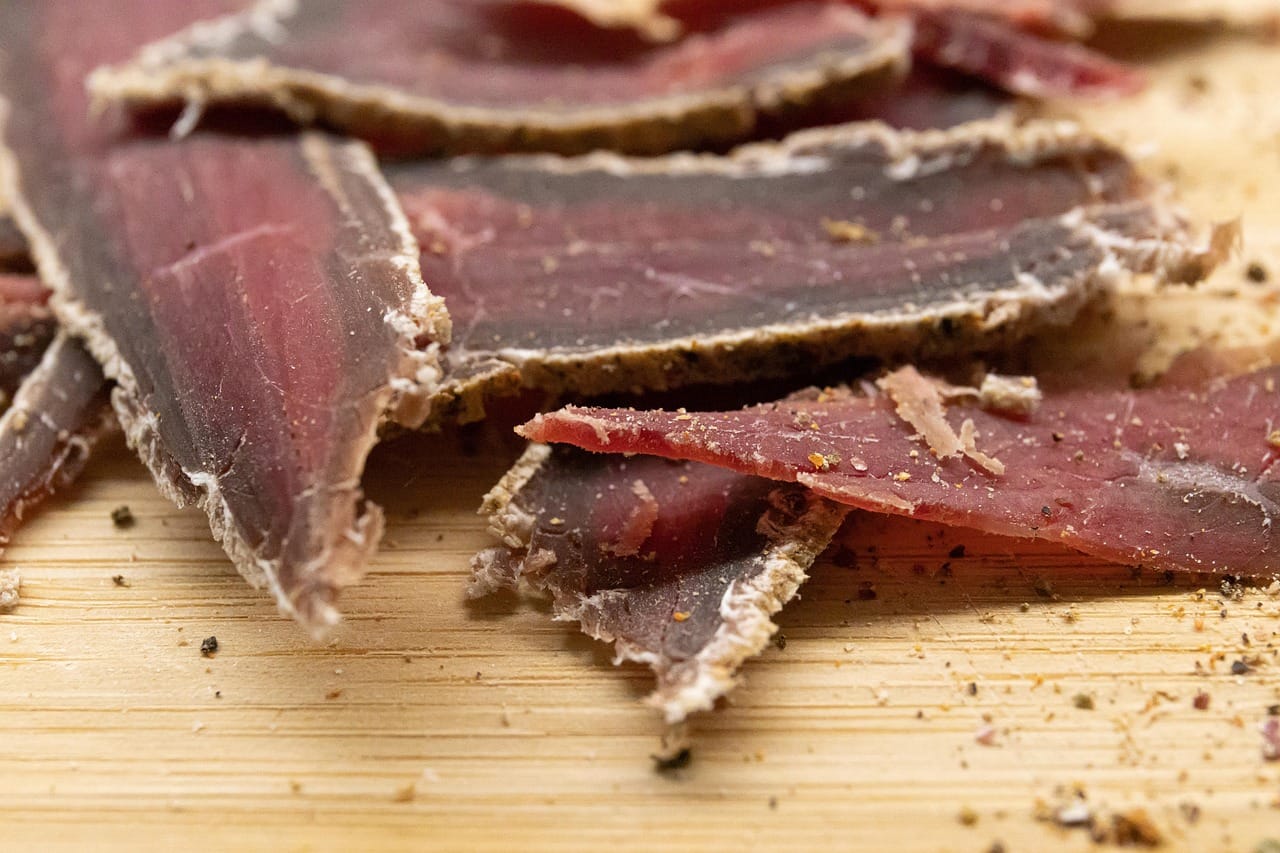
How to smoke venison jerky safely comes down to one rule: the meat has to reach 160°F before or while it dries, not after. North Dakota State University Extension says “If using a cooker or smoker to make jerky, be sure the product’s temperature reaches at least 160 F to ensure any bacteria are destroyed,” and warns, “Do not smoke the jerky at lower temperatures and finish at a higher temperature” (NDSU Extension). After that, it’s slicing, marinating and drying until the strips crack when bent. Here are the steps from Penn State and NDSU Extension.
Key Takeaways
- Freeze venison first. Penn State says to freeze it “at 0°F or below in portions that are six inches or less in thickness” for “at least 30 days to kill trichinella parasites.”
- Slice strips “¼ to ⅜ inch thick.” Cut across the grain for tender jerky.
- Get the meat to 160°F. If your smoker can’t reach that, precook the strips in boiling marinade or the oven first.
- Dry at “140 to 150 F in dehydrator, oven or smoker.”
- Done jerky “should crack when bent in half but should not break into two pieces.”
Why the 160°F step matters
Low smoker heat alone isn’t enough. Penn State Extension says “Using the dehydrator alone will inactivate microorganisms but not kill them,” and “If improperly cooked, homemade jerky may contain bacteria that can result in severe, life-threatening illness and possibly death” (Penn State Extension).
Venison has a track record here. NDSU reports that “In November 1995, 11 people in Oregon were infected with E. coli O157:H7 found in homemade venison jerky,” which “reportedly had been dried at 125 F to 135 F for 12 to 18 hours.” It also warns that game “can become heavily contaminated with fecal bacteria, depending on the skill of the hunter in dressing the animal and location of the wound” (NDSU Extension).
Step 1: Freeze the venison
Penn State says “If making jerky from venison, freeze at 0°F or below in portions that are six inches or less in thickness at for at least 30 days to kill trichinella parasites that might be in the venison.” Partly frozen meat is also easier to slice.
Step 2: Trim and slice
- Trim. Penn State says to remove “any visible fat, connective tissue, and gristle.” Fat “can cause rancidity and off flavors.”
- Slice. Cut “slightly frozen meat into strips that are ¼ to ⅜ inch thick, 1 to 1½ inches wide, and 4 to 10 inches long.”
- Pick a grain. “Jerky cut on the grain of the meat is chewy; cutting across the grain makes it more tender” (Penn State Extension).
Step 3: Marinate (cold)
Marinate in the fridge. NDSU says that if you have a “smoker or cooker that can reach high enough temperatures to fully cook the meat,” you can soak the strips in a non-boiling marinade “at refrigerator temperatures for four to 25 hours.” Penn State adds a caution: meat “marinated for several hours may be very salty.” Don’t reuse marinade. Penn State Extension says “Don’t save marinade for reuse” (Penn State Extension). For why acidic marinades don’t replace heat, see our guide on marinade acid levels.
NDSU’s sample marinade for “1½ to 2 pounds of lean meat such as beef, pork or venison” uses “¼ cup soy sauce,” “1 tablespoon Worcestershire sauce” and “1 teaspoon hickory smoke-flavored salt,” plus pepper, garlic and onion powder.
Optional cure. NDSU says “adding cure (sodium nitrite) to the formulation increases the destruction of bacteria, compared with jerky without added cure.” Common products include “Tender Quick,” “Speed Cure,” “Instacure” and “Prague Powder.” Follow the package rate; NDSU notes the amount used “is very small, in the parts per million range.”
Step 4: Heat to 160°F
You have two options.
In the smoker. If your smoker runs hot enough, NDSU says “the meat should be brought to a fully cooked temperature as smoke is applied.” Check the thickest strips with an instant-read thermometer.
Precook, then smoke-dry. If your smoker can’t reach that, heat the strips first. Penn State’s simmer method: bring marinade “to a rolling boil,” add strips, and “Reheat to a full boil for 1 minute.” Or bake on racks “in a 325°F oven” until strips hit 160°F (Penn State Extension). Then move them to the smoker for flavor and drying.
What not to do: start low and finish high. That’s the method NDSU says to avoid.
Step 5: Dry in the smoker
Lay strips in a single layer without touching. NDSU says to “Dry at 140 to 150 F in dehydrator, oven or smoker.” Penn State says to keep the temperature constant, because “the process must be fast enough to dry food before it spoils.” For more on holding steady temperatures, see our guide to safe dehydrator and oven temps for venison jerky.
Step 6: Test, cool and store
Penn State says “Strips should crack but not break when bent and should not contain any moisture or underdone spots.” Store jerky “in an airtight container because it will absorb moisture very easily from the air.” NDSU says “For best quality, store in a sealed container and use within two weeks,” or freeze it.
FAQ
What temperature should I smoke venison jerky at? Get the meat to 160°F, then dry at 140-150°F, per NDSU.
Can I use a pellet or electric smoker? Yes, if it can bring the meat to 160°F. If not, precook first.
Do I need curing salt? No, but NDSU says cure increases bacteria destruction.
How long does smoked venison jerky last? NDSU says use within two weeks for best quality, or freeze.
Want a different snack? Try our venison snack sticks guide.
The other side of it
Old-school smokers argue that a long, low smoke makes better jerky than anything precooked, and taste is their call to make. If your smoker can hold high heat, you can keep the smoke and still hit 160°F. But the hunter who says his grandpa smoked jerky at 120°F for 40 years and nobody got sick is describing survivorship, not a food-safety method.
Keep reading
Latest deer news
Sources
- Jerky Making: Producing a Traditional Food With Modern Processes, NDSU Extension
- Drying Jerky, Penn State Extension
- Proper Processing of Wild Game and Fish, Penn State Extension
Comments