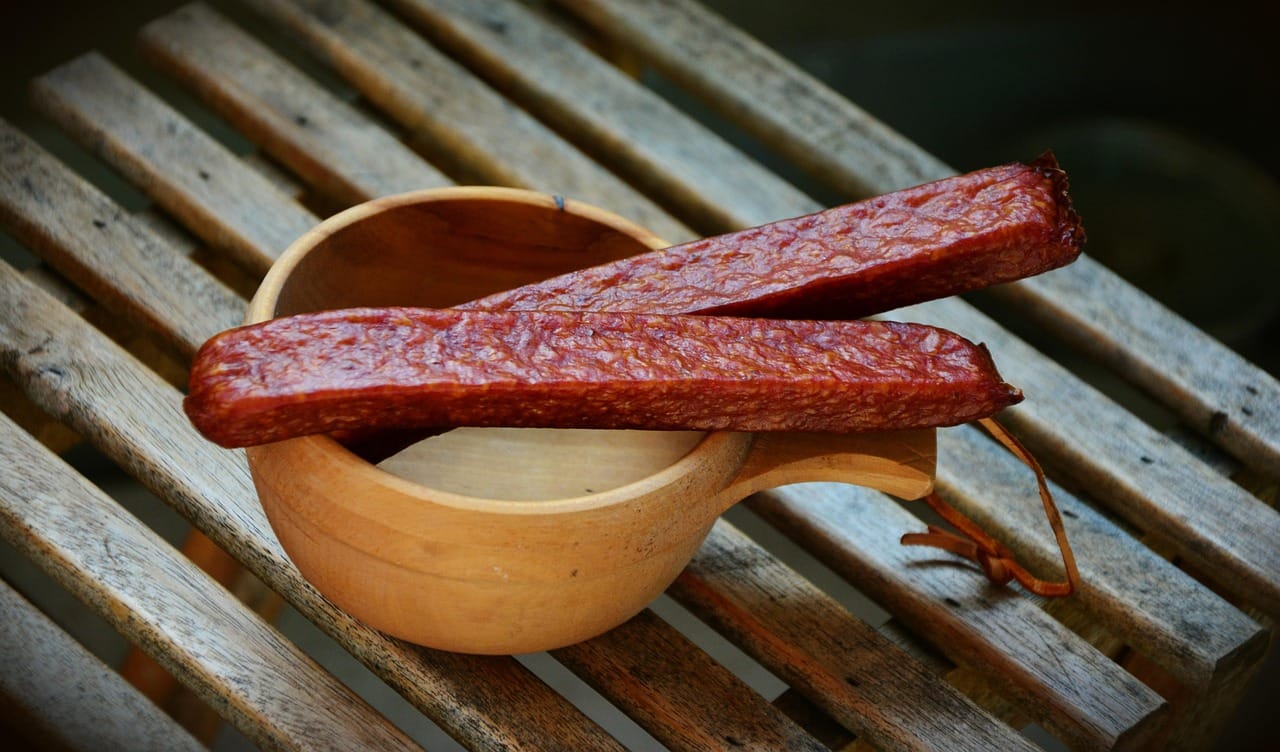
How to make venison snack sticks: grind lean venison with added pork or beef fat, mix in seasoning, Cure #1 and ice water, stuff it into thin casings, rest it overnight, then smoke or bake it low and slow until cooked through. The cure isn’t optional. Montana State University Extension says a cure “is needed for smoked products as it inhibits production and growth of botulism toxins.” Below is the process, using a 10-pound recipe from The Sausage Maker and safety guidance from Montana State and Penn State Extension.
Key Takeaways
- Add fat. The Sausage Maker says to “aim for about 20% fat,” for example 8 pounds venison to 2 pounds fat.
- Use Cure #1, not Cure #2, at the rate on the package. Montana State says to follow “specific cure formulations.”
- Rest the stuffed sticks overnight in the fridge before cooking.
- Raise the heat slowly. The Sausage Maker smokes at 135°F, then goes up 10°F per hour to 165°F.
- Cook by thermometer. Recipes stop at 152 to 155°F internal; Penn State Extension’s venison guide says 160°F.
What you need
Montana State Extension lists the equipment for meat sticks: “a thermometer, scale, meat grinder, sausage stuffer, cutting boards and knives, packaging, optional smoker, and optional dehydrator or oven” (Montana State University Extension).
For ingredients, The Sausage Maker’s recipe calls for “8 lbs. of venison with 2 lbs. of pork fat or fatty beef trimmings, 6.5 oz. of Snack Stick Seasoning, 2 level teaspoons of Insta Cure #1, and 1 pint of ice water” (The Sausage Maker). Montana State says meat sticks go into “smaller, dry collagen casings.” The Sausage Maker uses 19mm or 16mm collagen. For more on casing choice, see our guide to natural vs collagen casings for deer sticks.
Why venison snack sticks need fat
“Venison is very lean, so on its own it makes dry, crumbly sticks,” The Sausage Maker says. Its target is about 20% fat, from “pork fat (back fat or belly), bacon, or beef fat such as fatty brisket trimmings.” It adds: “Don’t use suet.” The point is the fat percentage, not the animal. “It’s less about pork and more about getting enough fat.”
Why the cure matters
Snack sticks cook for hours at low temperatures. That’s the condition the cure is there for. Montana State says the cure (sodium nitrite) “inhibits production and growth of botulism toxins” and that “Federal regulations permit a maximum of 0.25 oz of sodium nitrite per 100 pounds of chopped meat.”
You won’t measure pure nitrite at home. Cure #1 is a diluted product, and you use it at the rate on the package. The Sausage Maker is blunt: “Use Insta Cure #1, not #2.” It also says to use cure “whether you smoke or bake.” To work out the amount for your batch, see our home cure calculation worksheets for deer sticks.
How to make venison snack sticks step by step
1. Grind cold. The Sausage Maker says to “Make sure your venison and fat are well chilled.” It suggests running the venison through a 1/8-inch or 3/16-inch plate, or grinding everything through a 1/4-inch plate. Montana State’s method grinds through a coarse plate, then again through a finer one.
2. Mix. Add seasoning, Cure #1 and ice water. Montana State suggests making “a slurry with base mix, cure, spices, and water” so the cure spreads evenly. If you’re adding high-temperature cheese, The Sausage Maker says to “fold it in last.”
3. Stuff. Load a collagen casing onto a 1/2-inch tube and “Stuff firmly but don’t overstuff.” Keep your stuffer clean between batches. Our stuffer sanitation guide covers that.
4. Rest overnight. “Refrigerate the stuffed sticks overnight so the spices work into the meat.” The Sausage Maker adds, “Don’t skip this step.” Before cooking, bring them to room temperature and make sure they’re “dry or tacky to the touch.”
5. Smoke or bake. See the schedules below.
6. Cool fast. The Sausage Maker says to “Shower under cold running water until the internal temperature is 120°F or below.” It says this “stops the cooking, keeps the casings from wrinkling, and helps tenderize them.”
7. Rest again. “Refrigerate overnight before eating so the flavors can develop.”
Smoker schedule
The Sausage Maker’s smoker routine:
- Preheat to 120°F and let the sticks warm for 1 hour.
- “Raise the heat to 135°F and apply heavy smoke for 1–2 hours.”
- “Raise the heat 10°F every hour up to 165°F.”
- Cook until the sticks reach your target internal temperature.
Diameter changes how long this takes. Our page on snack stick diameter and process time goes deeper.
Moisture in the smoker matters too. NDSU’s sausage guide says higher humidity early in the cook can cut down on case hardening, where the outside dries into a shell while the center lags (NDSU Extension). Just remember the smoker’s air temperature isn’t the stick’s temperature. Probe the thickest stick to know where the core really is.
Oven method
No smoker? The Sausage Maker says to “Bake at 170–175°F until they reach 152–155°F internal,” adding liquid smoke when mixing if you want smoke flavor.
What internal temperature should snack sticks reach?
The sources differ, so here’s what each says. The Sausage Maker cooks to 152 to 155°F. Montana State says cooked smoked sausage is “fully cooked to an internal temperature of 155°F.” Penn State Extension’s venison guide is the most conservative: “Cook venison, including jerky, to a minimum internal temperature of 160°F to reduce the risk of food-borne illness” (Penn State Extension).
If you want the agency’s safety line for venison, use 160°F. Whatever target you choose, check it with a thermometer in the thickest stick.
FAQ
Do you need cure for venison snack sticks? Yes for smoked sticks. Montana State says cure “is needed for smoked products,” and The Sausage Maker uses it for baked sticks too.
What fat ratio is best for venison snack sticks? About 20% fat, per The Sausage Maker.
How long do you smoke venison snack sticks? It depends on diameter and smoker. The Sausage Maker starts at 135°F for 1 to 2 hours and raises the heat 10°F an hour. Cook to temperature, not time.
Why are my snack sticks dry or crumbly? The Sausage Maker says it’s usually “not enough fat, or they cooked too long.”
The other side of it
Plenty of hunters skip all this and drop their trim at a processor, and for a big batch that may be the smarter call. Making sticks at home takes a grinder, a stuffer, a scale and most of a weekend. But you control the fat, the spice and the cure, and you know whose deer is in it. Just don’t eyeball the cure. Pink salt is not a season-to-taste ingredient.
Keep reading
Latest deer news
Sources
- Meat Preservation: Jerky, Sausage, and Meat Sticks, Montana State University Extension
- Venison Snack Stick Recipe: Smoker or Oven, With or Without Cheese, The Sausage Maker (supplier)
- Canning and Freezing Venison, Penn State Extension
- The Art and Practice of Sausage Making | NDSU Agriculture, NDSU Extension
Comments